Sump Pump Discharge: A Practical Safe Outlet Guide
Sump pump discharge should go to an approved outlet that carries water away from the foundation, does not send it back into the soil beside the house, and does not create a problem for sidewalks, neighboring property, or sanitary sewer systems.
Quick Answer: Possible discharge arrangements can include a daylight outlet, a dry well, or a stormwater connection only when the site and local authority allow it. The right route depends on grade, soil, outlet access, backflow risk, and where the water will go after the pump shuts off.
A sump pump moves water out of a basin, but that is only one part of water control. If the line releases water beside the house or into a low spot, the same water can return toward the foundation, saturate soil, or keep the pump cycling. The better question is not just “Where does the pipe end?” but “Does the whole route move water away safely?”
Sump pump discharge choices start with the whole route
The discharge route begins at the basin, but the decision is made at the outlet. A working pump may remove water from a basement, crawl space, or interior drain system, yet the property can still have foundation water if the outlet sends that water back to the same area.
The DOE Building America Solution Center says the outflow from a sump pit must be directed to a storm sewer, if permitted by the local municipality, or to a dry well away from the foundation; it also says the discharge pipe should direct water out and away from the building in its drain or sump pump guidance. That guidance is a building-science starting point, not a universal approval for every lot.
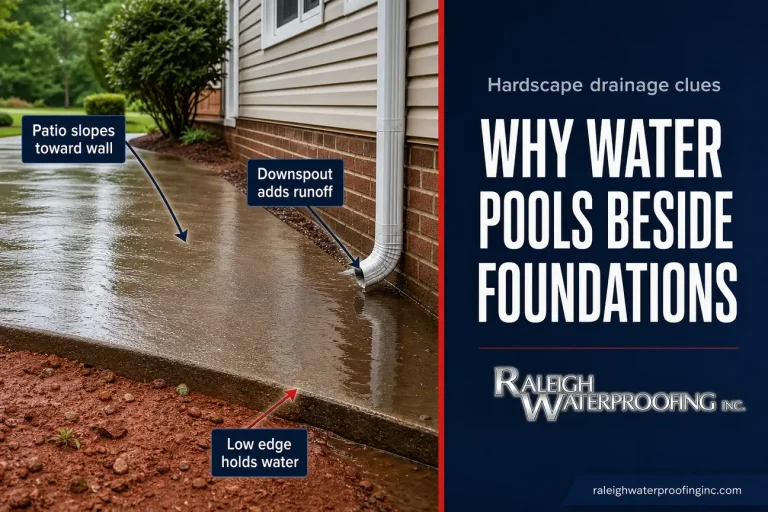
For a homeowner, the practical test is whether the route removes water from the building area without creating a new water-management problem. A poor sump discharge location can send water into a mulch bed against the wall, across a walkway, toward a driveway low spot, or back into soil that is already saturated.
A good evaluation looks at the water source, the pump, the discharge line, the outlet, the surface grade, and the place where the water will travel during a heavy rain. That is why Raleigh Waterproofing Inc. treats symptoms as clues, not as complete diagnoses.
Where can sump pump water go?
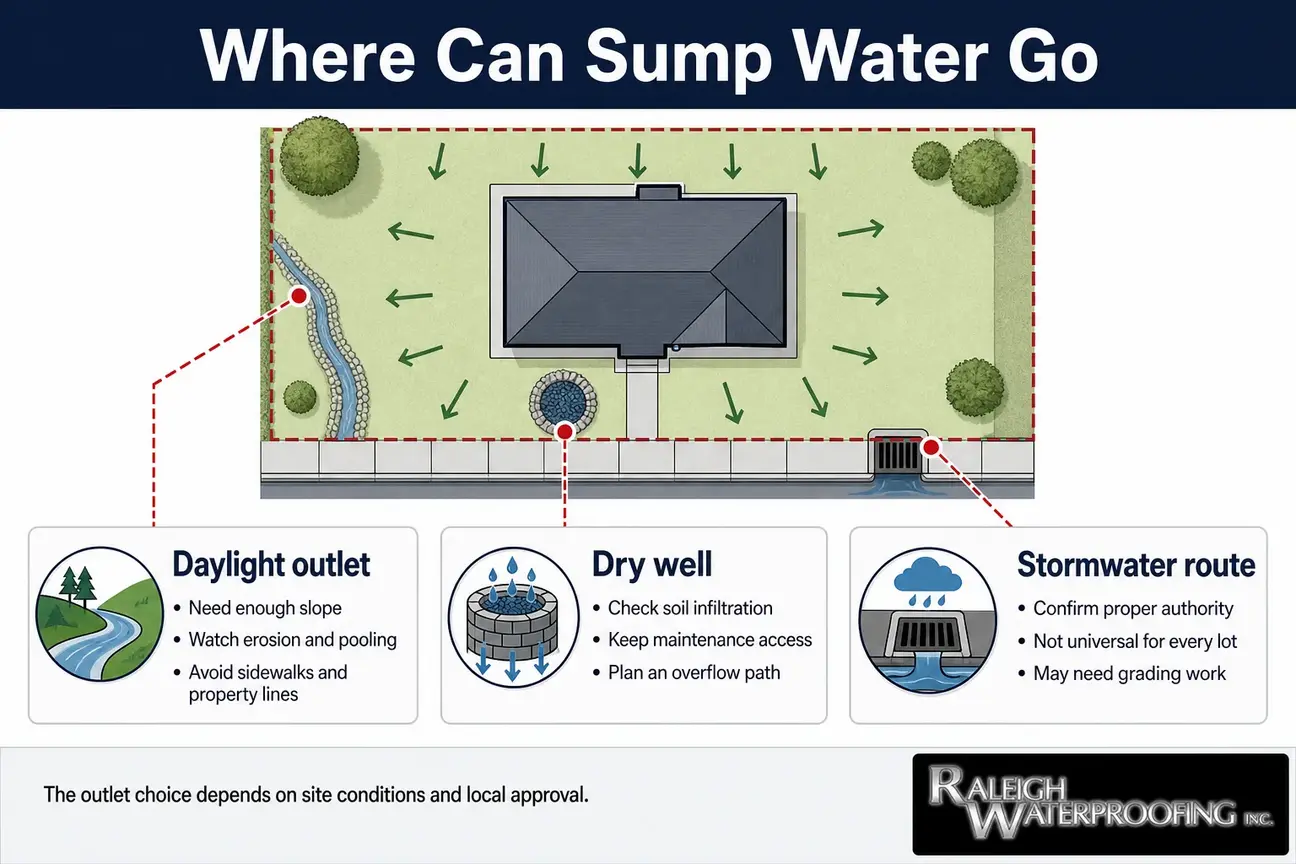
There is no single outlet that fits every property. The site may have enough slope for daylight discharge, a suitable area for a dry well, or a stormwater connection that must be confirmed with the proper authority. Some properties need grading or yard drainage work before a sump pump outlet can function well.
| Outlet or route | What to evaluate | Approval or caution |
|---|---|---|
| Daylight or above-grade outlet | Grade, erosion, pooling, outlet visibility, and whether water continues away from the house | Confirm local requirements and avoid sidewalks, property lines, and foundation areas |
| Dry well | Soil infiltration, groundwater, maintenance access, nearby structures, and overflow path | Only suitable where site conditions and local requirements allow it |
| Stormwater connection | Connection location, capacity, authority approval, and separation from sanitary sewer systems | Use only if permitted by the relevant municipality or authority |
| Sanitary sewer route | Not a proper destination for sump water | Do not direct sump discharge into a sanitary sewer |
A sump discharge location should be judged by what happens after the pump runs. If the outlet creates ponding, flows back toward the house, disappears under mulch, or sends water where people walk, the route needs evaluation.
The sump pump outlet also has to be reachable enough to inspect. An outlet hidden under leaves, buried in soil, disconnected underground, or submerged during storms may look acceptable on a dry day but fail during the event when the pump is needed most.
How to choose a sump discharge location
A sump discharge location should let gravity help after the pump has done its job. The line should not end in a low pocket that stores water beside the house. It should not empty into a planting bed that slopes back toward the wall. It should not stop at a property line and make the next yard the drainage outlet.
The best sump discharge location is also site-specific. Soil, slope, hardscape, underground utilities, easements, roof runoff, and existing drainage features can all change the answer. A short visible extension may look helpful, but if the grade falls back toward the foundation, it may not solve the problem.
Homeowners can start by observing the route during or shortly after a pump cycle from a safe location. Note where the line exits the building, where the water appears, whether it spreads or channels, and whether it returns toward the wall. Photos or short videos can help during an on-site evaluation.
Do not assume that a longer pipe automatically improves the sump discharge location. If the outlet is too flat, blocked, poorly supported, or aimed toward a hardscape surface, it can create another problem. The goal is controlled movement away from the building, not just distance.
What makes a sump pump outlet workable?
A sump pump outlet is workable when it releases water to a place that can receive it without backing up, pooling, eroding, crossing a walkway, or returning toward the foundation. The outlet needs to remain clear enough for water to leave the pipe when the pump runs.
The sump pump outlet should also be visible or serviceable enough that a homeowner or contractor can identify obvious problems. Mulch, leaves, roots, sediment, crushed pipe, and settling soil can all interfere with discharge. If the outlet is underground, the evaluation may need to consider whether the buried route is blocked, disconnected, or submerged.
A sump pump outlet that works during a light rain may still struggle during a stronger storm if the receiving area becomes saturated. That does not automatically mean the pump is the wrong size or that the basin is the source of the problem. It means the outlet and the surrounding drainage need to be considered together.
For homes where the pump is part of a larger sump station, the outlet is part of the system, not an afterthought. If surface water is also collecting in the yard, a separate yard drainage evaluation may be needed to understand where roof runoff, grading, and low spots are sending water.
How should the discharge line be directed?
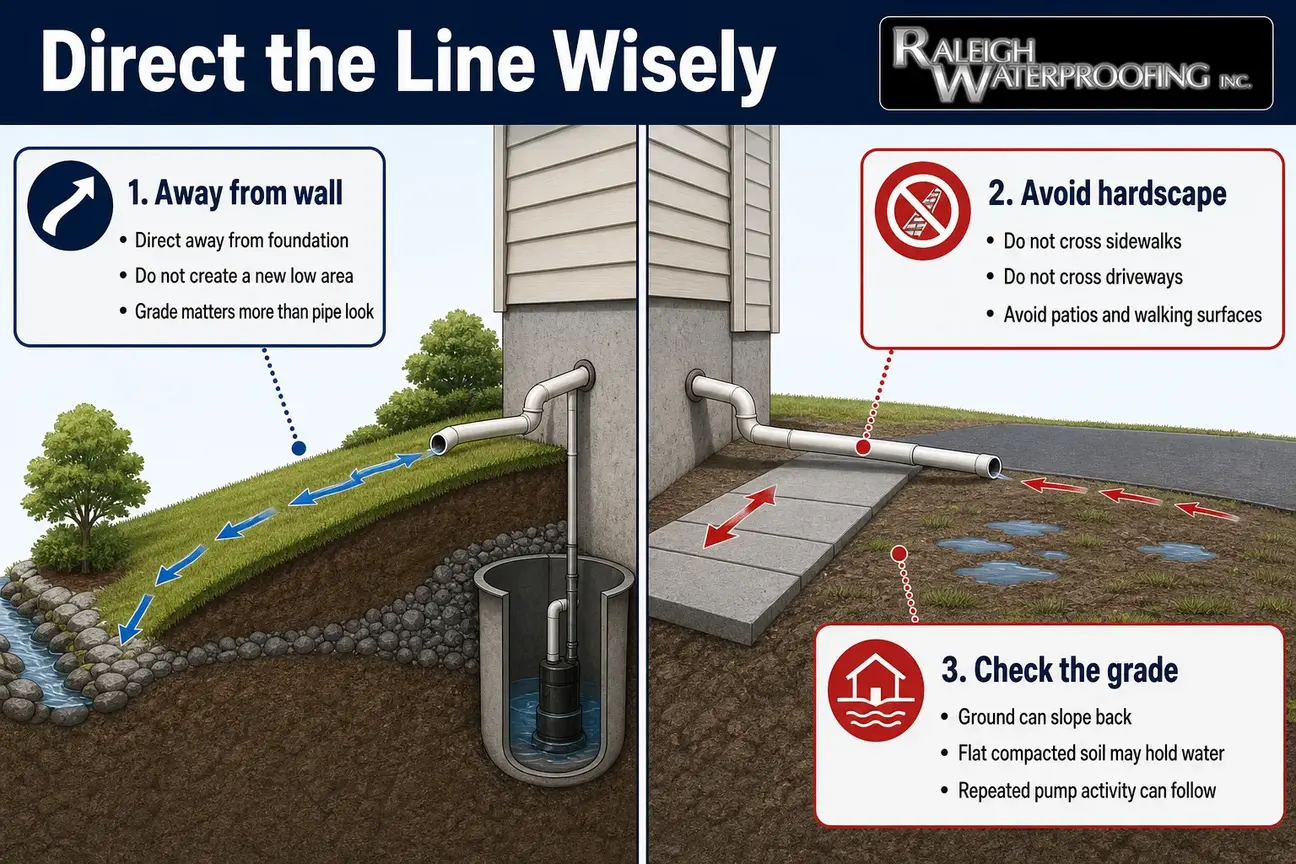
The discharge line should be directed away from the foundation and toward an outlet that does not create a new low area. The route should not send water across sidewalks, driveways, patios, or other walking surfaces. It also should not release water onto a neighboring property or into a location where it can enter another structure.
Grade matters more than the appearance of the pipe. If the line ends uphill from the foundation but the ground slopes back, water can still return. If the line ends in a flat side yard with compacted soil, the water may sit long enough to saturate the area and contribute to repeated pump activity.
Do not use this kind of article as an installation manual. Sump electrical work, buried discharge routes, excavation, trenching, and utility conflicts should be handled by qualified trades or evaluated on site. Homeowners should not dig without utility location, and they should not enter unsafe trenches.
If the discharge line appears damaged, leaking, or disconnected, document what you can see from a safe place. Do not open electrical components or modify pump wiring. The discharge route can often be evaluated without taking risks around energized equipment or unstable soil.
Which site clues can point to the right outlet decision?
The outlet decision starts with clues around the property. A side yard that stays wet after normal rain is different from a yard with steady slope to a stable daylight point. A paved driveway edge is different from a vegetated area that can receive flow without sending it back toward the building.
If water leaves the pipe and immediately spreads toward the foundation, the issue may be grade, outlet placement, or the receiving area. If the pipe discharges strongly but the basin refills quickly, the route may be recycling water, or exterior water may be entering the drainage system from another source. Those are clues for evaluation, not proof of one cause.
If the outlet is buried, the visible clue may be indirect. Look for soggy turf in a line, sediment at a pop-up outlet, water surfacing near a joint, or no visible flow when the pump is running. Buried lines can also be affected by roots, settlement, crushed pipe, or a receiving point that is underwater during storms.
Hardscape changes the decision. A patio, driveway, retaining wall, walkway, or tight side yard can leave few simple daylight options. In those cases, the answer may involve a planned drainage route rather than a short extension pipe. The goal is still the same: move water away from the structure without sending it somewhere improper.
What common discharge mistakes should homeowners avoid?
One common mistake is treating the closest exit point as the best outlet. The shortest route may be convenient, but it may also send water into backfill beside the foundation. A route that is convenient for the pipe is not always a good route for water.
Another mistake is hiding the outlet so well that nobody can inspect it. Mulch, leaves, decorative stone, and plantings can conceal a clogged or disconnected termination. If the outlet cannot be found during wet weather, it is difficult to know whether the system is working as intended.
A third mistake is focusing only on the pump. Replacing a pump may be appropriate in some situations, but it does not correct a bad outlet, blocked line, improper receiving area, poor grading, or roof runoff dumping beside the foundation. Pump performance and discharge routing need to be considered together.
Homeowners should also avoid improvising around sidewalks, streets, or sewers. A sump pump outlet should not create a nuisance, a walking-surface problem, or a connection that has not been approved. Local rules and site conditions matter before the route is changed.
Why discharge away foundation matters
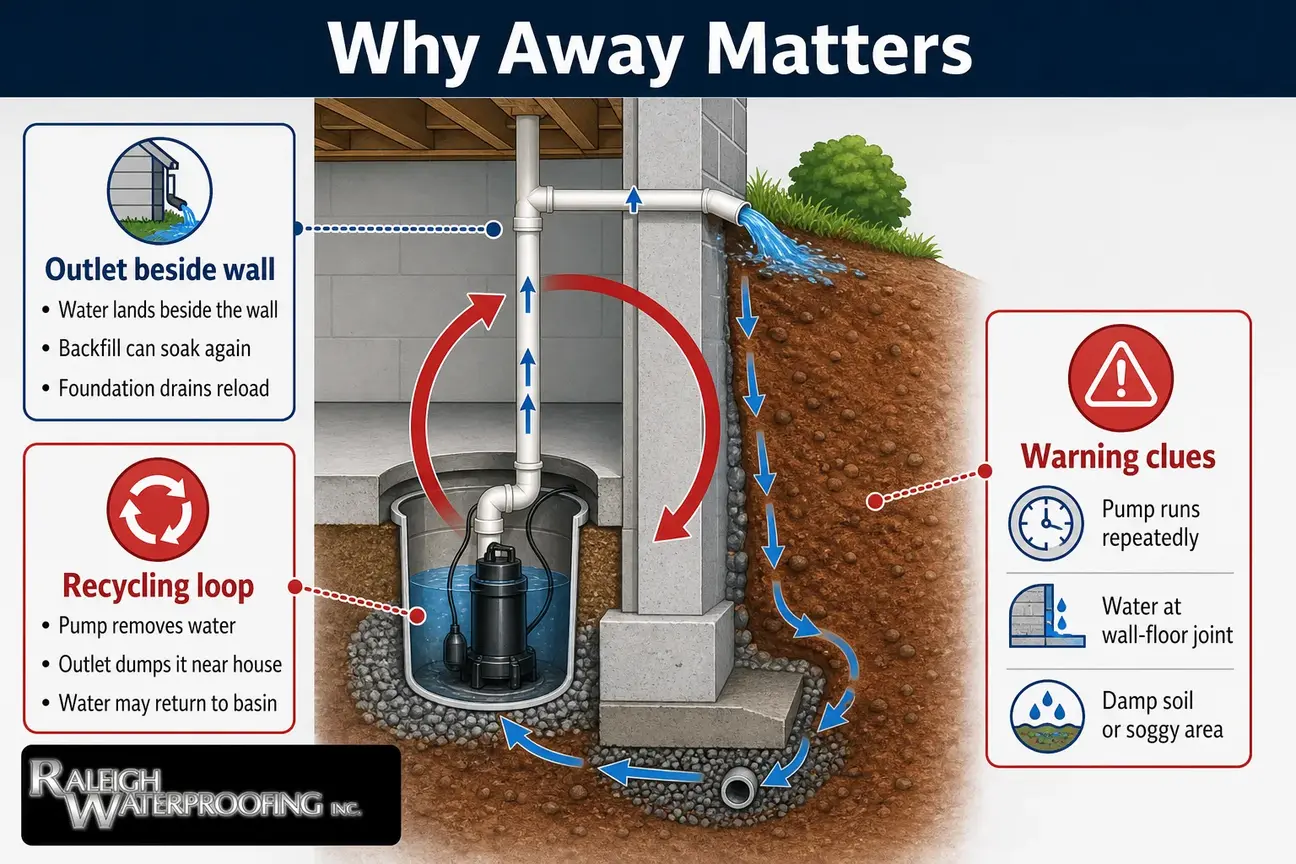
The phrase discharge away foundation is not just a search term; it is the basic drainage principle behind the route. Water that leaves the sump and lands beside the wall can soak the same backfill area that foundation drains or interior systems are trying to manage.
Building America warns that placing sump outflow next to the foundation can recycle water through the foundation drainage system. In plain terms, the pump removes water, the outlet dumps it near the house, and the water may find its way back to the same drainage pathway.
That cycle can show up as a pump that runs repeatedly after storms, water at the wall-floor joint, seepage in a crack, damp soil beside the house, or a soggy area near the outlet. Those symptoms do not prove one cause. They tell you the discharge away foundation question deserves attention.
If water is entering the home, the route may need to be evaluated alongside water intrusion repair concerns and a broader waterproofing problem diagnosis. The visible entry point inside the home is not always where the water began outside.
For example, water appearing near a basement wall may be related to roof runoff, grading, saturated soil, a footing drain issue, a crack, condensation, or plumbing. A discharge away foundation approach helps reduce one possible recycling path, but it does not replace diagnosis of the water source.
Can water flow back toward the sump basin?
Yes, water can move back toward the basin or the home when the outlet is submerged, the discharge route is poorly pitched, the line holds water after pump shutdown, or exterior water pressure overwhelms the outlet area. A check valve may help with reverse flow in the pipe, but it is not a cure for a bad outlet.
The Building America crawl-space water-management guide says Advanced Energy recommends using a check valve in sump pump out-flow pipes to prevent reverse flow of outside water into the crawlspace and reduce the chance of vermin entry in its existing crawlspace floor water-management guidance. That is a recommendation, not a guarantee that the whole site drainage problem is solved.
Backflow questions become more important when the discharge line runs underground, when the outlet sits in a low area, or when the receiving point is under water during storms. If the pump shuts off and water immediately returns to the basin, the sump pump outlet, line, valve condition, and outlet elevation may all need review.
A check valve cannot make an unsuitable sump discharge location acceptable. It cannot overcome a blocked pipe, poor grading, a submerged discharge point, or a yard that has no practical place for water to go. The outlet still has to be part of a complete water-management plan.
How sump water drainage fits the whole property
Sump water drainage is tied to roof runoff, grading, soil, foundation drains, hardscape, and neighboring drainage patterns. The pump is only moving water that has already reached the basin. It does not explain why that water entered the drainage system in the first place.
In the North Carolina Piedmont, soil around homes can be slow to drain, and soil modified around a home can behave differently from undisturbed soil. NC State Extension’s guidance on modifying soil for plant growth around your home discusses how soil texture, structure, compaction, and drainage affect water movement. Around a house, those same site conditions matter when deciding where discharge water will travel.
In Raleigh and nearby Triangle neighborhoods, compacted fill, tight side yards, downspout discharge, patios, and low swales can all affect sump water drainage. Heavy rain can expose a route that looks fine during normal weather but cannot move water away fast enough during a storm.
That is why a sump pump outlet should not be evaluated in isolation. If the yard stays wet, water ponds near the foundation, or the pump runs often after storms, the issue may involve surface-water management as much as the pump itself.
A complete evaluation may look at downspout discharge, soil slope, low points, foundation openings, crawl-space floor conditions, and where the discharge line actually ends. Sump water drainage works best when each part of the system has a place to send water next.
What should Raleigh and Triangle homeowners verify?
Local approval matters. A stormwater connection, dry well, daylight outlet, or other arrangement should be verified with the relevant local authority before a homeowner relies on it. Do not assume one citywide rule applies to every property, every subdivision, or every nearby municipality.
For properties in the city, the City of Raleigh stormwater drainage assistance resource is a local starting point for drainage questions. If a property is outside the city or in another Triangle jurisdiction, confirm with that municipality, county, utility, or stormwater authority.
Stormwater and sanitary sewer systems are not interchangeable. A stormwater route may still require approval, and a sanitary sewer should not be treated as a sump discharge destination. The proper outlet depends on the property and the authority responsible for the drainage route.
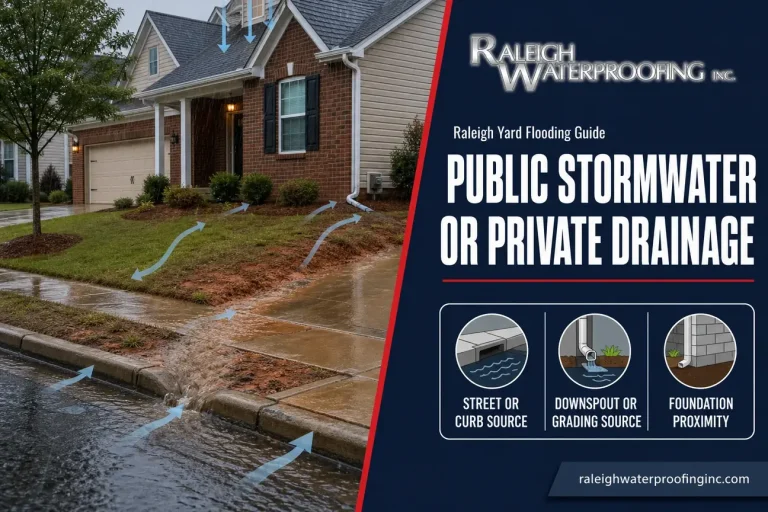
This is especially important when the proposed sump pump outlet is near a street, curb, drainage easement, creek buffer, sidewalk, shared swale, or property line. The acceptable route can depend on public infrastructure, private drainage rights, and site-specific conditions that are not visible from the basement.
Why avoid sidewalks, driveways, and neighboring property?
Water that crosses a sidewalk can create a walking-surface problem, contribute to erosion, or freeze during cold weather. A discharge line that crosses a driveway can create nuisance water and may be damaged by vehicles or maintenance. These concerns are practical even before local requirements are considered.
Neighboring property is also not a drainage solution. Sending water to the property line can create soggy turf, erosion, basement seepage, or disputes for the next homeowner. Even if the lot naturally slopes that way, a sump pump can concentrate water in a way that normal sheet flow would not.
The route should be evaluated across the whole lot. Where does water go after it leaves the outlet? Does it spread gently over a stable area, enter an approved drainage feature, or collect at a fence line? Does it move toward another foundation? Does it cross a walking route?
A sump pump outlet that avoids the foundation but creates a sidewalk or neighbor problem still needs attention. Good water management moves water away from the home without transferring the problem somewhere else.
What if the pump works but the basement or crawl space is still damp?
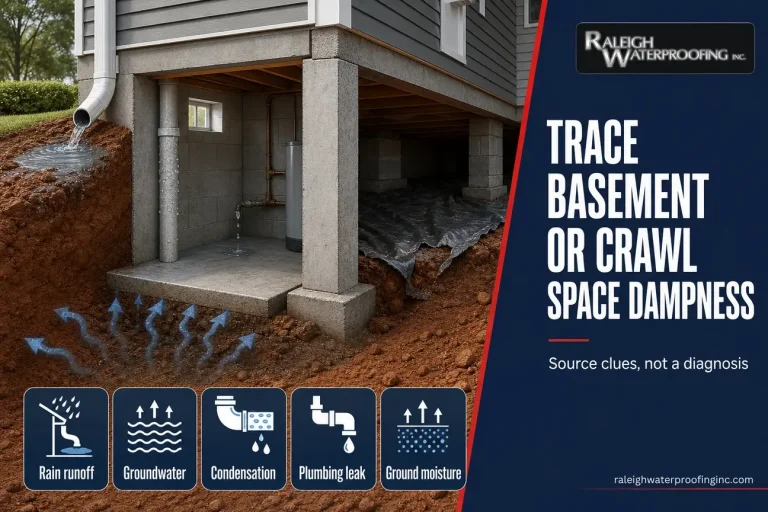
A working pump does not mean the basement or crawl space has been fully waterproofed. It means water reached the basin and the pump moved it out. The source may still be active outside the foundation, under the slab, along a crack, in a crawl-space low point, or from plumbing.
If water is collected along an interior perimeter, an interior drain system may be part of the discussion. If exterior foundation water is the source, foundation waterproofing may need to be considered. If surface water is feeding the problem, French drains, swales, box drains, or other yard drainage measures may be part of the solution.
Moisture under a vapor barrier, damp crawl-space soil, or recurring odors can point to water that is not being managed at the source. Condensation, humid air, groundwater, grading, and drainage all have to be separated before choosing a repair. Mold concerns should be handled by correcting the moisture first, and Raleigh Waterproofing Inc. does not provide mold testing or remediation.
If the pump runs frequently after rain, compare the timing with outlet conditions rather than assuming the pump is the only issue. The existing guide to a sump pump that keeps running after rain may help you distinguish pump frequency from discharge-location and drainage-route concerns.
Plumbing or sewer leaks should be evaluated by a plumber. Bowing, displacement, widening cracks, or settlement should be evaluated by a structural engineer. A waterproofing evaluation should not be used as a structural judgment.
What can a homeowner safely document before an evaluation?
Documentation helps because water problems change with weather. You do not need to diagnose the system yourself. You can safely record observations that help a contractor understand when and where the problem appears.
- When the pump runs: during rain, after rain, during dry weather, or in repeated short cycles.
- Where the discharge line exits the house and where the outlet appears to terminate.
- Whether water pools around the sump pump outlet during or after a pump cycle.
- Whether the route seems to send water toward the foundation, sidewalk, driveway, property line, or neighboring lot.
- Whether the outlet is covered by mulch, leaves, sediment, vegetation, or standing water.
- Whether moisture appears in the basement, crawl space, wall crack, wall-floor joint, or yard at the same time.
- Photos or video from a dry, safe location.
Safety note: never enter a flooded basement if wiring, outlets, appliances, or equipment may be energized. Do not perform sump electrical work, trench work, or excavation as a homeowner troubleshooting step. Call NC 811 before digging, and do not work in an unshored trench.
When should the discharge route be evaluated with the rest of the drainage system?
The discharge route should be evaluated when water returns after the pump runs, when the outlet is close to the foundation, when the yard stays saturated, when water shows up under a crawl-space vapor barrier, or when the pump cycles repeatedly after storms.
It should also be evaluated when interior and exterior clues do not line up. For example, the pump may discharge on one side of the house while seepage appears on another side. That does not rule out the discharge route, but it does suggest that roof runoff, grading, foundation drainage, soil saturation, and other water sources need to be traced.
Cost depends on the cause and the route, not just the pump. Important cost drivers can include access, depth, wall length, interior finishes, outlet options, hardscape, landscaping restoration, buried obstructions, and whether the issue is primarily interior drainage, exterior foundation water, or surface runoff. No article can price that accurately without an on-site evaluation.
If you need help tracing the source, route, outlet, grade, and surrounding drainage, you can request a free estimate in the greater Raleigh area, call 919-877-9969, or email [email protected]. Areas outside the Triangle may require a trip fee.
A practical way to think about the outlet
A sump discharge location is not chosen by looking only at the pipe. Start with the question: where will the water be after the pump stops? If the answer is “beside the foundation,” “across the sidewalk,” “in the neighbor’s yard,” “in a low spot,” or “I am not sure,” the route deserves a closer look.
A sump pump outlet should support the rest of the drainage system. It should move water away from the building, remain clear enough to function, avoid backflow conditions where possible, and comply with the authority that governs the property. Sump water drainage should reduce the burden on the foundation area, not keep reloading it.
Raleigh Waterproofing Inc. has served homeowners since 2001, and the same practical rule still applies: waterproofing is only as good as its drainage. The pump matters, but the outlet and the water source matter too.
General homeowner information. The right waterproofing or drainage solution depends on an on-site evaluation of the property.
Frequently Asked Questions
How far away from the foundation should a sump pump discharge?
There is no universal distance that fits every property. The important principle is that the discharge should move water away from the building and to an outlet that does not pool, backflow, erode soil, cross a walking surface, or affect neighboring property. Grade, soil, outlet access, and local requirements all matter.
Can a sump pump discharge into a storm sewer in Raleigh?
A stormwater connection should be verified with the relevant local authority before relying on it. Building-science guidance allows for a storm sewer only when permitted by the local municipality, so homeowners should not assume a connection is acceptable without confirmation.
Can I send sump pump water into the sanitary sewer?
No. Do not direct sump pump water into a sanitary sewer. Stormwater and sanitary sewer systems serve different purposes, and sewer-related questions should be confirmed with the proper authority rather than assumed.
Why is water coming back toward the sump pit after the pump stops?
Possible causes include reverse flow in the discharge line, a submerged or poorly placed outlet, a blocked route, or a drainage area that cannot receive the water. A check valve may help with reverse flow in the pipe, but it does not correct a bad outlet or poor grading.
What if the sump pump discharges across a sidewalk?
That route should be evaluated. Discharge across a sidewalk can create a walking-surface issue, erosion, pooling, or freezing concerns. The goal is to route water away from the foundation without creating a new problem for people using the property.
Does a working sump pump mean the basement is waterproofed?
No. A working pump means collected water is being moved out of the basin. The underlying source may still be roof runoff, grading, saturated soil, foundation drainage, a leaking crack, crawl-space seepage, condensation, or a plumbing issue.
What should I do if the discharge outlet is on my neighbor’s property?
Do not assume that arrangement is acceptable. A property line is not a drainage plan. The route should be evaluated and verified with the relevant authority or an on-site drainage professional so the water does not create a nuisance or damage risk for another property.