Why Is My Basement or Crawl Space Damp? Trace the Basement Moisture Source
Quick Answer: A damp basement or crawl space can come from roof runoff, saturated soil, condensation, exposed crawl-space ground, a plumbing or sewer problem, or more than one issue at the same time. The first wet spot is a clue, not a confirmed basement moisture source, because water can travel through soil, masonry, cracks, joints, framing, or utility openings before you see it. Start by comparing timing, location, weather connection, surface appearance, odor, and nearby plumbing use, then confirm the cause with an on-site evaluation before choosing a repair.
General homeowner information. The right waterproofing or drainage solution depends on an on-site evaluation of the property.
A basement moisture source framework for comparing clues
The most useful question is not just “Where is it wet?” It is “What changed before it became wet?” A damp corner after a thunderstorm points in a different direction than droplets on cold pipes during humid weather. Water beside a utility wall after a washing machine runs points in a different direction than seepage at a floor crack after several days of rain.
Use the table below as a sorting tool, not a diagnosis. A crawl space may have ground moisture and perimeter water. A basement wall may show condensation on a cold surface while the soil outside is also saturated. A plumbing leak can expose a separate waterproofing problem. The job of diagnosis is to connect the visible evidence with the likely source and then choose the repair that matches the cause.
| Possible source | Timing pattern | Common appearance | What to investigate next |
|---|---|---|---|
| Roof runoff, gutters, downspouts, or grading | During rain or shortly afterward | Wet exterior-facing wall, corner, window well, crack, or low spot | Downspout discharge, slope, low areas, yard drainage, exterior foundation conditions |
| Groundwater or hydrostatic pressure | After heavy or prolonged rain; may continue after rain stops | Wall seepage, damp masonry, floor seepage, joint leaks, standing water, staining | Exterior waterproofing, footing drainage, interior drain system, sump station, crack conditions |
| Condensation | Humid weather or temperature swings; not always rain-related | Droplets or damp film on cold pipes, ducts, walls, or broad surfaces | Humidity, air movement, insulation, crawl-space sealing needs, moisture sources |
| Crawl-space ground moisture | Persistent or seasonal; may worsen with rain or humidity | Damp soil, moisture under a vapor barrier, musty odor, wet insulation, condensation | Vapor barrier condition, crawl-space drainage, sealed crawl-space or encapsulation needs |
| Plumbing or sewer-related leak | Linked to fixture use, appliance cycles, drains, or continuous pipe leakage | Water near pipes, drains, cleanouts, mechanical equipment, or utility walls | Plumber first for supply, drain, sewer, or septic issues; separate waterproofing evaluation if needed |
| Roof or upper-wall leak | During rain, but visible moisture appears from above or inside framing | Ceiling stain, upper-wall path, chase or pipe route, vertical staining | Roofing or building-envelope evaluation; do not assume foundation leakage |
What does the timing tell you?
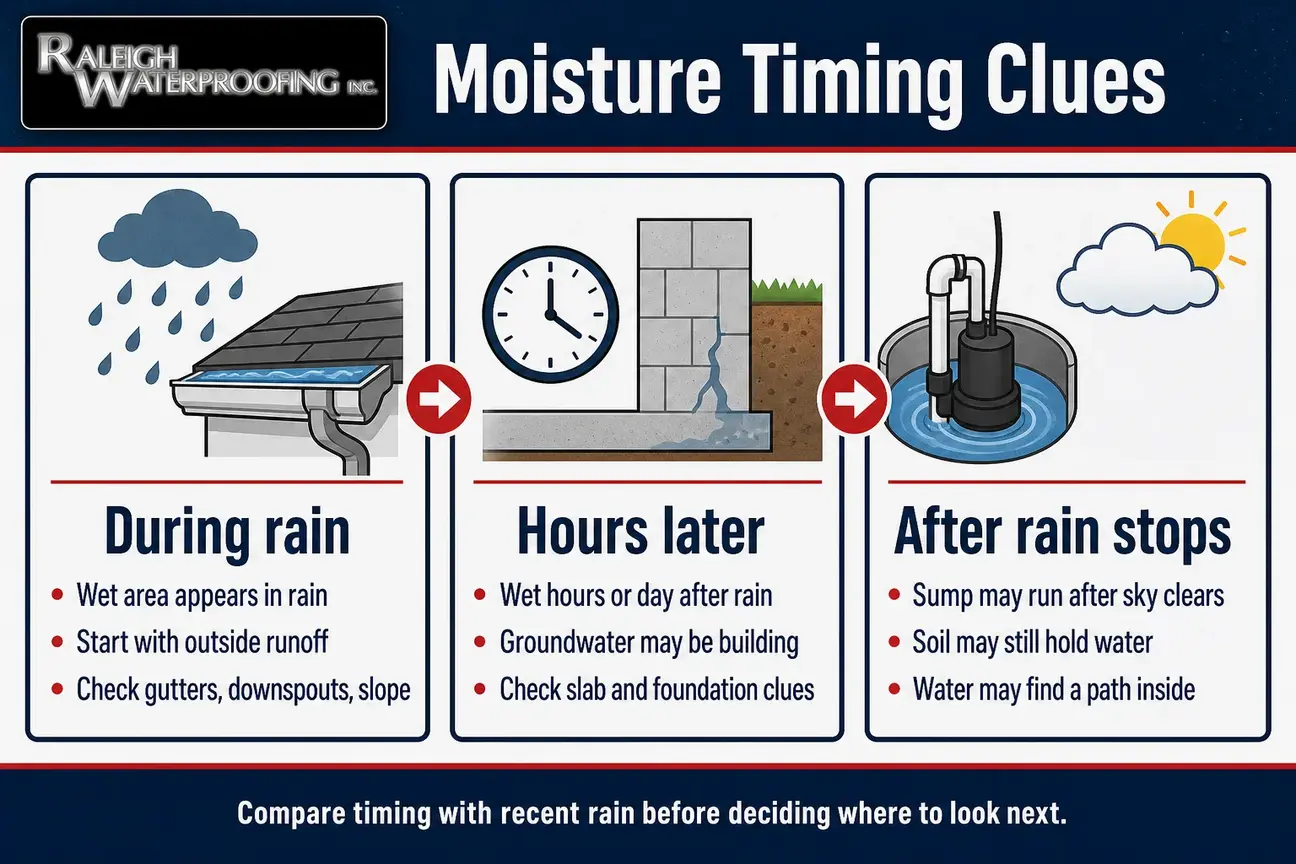
Timing is often the cleanest starting point because it separates weather-driven moisture from use-driven moisture. If the area becomes wet during rain, look outside first. Check the roof edge, gutters, downspouts, driveway slope, patios, mulch beds, window wells, and low areas that may push water toward the foundation.
If moisture appears several hours or a day after heavy rain, groundwater may be building around the foundation or beneath the slab. That timing can point toward hydrostatic pressure, failed or overwhelmed footing drainage, or a low point where collected water finally finds a path inside. A groundwater basement pattern can also explain why a sump pump runs after the sky clears.
If dampness appears in humid weather without a strong rain connection, condensation becomes more likely. This is especially true when the moisture is spread across cold pipes, ducts, walls, insulation, or framing rather than following one crack or joint. The EPA moisture and mold guide recommends drying wet materials and fixing the moisture source, and it treats condensation as a moisture problem that should be addressed promptly.
If the damp surface is a broad cold wall rather than one entry line, write down “possible condensation” in your notes. That note reminds you to compare humidity, air movement, temperature, and surface pattern before assuming seepage.
If water appears when a toilet flushes, a shower runs, a washing machine drains, or a water heater operates, treat it as a possible plumbing issue until a plumber rules it out. A plumbing leak basement pattern can exist with or without exterior water problems, so do not cover the symptom with waterproofing until the pipe, drain, or sewer concern is handled.
Where is the moisture appearing?
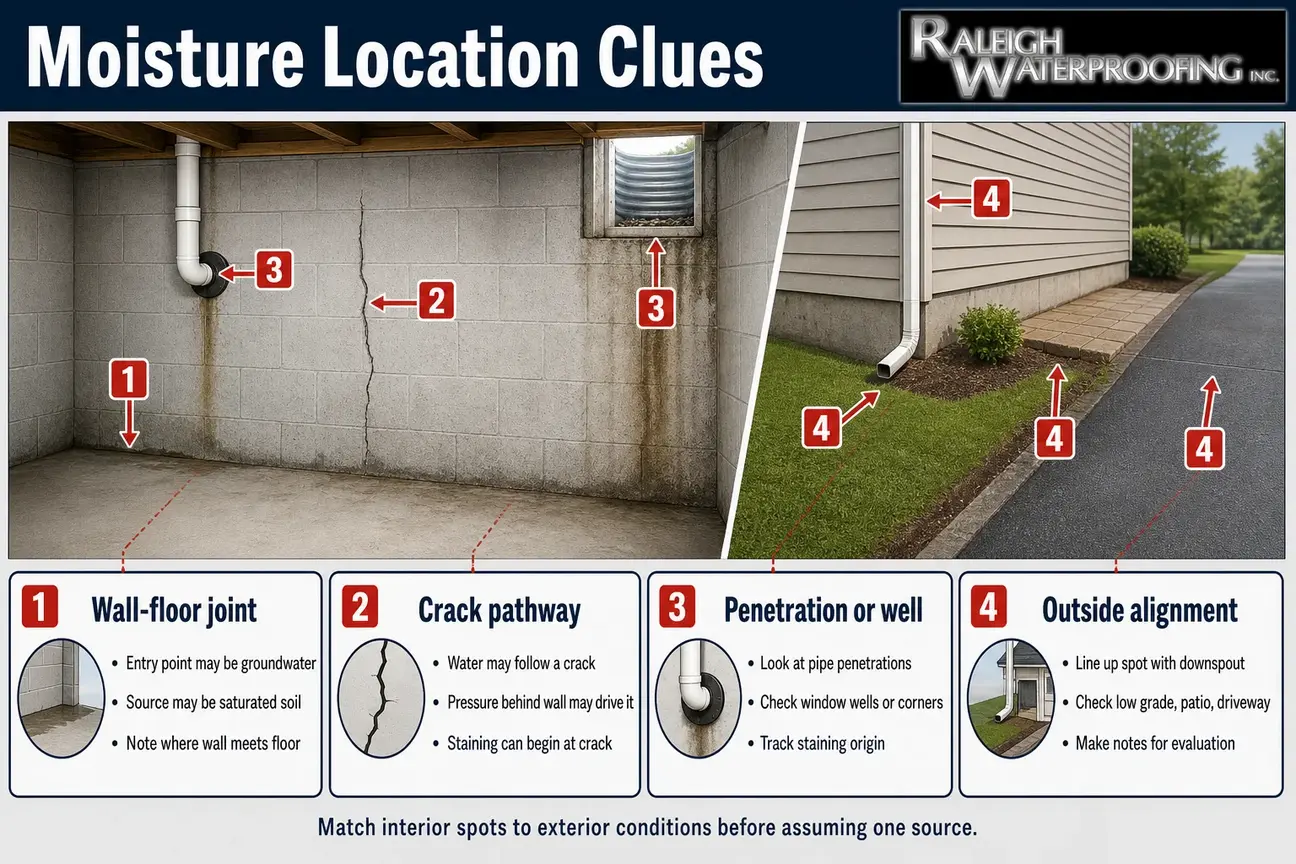
Location matters, but it can mislead you if you stop there. A wet wall-floor joint may be the entry point for groundwater, but the actual source may be saturated soil, roof runoff, a short downspout, failed exterior drainage, or a combination. A leaking crack may be the visible path, while the pressure behind the wall is the reason water is using that path.
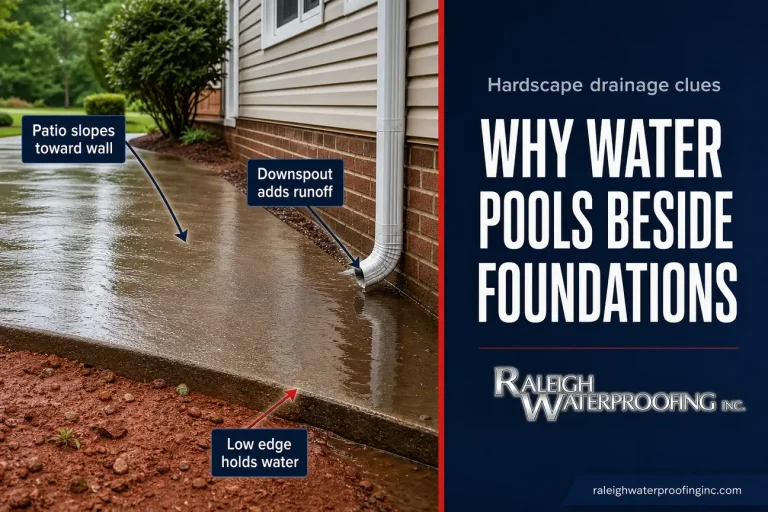
Moisture on an exterior-facing below-grade wall often points toward outside water or groundwater pressure. Look for staining that begins at a crack, a pipe penetration, a window well, a corner, or the point where the wall meets the floor. If that area lines up with a downspout, low grade, patio edge, or driveway slope outside, make a note.
Water on the basement floor can come from the wall-floor joint, through a floor crack, up through porous materials, from a drain backup, from mechanical equipment, or from a pipe. If it is near the lowest point in the room after heavy rain, groundwater deserves attention. If it is under a water heater, condensate line, washer, sink, or bathroom, plumbing deserves attention.
In a crawl space, the ground surface is part of the moisture picture. Damp soil, torn or displaced vapor barrier material, puddles beneath plastic, wet insulation, and condensation on ducts or pipes can point to different crawl space moisture causes. The visible wetness may be from ground vapor, liquid water, humid outside air, or a combination that requires more than one correction.
How do the surface and odor clues change the possibilities?
Surface appearance can help separate seepage from condensation. Droplets or a uniform damp film on cold surfaces suggest air moisture condensing on a cooler material. A defined trail, a wet line at a joint, muddy water, mineral staining, or peeling paint is more consistent with liquid water moving through or across building materials.
Clear water does not automatically mean groundwater, and discolored water does not automatically mean a sewer issue. Muddy water may point toward soil contact or surface runoff. Cloudy, greasy, or sewage-smelling water needs plumbing attention. A musty odor can occur when moisture persists, but odor alone does not identify the source.
Mineral residue or staining after water dries can show where moisture has been moving, but it does not confirm why. It may appear where water evaporates after traveling through masonry. It can remain after an active problem has slowed or after conditions change seasonally. Photograph it, but avoid treating it as a complete diagnosis.
A broad damp film can support a condensation note, while a defined line at a crack or joint supports a seepage note. In a crawl space, the same odor might come from several moisture drivers, so pair odor notes with photos of soil, plastic, insulation, framing, ducts, and perimeter walls.
Could roof runoff or yard drainage be the source?
Runoff problems usually show a weather pattern. Water may appear during a storm, after gutters overflow, after downspouts discharge near the foundation, or when a low area beside the house stays soggy. The interior spot may be a basement wall, a crack, a corner, a window well, or crawl-space soil near the exterior wall.
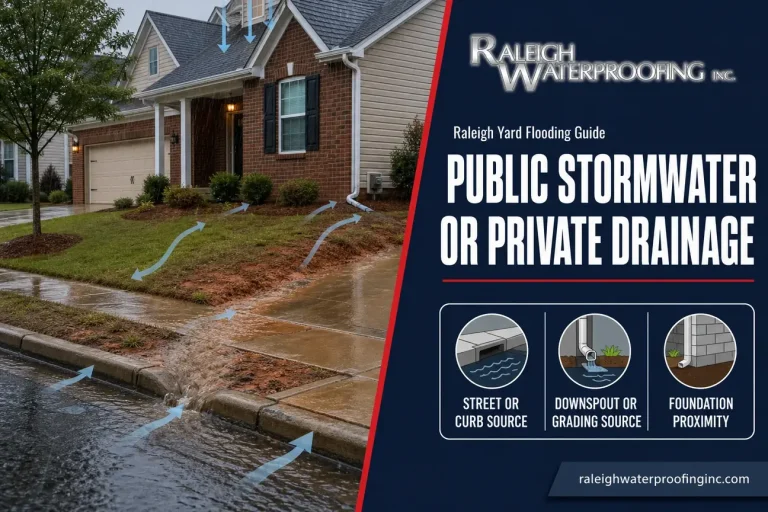
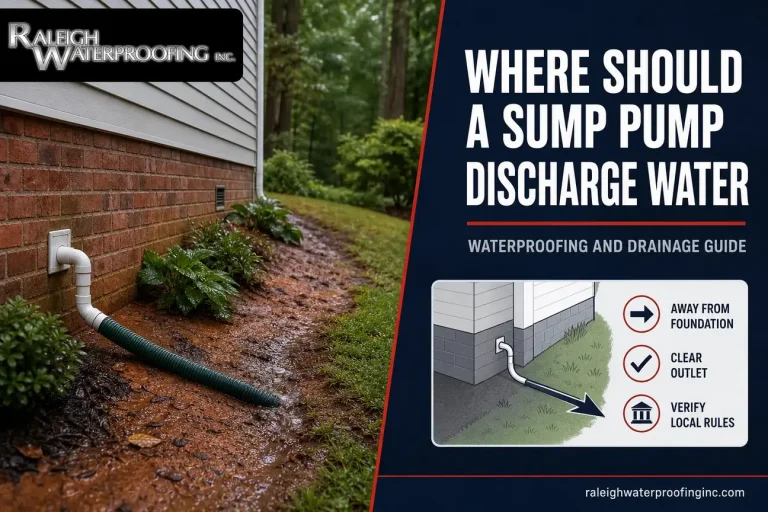
Walk the outside from a safe location after rain. Look for water dumping from a roof valley, gutter seam, downspout elbow, splash block, driveway edge, patio, retaining feature, or compacted low area. Do not redirect water onto a neighbor’s property, across a sidewalk, or into a sanitary sewer. Drainage must have a suitable outlet and must follow local requirements.
North Carolina properties can vary widely in soil and drainage behavior. NC State Extension soil guidance discusses modifying soil around the home and is a useful reminder that soil conditions affect how water moves near a structure. Around newer homes, compacted fill can also slow drainage and concentrate water near the foundation.
When surface water is the driver, the repair direction may include downspout discharge correction, grading-related drainage, a French drain, box drain, channel drain, or other yard drainage approach. If water has been entering through the below-grade wall, exterior foundation conditions also need to be evaluated. Waterproofing is only as good as its drainage.
Could groundwater basement pressure be pushing water in?
Groundwater basement clues often appear after prolonged rain, repeated storms, or saturated soil conditions. Water may show up at the lowest parts of the basement, along the wall-floor joint, through a floor crack, through masonry, or through a foundation crack. It may continue for a while after rain stops because soil around the foundation is still holding water.
Basement groundwater problems are not always one dramatic leak. Sometimes the evidence is damp masonry, repeated staining, seepage in more than one location, or a sump pump that runs during wet periods. The water is following available paths, and those paths can include cracks, joints, porous materials, and openings around penetrations.
Another clue is a pattern that repeats after several rain events even when gutters and downspouts seem to be functioning. That does not prove the footing drain, exterior waterproofing, or slab area is the source, but it does move the evaluation toward soil saturation and controlled drainage.
When the outside wall and footing area can be accessed, foundation waterproofing may be considered. The company’s described exterior method includes excavating to the footer, cleaning and parging the wall, applying the Tuff-N-Dry system, installing a foundation drain daylighted away from the house, backfilling, and restoring landscaping. This is a project that requires proper evaluation and is not a do-it-yourself trenching job.
Where exterior excavation is not feasible or where groundwater must be collected from inside, an interior drain system may be part of the discussion. Interior drainage collects water that reaches the inside perimeter and directs it to a sump station. The right layout depends on the actual path of water, the slab and footing conditions, the discharge route, and whether outside drainage also needs correction.
Condensation basement walls: when dampness is air, not seepage
Condensation basement walls clues are different from a leak trail. Condensation often looks like droplets, sweating, or a broad damp film on cold masonry, pipes, ductwork, or other surfaces. It may be worse during humid weather, during temperature swings, or where air does not move well.
If you are comparing condensation against seepage, ask whether the moisture is spread evenly or concentrated at a crack, joint, or penetration. Condensation tends to show up on cooler surfaces and may not increase immediately after rain. Seepage tends to follow a pathway and often leaves a stain, sediment, or a wet line where water traveled.
Condensation can still matter even when it is not liquid water intrusion. It can dampen materials, create odors, and hide a separate problem. Drying the surface without reducing the moisture source may only reset the clock until the next humid period. An evaluation should consider humidity, ventilation, air leaks, insulation, exposed soil, and whether a crawl-space design is allowing outside air and ground moisture to affect the area.
A useful comparison is to dry a small area and watch how it returns under safe conditions. If moisture returns as a uniform film during humid weather, condensation stays on the list. If moisture returns as a line from a crack, joint, or penetration after rain, liquid water movement becomes more likely.
Crawl space moisture causes: ground, air, and drainage
Crawl space moisture causes often overlap. Exposed soil can release moisture. Humid outside air can condense on cooler ducts, pipes, framing, or insulation. Surface water can enter from the perimeter. Groundwater can rise beneath a vapor barrier. A plumbing leak can add water unrelated to weather.
When homeowners search for crawl-space moisture answers, they often notice musty odor first. Odor is useful, but it is not a diagnosis. Look for damp soil, water beneath plastic, displaced vapor barrier material, sagging or wet insulation, condensation on metal ducts, wet foundation walls, or puddles near a low point.
Some crawl-space conditions are seasonal. Humid summer air may create more condensation, while repeated storms may increase liquid water at the perimeter. If the vapor barrier is wet underneath, document whether the water is isolated in low pockets, connected to the foundation edge, or spread across the ground surface.
Possible repair directions include crawl space vapor barrier work where soil moisture is the primary contributor, crawl-space drainage or a sump station where liquid water is present, and sealed crawl-space or encapsulation work where the design needs broader moisture and air control. Closed crawl-space work can require a permit in North Carolina, and the NC OSFM closed crawl space permit interpretation is a reason to confirm requirements with the local building department before work begins.
Plumbing leak basement patterns to separate from seepage
A plumbing leak basement issue usually has a use pattern. Water appears when a shower runs, a toilet flushes, a sink drains, a washing machine cycles, a condensate line discharges, or a water heater leaks. Sometimes it appears continuously because a supply line is leaking. That is different from water that follows rain or groundwater conditions.
Look at the location. A plumbing-related clue may be concentrated around a pipe, drain, cleanout, utility wall, mechanical room, framed chase, or fixture location above. Water may be warm, cloudy, discolored, greasy, or carry a sewage odor. If sewage is suspected, avoid contact and call the appropriate professional.
A pipe or drain issue can also mimic seepage when water follows framing, a pipe chase, or a wall cavity before appearing at the floor. That is why timing with fixture use matters. Note whether moisture changes after showers, laundry, dishwashing, toilet flushing, condensate discharge, or long periods with no plumbing use.
Raleigh Waterproofing Inc. does not provide plumbing, sewer, or septic repair. A suspected supply, drain, sewer, or septic leak should be evaluated by a plumber. Waterproofing may still be relevant after the plumbing issue is addressed if there is also foundation seepage, groundwater pressure, crawl-space moisture, or surface drainage directing water toward the structure.
What can you safely document before an evaluation?
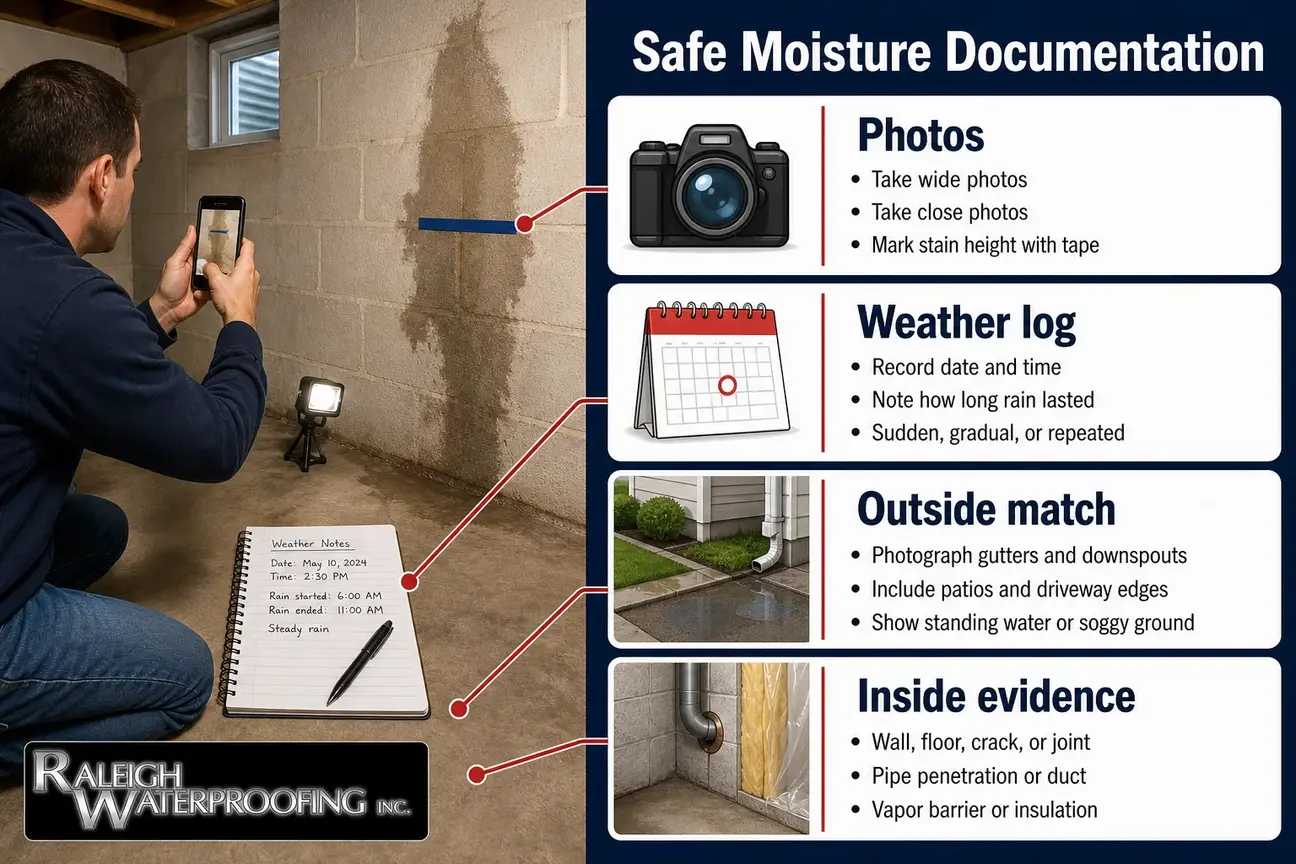
Good documentation helps without requiring invasive work. Take wide photos and close photos. Record the date, time, weather, and how long it had been raining, if rain was involved. Note whether the moisture appeared suddenly, gradually, repeatedly, or only during certain conditions.
Photograph the outside area that lines up with the inside dampness. Include gutters, downspouts, splash blocks, low spots, patios, driveway edges, window wells, standing water, and soggy ground. From inside, record whether moisture is on a wall, floor, crack, joint, pipe penetration, crawl-space soil surface, insulation, duct, or vapor barrier.
Use removable tape if you want to mark the approximate height of a stain, but do not damage finishes. Note odor, color, sediment, whether the water is clear or cloudy, and whether plumbing use changes the amount of moisture. If there is a sump pump, record whether it is running often, only after rain, or not at all.
If you suspect a plumbing pattern, write down which fixtures were used before the water appeared. If you suspect condensation, write down indoor humidity clues, recent weather, and whether the dampness forms on cold surfaces. If you suspect groundwater pressure, note how many hours or days after rain the water appears.
Safety note: Never enter a flooded basement if water may have reached wiring, outlets, appliances, or other energized equipment. Do not open electrical equipment, disturb suspected sewage, cut into walls, or excavate around the foundation. Before any digging, contact NC 811 so underground utilities can be marked, and leave trenching and excavation work to properly equipped professionals.
How does diagnosis determine the repair?
The repair should follow the source. If roof runoff or surface water is saturating soil beside the house, drainage and discharge correction may matter more than coating an interior wall. If groundwater is pushing at the footing, an interior drain and sump station may be part of the solution. If a suitable nonstructural crack is the pathway, crack injection may be considered after the surrounding water conditions are evaluated.
If the evidence points toward a groundwater condition, the repair conversation usually includes how water will be collected, directed, and discharged. If the evidence points toward condensation basement walls, the discussion shifts toward moisture control, air movement, insulation, and other sources of humidity rather than simply sealing a visible surface.
If water is entering through the below-grade wall and the outside can be accessed, exterior waterproofing may address the wall and drainage plane directly. That work is different from interior water collection. Exterior work aims to manage water before it enters; interior drainage collects water that reaches the inside perimeter and directs it to a sump.
If a crawl space has persistent damp soil and no standing water, vapor-barrier work may be appropriate. If it has perimeter water, groundwater, condensation, and outside-air movement, the conversation may shift toward drainage, crawl space repair, a sealed crawl space, or encapsulation. A barrier alone should not be treated as proof that every liquid-water source has been solved.
If a plumbing leak is suspected, the first repair direction is plumbing, not waterproofing. If a roof or upper-wall leak is suspected, a roofing or building-envelope professional should evaluate it. Basement or crawl-space water control can be important, but it should not be used to rename a pipe, sewer, or roof problem.
If bowing, displacement, widening cracks, or settlement are present, a structural engineer should evaluate those concerns. Crack injection and waterproofing are not a substitute for structural engineering judgment. The same caution applies when a homeowner is unsure whether a crack is changing: document the condition and get the right professional involved.
What happens during an on-site evaluation?
A good evaluation connects interior evidence with exterior conditions. Outside, the evaluation may look at roof drainage, downspout discharge, grading, patios, driveways, compacted fill, low spots, foundation wall exposure, window wells, visible cracks, existing drain outlets, and whether water has a lawful and practical discharge path.
Inside, the evaluation may look beyond the most obvious wet spot. It should consider wall-floor joints, cracks, penetrations, floor surfaces, staining patterns, odor, mineral residue, plumbing fixtures, pipes, drains, mechanical equipment, condensate lines, crawl-space soil, vapor barrier condition, insulation, sump basin, pump operation, and discharge route.
That broader view is why waterproofing problem diagnosis comes before repair selection. A basement moisture source can be misread if the inspection stops at the first wet area. The goal is to determine whether the visible location is the source, the entry point, or simply the place where hidden water finally became visible.
During the same visit, the evaluator may compare crawl-space conditions with basement evidence if the home has both areas. A damp crawl space and a damp basement do not automatically share one source, but the outside drainage pattern, soil conditions, and discharge paths may connect the clues.
Raleigh-area conditions that can complicate moisture diagnosis
Homes in the Raleigh area can see several moisture drivers at once: slow-draining Piedmont soils, compacted fill around newer construction, heavy summer storms, tropical-storm rain patterns, humid weather, and many crawl-space foundations. The National Weather Service Raleigh office is a useful local weather reference when homeowners are comparing moisture timing against recent heavy rain. Local conditions do not diagnose a specific house, but they explain why timing, drainage, and humidity all belong in the same conversation.
A homeowner in Cary with a damp crawl space, for example, may be dealing with humid air, ground moisture, and a low exterior grade at the same time. Another home may have a basement corner that gets wet because a downspout saturates the soil, while a separate pipe leak affects a utility wall. Local conditions make a careful sequence more useful than guessing from one symptom.
In the Triangle, a groundwater symptom can appear after repeated storms even when the surface looks dry a day later. Likewise, crawl-space moisture can shift with the season because humid air, ground vapor, and surface drainage do not always peak at the same time.
When should you request an evaluation?
Request an evaluation when moisture repeats, spreads, appears after rain, leaves stains, creates odors, affects a finished area, collects beneath a vapor barrier, or cannot be clearly tied to a plumbing fixture. Also request help when earlier patching, waterproof paint, or sealant did not address the pattern. Those products may cover a symptom while the source continues.
Raleigh Waterproofing Inc. offers a free estimate in the greater Raleigh area for waterproofing services, including damp basement and crawl-space concerns. To discuss what you are seeing, you can request a free estimate, call 919-877-9969, or email [email protected]. Areas outside the Triangle may carry a trip fee, but no dollar amount should be assumed without confirmation.
The practical takeaway is simple: do not choose a repair from the wet spot alone. Compare timing, location, weather, odor, surface clues, plumbing use, and exterior drainage. Then use an on-site evaluation to confirm the basement moisture source and match the repair to the cause.
General homeowner information. The right waterproofing or drainage solution depends on an on-site evaluation of the property.
Frequently Asked Questions
How can I tell whether basement moisture is condensation or a foundation leak?
Condensation usually appears as droplets or a broad damp film on cold surfaces and may track humidity more than rainfall. A foundation leak is more likely to follow rain or groundwater conditions and emerge through a wall, crack, joint, or floor. The two can overlap, so an on-site evaluation is the safest way to separate them.
Why is my crawl space damp if there is no standing water?
Ground moisture, humid air, condensation, minor perimeter water, or a hidden plumbing issue can all contribute. Damp soil, water beneath a vapor barrier, wet insulation, or condensation on pipes and ducts should be documented as clues, not treated as proof of one cause.
Can water enter through a foundation crack even when the crack is not the source?
Yes. A crack can be the visible entry point while the source is saturated soil, roof runoff, poor drainage, or groundwater pressure. Crack injection may be appropriate for some leaking cracks, but widening, displacement, bowing, or settlement should be evaluated by a structural engineer.
What clues suggest a plumbing leak instead of groundwater?
Moisture that changes when a fixture is used, a toilet flushes, a washer drains, or a water heater operates points toward plumbing. Water near pipes, drains, cleanouts, utility walls, or mechanical equipment should be checked by a plumber before waterproofing work is chosen.
Does a vapor barrier stop all crawl-space moisture?
No. A vapor barrier can help address ground moisture, but it does not automatically solve perimeter water, groundwater, plumbing leaks, condensation, or drainage problems. If water is under the barrier or entering from the crawl-space edge, the source still needs to be traced.
Should I use an interior drain or exterior waterproofing?
It depends on the source, access, drainage path, and site conditions. Exterior waterproofing addresses the outside wall and drainage plane when access is practical, while an interior drain collects water that reaches the inside perimeter and directs it to a sump station. Diagnosis should come first.
Does Raleigh Waterproofing Inc. provide mold testing or remediation?
No. Raleigh Waterproofing Inc. does not provide mold testing or remediation. The moisture source should be corrected first, and mold concerns should be handled by the appropriate specialist if testing or remediation is needed.