
Why Does My Sump Pump Keep Running After the Rain Stops?
If your sump pump keeps running after heavy rain, it does not automatically mean the pump is failing. It may still be removing groundwater, or the system may have a float, discharge, drainage, or capacity problem that needs evaluation.
If your sump pump keeps running long after a heavy Raleigh rain has ended, it does not automatically mean the pump is failing.
The pump may still be removing groundwater that is continuing to reach the sump basin after surface rainfall has stopped. But continuous operation can also point to a stuck float switch, water flowing back toward the basin, a discharge problem, an undersized system, or a larger drainage issue around the foundation.
The most important distinction is this:
A sump pump that is running frequently because it has a large amount of water to remove is a different problem from a pump that cannot shut off correctly.
If your pump runs continuously, cycles much more often than usual, or appears unable to keep the water level under control, Raleigh Waterproofing Inc. provides sump station installation, repair, and replacement for Raleigh-area homes and properties.
For help determining whether the problem is the pump or the amount of water reaching it, call 919-877-9969 or contact Raleigh Waterproofing Inc..
Is It Normal for a Sump Pump to Keep Running After Heavy Rain?
It can be normal for a sump pump to continue operating after the rain stops.
Rainwater does not instantly disappear from the soil when the storm ends. Water that has soaked into the ground may continue moving through the soil and toward lower areas around or beneath a foundation.
If an interior or exterior drainage system collects that water and sends it to a sump basin, the pump may continue cycling while the drainage system catches up.
The real question is whether the pump is:
- Cycling normally as water enters the basin
- Running continuously without shutting off
- Turning on and off every few seconds
- Running but failing to lower the water level
- Operating much longer than it did previously
Those patterns can point to different causes.
Why Does Groundwater Keep Reaching the Sump After the Rain Stops?
A sump system manages water that has already reached the drainage system.
After a significant storm, water may continue moving through:
- Saturated soil
- Foundation backfill
- Sub-slab areas
- Perimeter drainage
- French drains
- Interior drainage channels
- Low areas of the property
That movement can continue after the sky clears.
The City of Raleigh notes that stormwater and drainage conditions can affect private property and that many private drainage conditions remain the responsibility of the property owner. Raleigh Stormwater provides information about flooding, erosion, and drainage concerns.
If your sump pump only works hard after major storms and eventually returns to normal operation as the property drains, the high run frequency may be related to a temporary increase in water load.
If it never returns to normal, another problem may be present.
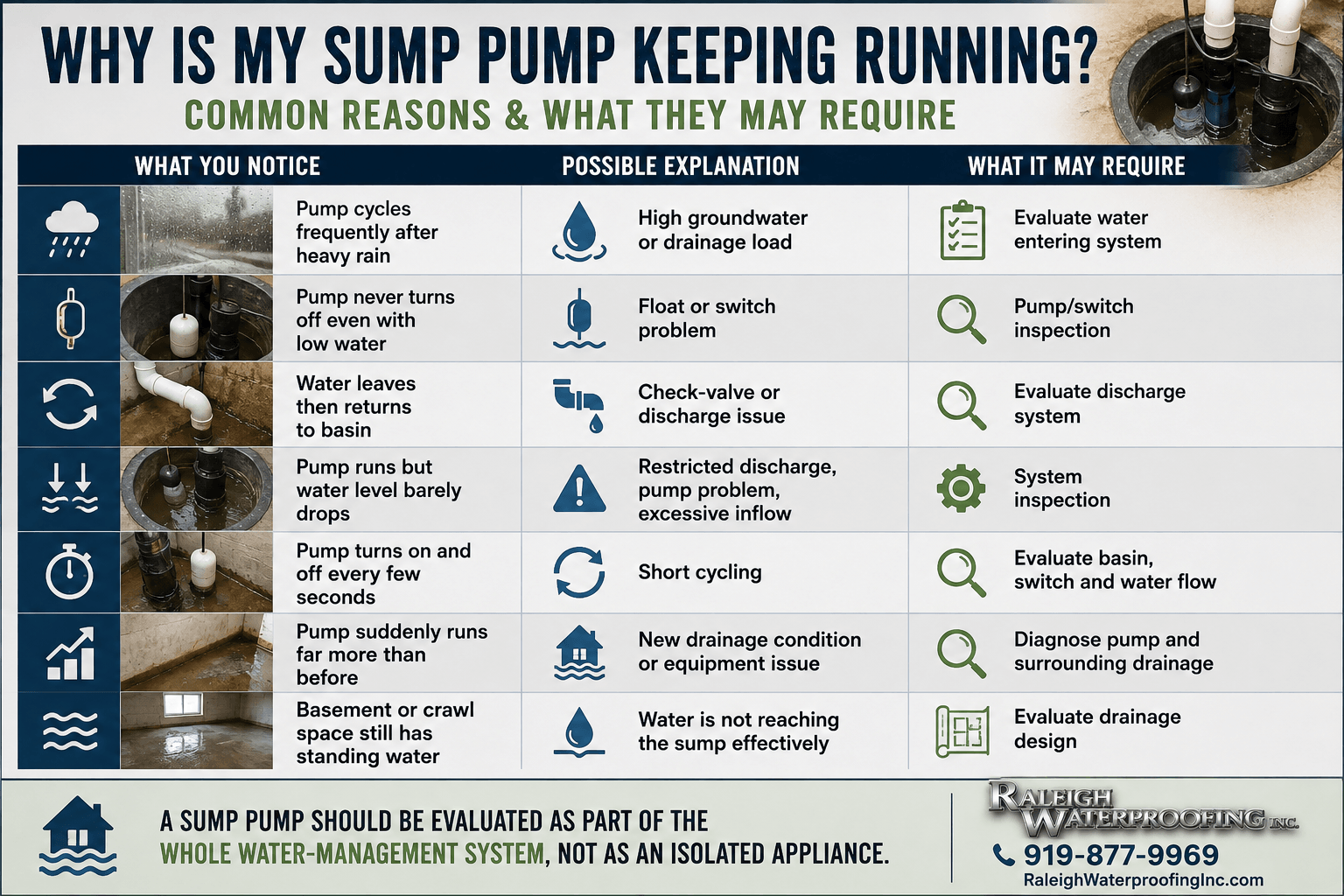
What Are the Most Common Reasons a Sump Pump Keeps Running?
Several different conditions can produce what appears to be the same symptom.
| What You Notice | Possible Explanation | What It May Require |
|---|---|---|
| Pump cycles frequently after heavy rain | High groundwater or drainage load | Evaluate water entering system |
| Pump never turns off even with low water | Float or switch problem | Pump/switch inspection |
| Water leaves then returns to basin | Check-valve or discharge issue | Evaluate discharge system |
| Pump runs but water level barely drops | Restricted discharge, pump problem, excessive inflow | System inspection |
| Pump turns on and off every few seconds | Short cycling | Evaluate basin, switch and water flow |
| Pump suddenly runs far more than before | New drainage condition or equipment issue | Diagnose pump and surrounding drainage |
| Basement or crawl space still has standing water | Water is not reaching the sump effectively | Evaluate drainage design |
The pump should be evaluated as part of the whole water-management system, not as an isolated appliance.
Could the Float Switch Be Stuck?
Yes.
The float switch tells an automatic sump pump when the water level is high enough to turn on and when it has dropped enough to shut off.
If the float becomes stuck in the “on” position, the pump may continue operating even after most of the water has been removed.
Pump manufacturer Pentair lists two general reasons a pump may run continuously: a large amount of incoming water or a float switch stuck in the on position. Pentair’s sump pump troubleshooting guidance provides additional information.
Depending on the pump, a float can potentially be restricted by:
- The side of the basin
- Discharge piping
- Debris
- Another component inside the basin
- A failed switch mechanism
Safety note: Do not reach into a powered sump basin to test the float. Water and electricity are a dangerous combination. If inspection requires handling the pump or electrical components, disconnecting power and following the manufacturer’s safety instructions is essential.
What Is Sump Pump Short Cycling?
Short cycling occurs when the pump turns on and off repeatedly over a short period instead of completing a normal pumping cycle.
You may hear:
every few seconds or minutes.
Zoeller Pump Company explains that short cycling can be affected by the basin diameter and the pump's on/off range, and that excessive short cycling can reduce switch-assembly service life. Zoeller Pump Company provides manufacturer support information about this condition.
Short cycling may be associated with:
- A small sump basin
- Water returning to the basin
- A switch configuration problem
- High incoming water volume
- Check-valve problems
- Drainage-system design
The correct response depends on why the cycling is occurring.
Could Water Be Flowing Back Into the Sump Pit?
Yes.
The discharge system carries pumped water away from the basin.
When the pump shuts off, some water remains in the discharge piping. A properly functioning system is designed to limit unwanted backflow.
If water repeatedly returns to the basin after each pumping cycle, the pump may have to remove the same water again.
A check valve or discharge-system problem may contribute to this type of cycling.
However, a homeowner should not assume every cycling problem is caused by a check valve. High groundwater can create a very similar pattern because new water is continuously entering the system.
Could the Discharge Pipe Be Causing the Problem?
Yes.
A pump can only remove water effectively if the discharge system allows that water to leave the property as intended.
Problems can occur when the discharge:
- Is restricted
- Is obstructed
- Has become disconnected
- Returns water too close to the foundation
- Drains to an ineffective location
- Allows water to move back toward the building
Imagine pumping water out of a basement only to discharge it beside the foundation where it can migrate back toward the drainage system.
The pump may appear to be working hard, but the property is effectively recycling part of the water.
The discharge location therefore matters almost as much as the pump.
Is My Sump Pump Too Small?
Possibly, but frequent operation alone does not prove the pump is undersized.
A sump pump is selected to move a certain volume of water against a specific discharge height and system configuration.
If incoming water exceeds what the system can effectively manage, the water level may remain elevated even while the pump is operating.
Possible signs worth evaluating include:
- Water rising while the pump is running
- Pump operating nearly continuously during moderate rain
- Basin frequently approaching overflow
- Water remaining elsewhere in the crawl space or basement
- Major changes after property drainage has changed
However, simply installing a larger pump may not solve a poorly designed drainage system.
The first question should be:
Why is this amount of water reaching the sump?
Could the Problem Be Too Much Water Rather Than the Pump?
Absolutely.
This is one of the most important distinctions homeowners can make.
A pump can be operating correctly and still run frequently because the property is delivering an unusually large volume of water into the drainage system.
Potential sources include:
- Heavy rainfall
- Saturated soil
- Poor grading
- Roof runoff near the foundation
- Yard drainage problems
- Groundwater
- Foundation drainage
- Concentrated water from another part of the property
In that situation, replacing a functioning pump without addressing the water load may leave the underlying problem unchanged.
Raleigh Waterproofing Inc. also provides professional water-problem diagnosis when the homeowner knows water is present but the actual source is unclear.
Should I Look Outside the House?
Yes.
A sump system should not be evaluated without considering where the water may be coming from.
After a significant rain, safely walk around the affected side of the property and look for:
- Standing water near the foundation
- Downspouts terminating close to the house
- Overflowing gutters
- Low areas beside the foundation
- Soil sloping toward the house
- Concentrated runoff from a driveway or patio
- Water flowing toward a crawl space
- Erosion
- Discharge water returning toward the building
These observations can help distinguish a pump problem from a broader drainage problem.
Could I Need a French Drain Instead of a New Sump Pump?
Possibly.
A sump pump removes water from the sump basin.
It does not automatically collect water from every wet area on the property.
If water is standing in a different section of the basement, crawl space, or yard and has no effective route to the sump, changing the pump alone may do very little.
A drainage system is often what collects and directs the water.
A pump is what moves water out of the collection point.
Raleigh Waterproofing provides French drain installation where site conditions make that type of drainage system appropriate.
The two systems can work together, but they perform different jobs.
Why Is There Still Standing Water if I Already Have a Sump Pump?
Because a sump pump can only remove water that reaches the sump basin.
This is an important misconception.
Raleigh Waterproofing's own sump-station guidance explains that a pump installed in one location will not necessarily address standing water somewhere else if there is no drainage system carrying that water to the pump.
For example, imagine a crawl space with standing water in the far corner.
A pump located 25 feet away cannot collect that water merely because both are beneath the same house.
The water needs a drainage pathway.
That may involve an appropriately designed interior drainage system, depending on the diagnosed source.
Could I Need an Interior Drain System?
If water is entering at multiple points along the perimeter of a basement or crawl space, an interior drain system may be considered to collect the water and direct it toward a sump basin.
A typical concept is:
Without the collection portion, the pump only manages water that naturally finds its way to the pit.
That is why a sump pump and drainage system should be evaluated as components of one water-management strategy.
Could Exterior Drainage Be Overloading My Sump?
Yes.
A property can send more water toward the foundation than the sump system was intended to manage.
Examples include:
- Short downspout extensions
- Negative grading
- Low spots near the foundation
- Runoff from uphill areas
- Hard surfaces directing water toward the house
- Drainage modifications on nearby property
If the exterior water load can be reduced, the sump system may not have to work as hard.
That does not mean exterior drainage correction will solve every groundwater or foundation-water problem.
It is one part of the diagnostic process.
How Can I Tell Whether the Pump or Drainage Is the Real Problem?
Look at the relationship between water entering the basin and the pump's response.
Scenario 1: Lots of Water Is Entering and the Pump Removes It
The pump may simply be responding to a high water load.
Investigate why so much water is reaching the system.
Scenario 2: Little Water Is Present but the Pump Never Stops
A switch or float problem becomes more likely.
Scenario 3: Pump Runs but Water Level Does Not Drop
The pump, intake, discharge line, or system capacity may need evaluation.
Scenario 4: Water Level Drops and Immediately Rises Again
Backflow or a very high incoming water rate may be involved.
Scenario 5: Pump Works but Water Remains Elsewhere
The drainage system may not be collecting water effectively.
This framework is more useful than assuming:
“The pump is running, so I need a new pump.”
Is a Constantly Running Sump Pump Bad for the Pump?
Continuous or unusually frequent operation can increase wear because mechanical and electrical components are operating more often.
However, shutting off a pump that is actively managing incoming groundwater can create a much larger problem.
Do not unplug an actively working sump pump simply because it is running frequently unless there is an immediate safety concern or a qualified professional instructs you to do so.
The goal is to determine why it is running.
If the pump is preventing the basin from overflowing during heavy inflow, stopping it could allow water to rise.
When Should I Be Concerned About a Sump Pump That Keeps Running?
Consider having the system evaluated when:
- It never turns off
- It runs when very little water is in the basin
- It suddenly behaves differently than before
- The water level continues rising while it runs
- It is short cycling constantly
- It makes unusual noises
- Water is returning to the basin
- The discharge appears blocked or ineffective
- The basement or crawl space still has standing water
- The pump struggles during ordinary rainfall
- You are unsure whether the pump can manage the next major storm
A change in behavior is particularly useful information.
If a pump that previously handled storms comfortably is suddenly running continuously under similar conditions, something in the water load, pump, switch, discharge, or drainage system may have changed.
What Should I Check Without Taking the Pump Apart?
Homeowners can make several basic observations without attempting electrical or mechanical repairs.
Look at the Water Level
Is water entering the basin rapidly?
Listen to the Pump
Does it run continuously or cycle?
Observe When It Shuts Off
Does it ever stop after lowering the water level?
Look at the Discharge Point
If visible and safe to inspect, determine whether water is actually being discharged.
Look Around the Foundation
Check for standing water and concentrated runoff.
Note the Weather
Did the behavior begin after a major rain event, or does the pump run this way during dry weather too?
Document the Pattern
A short video of the basin cycling or the discharge operating may help explain what is happening when a contractor evaluates the system.
Do not remove covers or reach into electrical equipment unless you can do so safely and according to manufacturer instructions.
What Should I Do if the Sump Pump Is Running but Not Pumping Water?
A motor that is running without effectively moving water should be evaluated promptly.
Possible causes can include:
- A blocked intake
- A discharge restriction
- An air-related problem
- Pump wear or mechanical failure
- A system configuration problem
Manufacturer troubleshooting instructions vary by pump model.
Do not assume that because you hear the motor, the system is protecting the basement.
The key evidence is whether the water level actually drops and water is successfully discharged.
Should I Replace the Pump or Repair It?
That depends on what is wrong.
Replacement may not be necessary when the actual issue is:
- An obstructed float
- A switch problem
- Discharge configuration
- Backflow
- Drainage design
- Excessive incoming water
On the other hand, a worn, damaged, unreliable, or improperly sized pump may need replacement.
Raleigh Waterproofing Inc. identifies pump installation, repair, and replacement as part of its sump-station services.
That allows the evaluation to start with the problem rather than assuming a new pump is automatically required.
What About a Battery Backup Sump Pump?
A backup system can provide additional protection when the primary pump cannot operate because of certain power or equipment failures.
A backup can be especially relevant when a home relies heavily on an electrically powered sump system during storms.
But a backup pump does not correct:
- Poor exterior drainage
- A blocked drainage system
- An ineffective discharge location
- Water that never reaches the sump basin
- A drainage design that cannot manage the water
Backup pumping is a layer of redundancy, not a substitute for diagnosing the complete water-management system.
Could a Power Outage Happen at the Same Time I Need the Pump Most?
Yes.
The same severe weather that produces heavy rainfall can also create conditions that affect electrical service.
If the home depends on a sump pump to manage active groundwater or drainage, it is reasonable to consider what happens if the primary pump loses power.
Raleigh Waterproofing's current sump-station information lists both electrical pumps and battery backup options.
The appropriate backup arrangement depends on the property and system.
Is My Sump Pump the Only Thing Protecting My Basement?
Ideally, no.
A well-designed water-management strategy can involve multiple layers:
Not every home requires all of these components.
The point is that the sump pump is usually one part of a larger system.
If the rest of that system is not moving water effectively, the pump may be forced to compensate—or may never receive water from the areas that actually need drainage.
What Does Raleigh Waterproofing Evaluate?
When a sump system is not behaving normally, the useful question is not just whether the motor turns on.
The broader evaluation may need to consider:
- Where the water is coming from
- How rapidly it reaches the basin
- Whether the pump cycles normally
- Whether the float operates correctly
- Whether water is being discharged effectively
- Whether water is returning
- Whether standing water exists elsewhere
- Whether a drainage system feeds the sump
- Whether exterior runoff is contributing
- Whether the existing system matches the property's water load
Raleigh Waterproofing Inc. has provided residential and commercial waterproofing services since 2001 and lists sump-pump installation, repair, and replacement among its current services.
The correct recommendation should address the diagnosed condition rather than replacing equipment unnecessarily.
How Much Does Sump Pump Repair or Replacement Cost?
There is no useful single price without knowing what the system needs.
Cost can vary based on:
- Whether repair or replacement is needed
- Pump type
- Basin condition
- Switch or control configuration
- Discharge piping
- Check-valve condition
- Access
- Drainage-system changes
- Need for additional water collection
- Backup-pump requirements
- Site conditions
If the pump is running continuously because of a drainage problem, the correct scope may involve more than the pump itself.
An accurate estimate generally requires evaluating both the equipment and the water-management system.
Does a Constantly Running Pump Mean I Need Waterproofing?
Not necessarily.
The pump symptom does not diagnose the entire property.
A continuously running pump could indicate:
- High groundwater
- Heavy stormwater load
- A mechanical or switch problem
- Discharge backflow
- Drainage design issues
- A combination of conditions
The correct sequence is:
That prevents a homeowner from paying for the wrong solution.
Sump Pump Keeps Running After Rain in Raleigh? Have the Whole System Checked
If your sump pump keeps running after the storm has passed, do not automatically assume the pump needs to be replaced.
First determine whether:
- Large amounts of groundwater are still arriving
- The float or switch is functioning normally
- The pump is actually lowering the water level
- Discharged water is staying away from the foundation
- The drainage system is carrying water effectively
- Standing water exists elsewhere
- The existing sump system matches the property's needs
Raleigh Waterproofing Inc. provides sump pump and sump station services along with drainage and waterproofing solutions for Raleigh-area homes and properties.
If your sump pump is running continuously, short cycling, or struggling to keep up, call 919-877-9969 or request an evaluation.
A sump pump symptom alone does not identify the repair. The pump, drainage system, water source, and discharge path should be considered together.
Frequently Asked Questions
Why is my sump pump still running even though it stopped raining?
Water can continue moving through saturated soil and drainage systems after surface rainfall ends. If significant water is still entering the sump basin, the pump may continue operating normally. If the water level is low and the pump still will not shut off, a float, switch, or other equipment problem may need evaluation.
How long should a sump pump run after heavy rain?
There is no universal normal time because properties receive and drain water differently. Soil conditions, rainfall amount, groundwater, drainage design, basin size, pump capacity, and discharge conditions all affect operation. The pattern is more useful than a fixed number of minutes or hours.
Why does my sump pump turn on every few minutes?
Frequent cycling may result from a large incoming water load, a small basin, switch configuration, backflow, or other system conditions. If the cycling is unusually frequent or continues long after wet conditions have passed, the pump and drainage system should be evaluated.
Can a bad check valve make a sump pump run repeatedly?
A check-valve problem can allow water in the discharge piping to return toward the basin, potentially causing additional cycles. However, frequent cycling can also result from new groundwater entering the pit, so the symptom should not be attributed to the valve without inspection.
Why is there still water in my crawl space if my sump pump works?
The pump only removes water that reaches its basin. Standing water elsewhere may indicate that the drainage system is not collecting and directing that water to the sump. The water source and drainage pathway should be identified before assuming a larger pump will solve the issue.
Does a constantly running sump pump need to be replaced?
Not automatically. The cause could be a stuck or failed switch, unusually high incoming water, drainage problems, discharge issues, or pump wear. Raleigh Waterproofing provides sump-pump installation, repair, and replacement, allowing the condition to be evaluated before deciding whether replacement is appropriate.
Should I unplug a sump pump that will not stop running?
Generally, do not disable a pump that may be actively preventing water from rising unless there is an immediate safety problem or a qualified professional instructs you to do so. If the pump is running abnormally, arrange an evaluation rather than allowing the basin to overflow.
Can yard drainage cause my sump pump to run more often?
Yes. Water directed toward the foundation can increase the amount of water the drainage and sump system must manage. Grading, roof runoff, low areas, and other site-drainage conditions can contribute to the water load, although the property should be evaluated before assuming exterior drainage is the only cause.