
Moisture doesn’t negotiate. If your home has a musty odor, cold floors in winter, condensation on ductwork, or visible puddling underfoot, your crawl space is telling you the environment beneath your home isn’t controlled. With crawl space waterproofing in Raleigh, NC, you can shift from reacting to symptoms to building a stable, dry foundation for the entire house.
Raleigh Waterproofing Inc., led by owner David Hawkins, serves homeowners across Raleigh, Cary, and the Triangle with diagnostics-first solutions—encapsulation, drainage systems and sump pumps, vent sealing, dehumidification, and targeted repairs. This guide explains what makes crawl spaces in our region vulnerable, how we diagnose the true sources of moisture, and what to expect from a professional crawl space waterproofing plan.
Why Raleigh Crawl Spaces Struggle With Moisture
Humid climate + cool crawl = condensation
For much of the year, outside air in Raleigh carries a high moisture load. When that air enters a cooler crawl space, it can condense on cold surfaces—ductwork, joists, insulation facings—fueling mold and mildew. Storm events add bulk water that can linger, especially on clay-heavy lots.
Clay soil and slow drainage
Wake County’s red clay holds water and releases it slowly. After heavy rain, water can pond against foundation walls or find a path into the crawl through small openings and utility penetrations. If the crawl space lacks a way to collect and remove that water, it cycles between “wet” and “damp,” which is still a problem.
Red flags you shouldn’t ignore
- Musty odors creeping into living areas
- Condensation on ducts or fallen/soaked insulation
- White, powdery efflorescence on block walls
- Cold floors above the crawl in winter; uneven temperatures
- Standing water or damp soil for days after storms
- Insects or rodents drawn to wet wood and paper facings
If you’re seeing any of these, start with a focused problem diagnosis to confirm sources and prioritize fixes.
What Crawl Space Waterproofing Raleigh NC Actually Involves
“Waterproofing” is not a single product. It’s a system that addresses liquid water, water vapor, and air exchange together—because all three fuel the problems homeowners notice.
Encapsulation vs. basic vapor barriers
- Basic vapor barrier: Plastic ground cover that reduces moisture rising from soil, but doesn’t seal walls, piers, or vents. Helpful but limited.
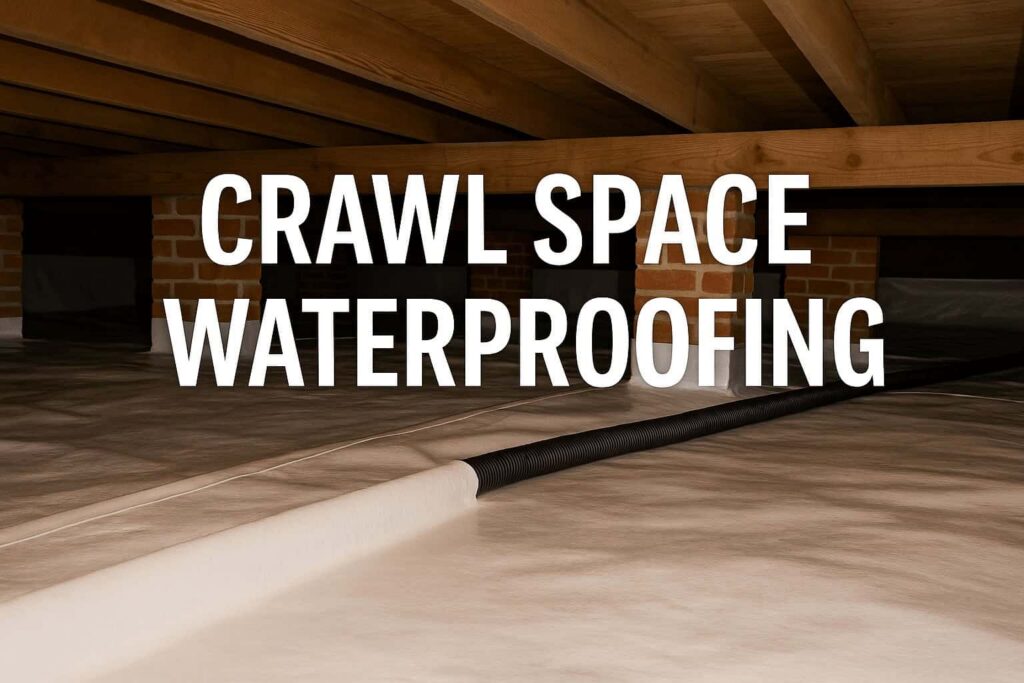
- Encapsulation (comprehensive): A continuous liner across floor, walls, and piers, with sealed seams, vent closures, and a crawl space dehumidifier to maintain target humidity. Encapsulation makes moisture control predictable, not seasonal.
Explore how encapsulation fits into crawl space repair options and when we recommend it.
Interior drainage and sump pumps (when water actually enters)
If bulk water is present, interior perimeter drains route flow to a sump basin with a sump pump, discharging away from the foundation. In Raleigh’s clay, this is often the backbone of crawl space waterproofing Raleigh NC. Battery backups sustain pumping during storm outages.
See drainage-related options under our broader services.
Crack injections (stop seepage at the source)
Water sneaking through wall seams or hairline cracks? Targeted crack injections can seal pathways while drainage manages pressure and flow. We often pair these for a durable solution.
Dehumidifiers and vent sealing (control the air, not just the water)
Even with a liner, uncontrolled outside air can reintroduce humidity. We seal vents and install a right-sized dehumidifier to hold a safe relative humidity (often 50–60%—[Needs verification] for your home), reducing the chance of recurring condensation.
Our Process: From Assessment to Aftercare
When you book crawl space waterproofing in Raleigh, NC with our team, here’s what to expect:
1) Diagnostic inspection (outside and in)
- Site assessment: Grading, downspout discharge, hardscape slopes, and places water could pool.
- Crawl evaluation: Humidity readings, signs of seepage, staining, mold growth, failing insulation, and air pathways.
- Root-cause mapping: Is this bulk water, ground vapor, air exchange, condensation, or a combination?
2) Plan and prioritize (cause, then comfort)
We’ll show you a staged plan—what must happen first to stop the cause (e.g., drainage and sump), and what can follow for comfort and longevity (encapsulation, dehumidifier, vent sealing). If budget requires phases, we sequence steps to deliver real gains at each stage.
3) Installation (done right, in the right order)
- Drainage & sump (if needed): Trenching, pipe run, filter fabric, basin, pump, check valve, code-compliant discharge.
- Crack injections (if needed): Pressure-injected materials seal seepage points.
- Encapsulation: Floor, walls, piers; taped seams; mechanically fastened wall runs; penetrations sealed.
- Dehumidifier & vent sealing: Equipment installed, condensate managed, vents closed, rim/band areas addressed as appropriate.
4) Walkthrough & aftercare
We review the finished work, show you the dehumidifier settings, point out protective measures around landscaping and discharge, and outline simple care steps—then we’re available if questions arise.
Benefits That Extend Above the Crawl
- Odor and mold control: Keeping relative humidity lower reduces conditions that support mold growth. (Any health-related claims require human verification; this is general building-science guidance.)
- Structural protection: Drier wood and hardware perform better; you reduce risk of rot, rust, and fastener corrosion.
- Comfort and efficiency: Fewer cold-floor complaints, less duct sweating, less moisture-laden air infiltrating living areas; some homes see energy improvements ([Needs verification] for your specific setup).
- Pest deterrence: Dry, sealed spaces are less attractive to termites and rodents; you still follow integrated pest management where needed.
- Resale signals: Buyers increasingly value documented crawl space waterproofing Raleigh NC—especially encapsulation with maintenance records.
Raleigh-Specific Scenarios (And How We Solve Them)
1) Clay-lot with standing water after storms
Symptoms: Puddling, muddy soil, recurring musty odor.
Plan: Interior drain + sump first; then encapsulation; dehumidifier to stabilize RH.
Why: Routing liquid water out is non-negotiable; air control works after bulk water is handled.
Related service: See services for drainage system options.
2) Ventilated crawl with condensation and falling insulation
Symptoms: Condensation on ducts/pipes, wet insulation, winter cold floors.
Plan: Encapsulation + vent sealing + dehumidifier; replace insulation sections as needed.
Why: In a humid climate, vented air can worsen moisture; sealing and mechanical drying win consistently.
Learn more: Crawl space repair.
3) Hairline wall seepage + humid air
Symptoms: Efflorescence on block walls, minor trickling, stale air.
Plan: Crack injections at seepage points; interior drain if pressure persists; encapsulation to finish.
Why: Stop the path, manage pressure, then control air and vapor for lasting results.
4) Basement + crawl combination
Symptoms: Wet basement and musty crawl space.
Plan: Coordinate basement waterproofing with crawl encapsulation so both levels stabilize.
Why: Treating one area without the other can move moisture problems around, not solve them.
Homeowner Prep & Aftercare (Practical and Simple)
Before work begins
- Clear items from near the crawl access; secure pets indoors.
- Tell us about any known leaks, previous repairs, or contractor work.
- Confirm power availability for pumps/dehumidifiers.
After installation
- Dehumidifier: Replace/clean filters per manufacturer; keep setpoint steady (often ~50–60%—[Needs verification] for your home).
- Sump system: Test quarterly; consider a battery backup for storm resilience.
- Gutters/Downspouts: Keep them clean; extend discharge 6–10 feet where possible.
- Annual check: Schedule a quick problem diagnosis review to confirm performance and catch small changes early.
What Sets Raleigh Waterproofing Inc. Apart
- Owner-led accountability: Learn about David Hawkins and our approach—diagnose first, build the right sequence, and stand behind the work.
- Cause-first planning: We solve why your crawl is wet, not just where it looks damp.
- Right method, right order: Drainage and sump where needed, then encapsulation and air control—never band-aids.
- Clear scopes: You’ll see what we’ll do, why we’ll do it that way, and how to maintain results.
- Triangle coverage: Raleigh, Cary, and surrounding communities with responsive scheduling and follow-through.
Local, In-Body Calls to Action
- Explore solutions on our services page.
- Learn how encapsulation fits into crawl space repair.
- Not sure what’s going on? Start with a problem diagnosis.
- Stop seepage at the source with crack injections.
- Coordinate with basement waterproofing if both spaces need attention.
- Ready to schedule or have questions? Contact us.
FAQs
1) How do I know if I need crawl space waterproofing?
Musty odors, persistent damp soil, condensation on ducts, or fallen insulation are strong indicators. Start with a problem diagnosis.
2) Is encapsulation always necessary?
No. If you have bulk water, draining and pumping may come first. Encapsulation and dehumidification then stabilize humidity long-term.
3) Do vents help or hurt in Raleigh’s climate?
In humid months, open vents can increase moisture. Sealing vents and controlling humidity mechanically is more reliable.
4) Will this reduce my energy bills?
Many homes experience comfort gains and potential energy savings after encapsulation ([Needs verification] for your setup).
5) Can you stop water coming through wall cracks?
Yes—crack injections can seal seepage points; if pressure persists, we add interior drainage.
6) How long does the work take?
Simple barriers can be 1–2 days; full drainage + encapsulation can take several days. We’ll provide a clear timeline upfront.
7) What maintenance is required?
Replace dehumidifier filters, test pump/alarm quarterly, keep gutters clear, and schedule an annual check.
8) Do you service both Raleigh and Cary?
Yes, we cover Raleigh, Cary, and the broader Triangle with responsive scheduling.
9) Is this covered by insurance?
Insurance typically covers damage from sudden events, not preventive waterproofing. We’ll help document conditions for your records.
10) How do I get a quote?
Use our contact form to schedule an on-site evaluation and receive a clear, prioritized plan.
Sources
- EPA — Moisture Control Guidance for Building Design & Construction
https://www.epa.gov/indoor-air-quality-iaq/moisture-control-guidance-building-design-construction - NC State Extension — Crawl Space Moisture Management
https://content.ces.ncsu.edu/crawl-space-moisture-management - U.S. Department of Energy — Crawl Space Insulation & Encapsulation
https://www.energy.gov/energysaver/crawl-space-insulation - American Society of Home Inspectors (ASHI) — Crawl Space Issues
https://www.homeinspector.org