Why Water Pooling Foundation Issues Happen After Hardscaping
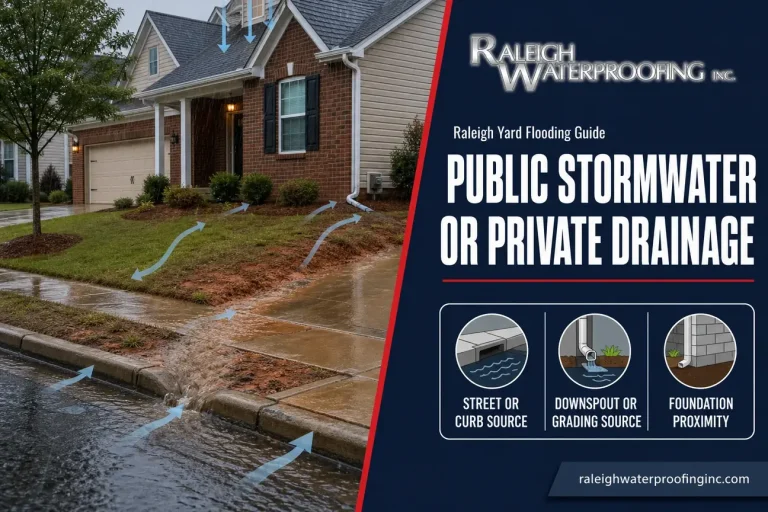
When homeowners search for “water pooling foundation” after a new driveway, patio, walkway, porch slab, or other hardscape, the hardscape may have changed the way rainwater moves across the property. A surface that used to shed water away from the house can settle, develop a low edge, or concentrate runoff toward one foundation wall. That visible puddle is an important clue, but it is not a complete diagnosis. Roof runoff, downspouts, compacted soil, saturated fill, foundation drainage, cracks, crawl-space conditions, or plumbing can also be involved.
Quick Answer: Water may pool beside a foundation when a hard surface no longer slopes away from the house, or when runoff is collected and released at a low edge near the wall. The right response depends on an on-site evaluation of surface flow, soil, outlets, foundation conditions, and any basement or crawl-space evidence.
How can hardscape drainage change after a patio, driveway, or walkway?
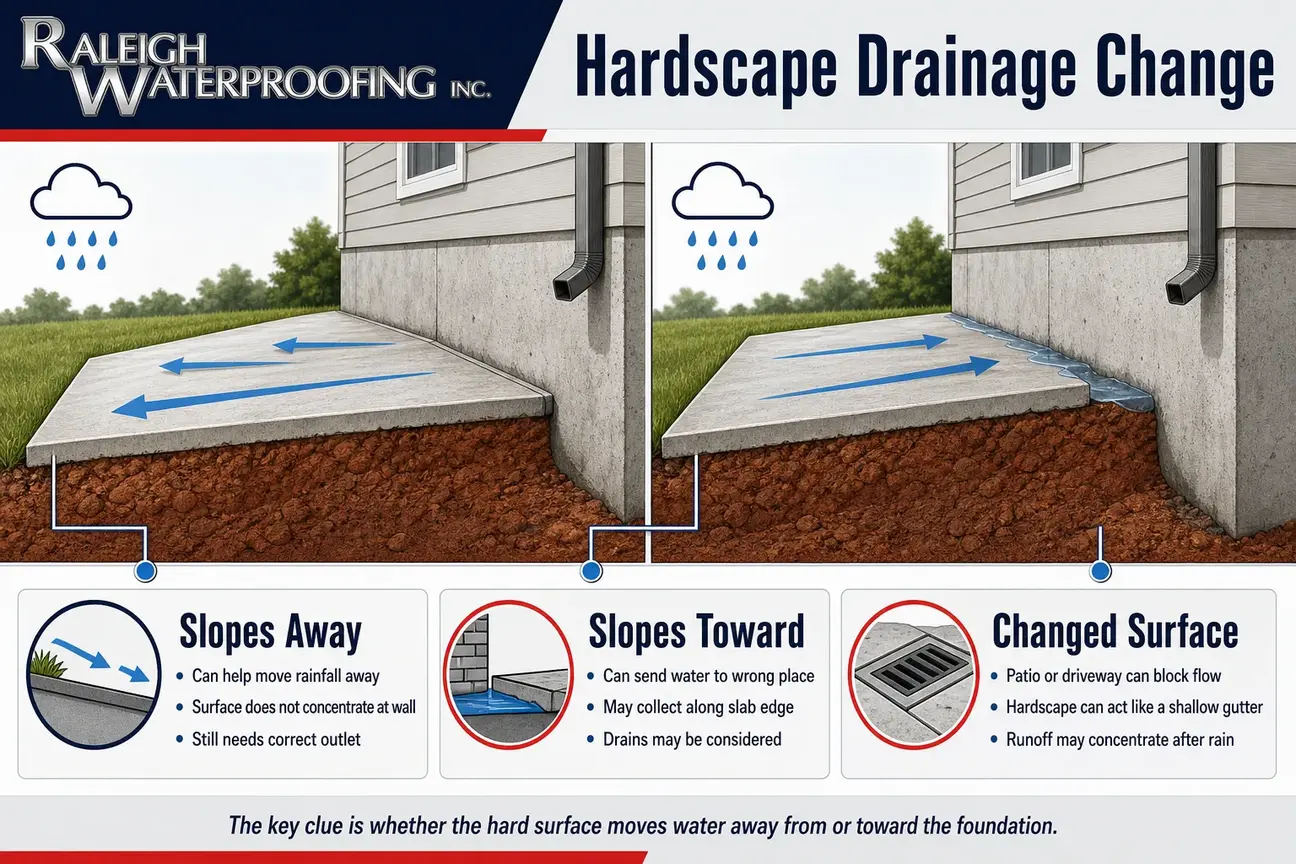
Hardscape drainage changes when a surface blocks, redirects, or concentrates water that used to spread out across soil. A patio, driveway, porch slab, or walkway can act like a shallow gutter. If it slopes away from the home, that can help move rainfall away from the foundation. If it slopes toward the home, settles unevenly, or catches runoff from a larger paved area, it can send water to the wrong place.
The PNNL / Building America Solution Center guidance says to ensure patios, sidewalks, and driveways slope away from the house, and to consider correctly sloped concrete, pervious pavers, or drains where surfaces slope toward the foundation. That guidance supports the general principle, but it does not prove that hardscape alone is the source of every foundation moisture problem.
One common pattern is sheet flow across a patio or walkway. Water may travel evenly across the surface during rain, then spill off the lowest edge. If that edge is beside the foundation, the soil along the wall can stay wetter than surrounding areas. Over time, repeated wetting may also create erosion channels that guide runoff toward the same spot.
Another pattern occurs when a driveway runoff path drains toward the garage, side yard, or a low corner near the house. Driveways collect water from a broad paved area. When the low end points toward the foundation, runoff can arrive faster and in a more concentrated path than it would across grass or planting beds.
A third pattern involves transitions. A walkway may be pitched correctly at one end but have an uneven joint, sunken section, or soil gap along the side. Water follows the easiest path. A small low point at a slab edge can become the spot where runoff leaves the hardscape and enters the soil next to the foundation.
When “patio slopes foundation” describes what you see, what clues matter most?
When a homeowner describes the concern as “patio slopes foundation,” the most useful clues are direction, timing, and connection to interior symptoms. A patio that appears nearly flat when dry may show its real pitch during a steady rain. Watch from a safe location and look for water moving toward the foundation, collecting along a slab edge, or disappearing into a gap where concrete meets soil.
The phrase patio slopes foundation sounds like a conclusion, but for a homeowner it is better treated as a working observation. You may see water travel toward the house, yet the final repair still depends on what happens after it reaches the edge. Does it spread across mulch? Does it fall into an eroded trough? Does it collect beside a crawl-space wall? Does it coincide with dampness inside?
Settlement can make the pattern worse. A patio may have been installed with adequate pitch, then the base or surrounding soil may settle. That can create a reverse slope or a depression that holds water. Cracks, separated joints, tilted sections, and soil washout are clues that the hardscape-to-soil transition has changed.
It is also possible for a patio to contribute to water near the foundation without being the only cause. A nearby downspout can add roof runoff to the same area. Slowly draining soil may keep water there longer. A footing drain, if present, may not be moving water away effectively. A basement or crawl-space symptom may show up at the nearest weak point, not necessarily at the original source.
What driveway runoff and walkway drainage can reveal
Driveway runoff often reveals how water is being concentrated. A driveway can gather rain from a large area and send it toward one edge, apron, garage corner, or side yard. If that low edge points toward the house, the water may not look dramatic during a light shower, but it can become obvious during heavier rain.
Walkway drainage can be more subtle. A narrow walkway beside a home may seem too small to matter, but it can intercept water from a roof drip line, planting bed, slope, or side yard. If the walkway is higher than the soil on one side and lower near the foundation side, runoff may be directed toward the wall or crawl-space perimeter.
Driveway runoff and walkway drainage should be compared with downspout discharge. A downspout that releases near the same low point can make a hardscape problem look worse than it would be by itself. The visible puddle tells you where water is collecting; it does not automatically tell you how much came from pavement, roof runoff, soil saturation, or subsurface flow.
That is why Raleigh Waterproofing Inc. emphasizes diagnosis before repair. A homeowner may suspect the driveway because the problem began after installation, but an on-site evaluation should still check the full pattern. If the surface water is only one contributor, a single surface drain may not address the whole issue.
What does settlement or erosion change beside a foundation?
Settlement changes slope. Erosion changes the path water follows. Together, they can turn a hardscape edge into a water channel beside the foundation. Soil may consolidate under a slab or wash out along the edge. Once a small trough forms, later storms tend to follow the same route.
Look for uneven joints, low corners, separated caulk lines, gaps between concrete and the wall, exposed aggregate, bare soil, or mulch washed into one corner. These signs do not prove a specific repair, but they help show where water has been traveling. They also help an evaluator compare the outside pattern with what is happening inside the basement or crawl space.
Avoid jumping from settled hardscape to a structural conclusion. A sunken walkway or cracked slab can be a drainage clue without proving that the home’s foundation is structurally moving. If you see bowing, displacement, widening cracks, or settlement of the foundation itself, that is a reason to consult a structural engineer. Waterproofing and drainage evaluations should not remotely classify structural movement from photos.
Erosion also matters because it can remove the soil that should shed water away from the home. Where soil drops beside a patio or walkway, runoff may fall into the gap and sit against the foundation. Where mulch or topsoil washes out repeatedly, replacing it without addressing the water path may only reset the problem until the next heavy rain.
Is the hardscape the only possible cause?
No. A hardscape can be an important clue, but it is rarely wise to assume it is the only cause without checking the rest of the property. The same wet corner beside a foundation can involve roof runoff, a short downspout, compacted fill, saturated soil, subsurface water, foundation-wall conditions, or plumbing.
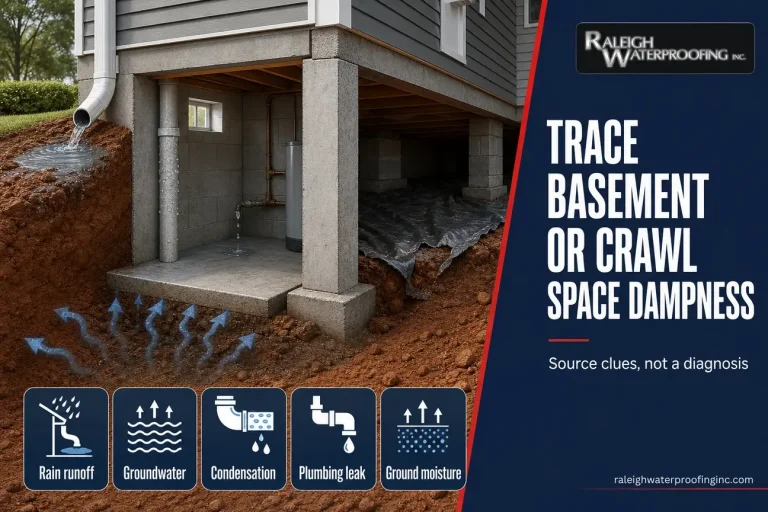
Surface runoff is the water you can see moving across concrete, pavers, asphalt, mulch, or soil during rain. Subsurface water is harder to see. It may travel through soil and appear later as seepage at a wall crack, crawl-space floor, wall-floor joint, or low interior area. A visible entry point is not always the original source.
Downspouts deserve a close look. A downspout that discharges near a patio edge can add roof water to the same low spot where the hardscape already sends rainfall. In that case, driveway runoff or patio runoff may be part of the pattern, but roof drainage may also need attention.
Soil conditions matter as well. NC State Extension explains that soil around a home may need attention for water movement and plant growth, and that clay content, compaction, and organic matter influence how soil behaves. Around the Triangle, slowly draining Piedmont soils and compacted fill around newer homes can keep water near a foundation longer, but those conditions are context, not a diagnosis.
Foundation conditions matter, too. Water can collect outside and never enter the home, or it can find a crack, joint, pipe penetration, or weak point. If dampness appears inside, a waterproofing problem diagnosis should compare exterior drainage patterns with interior evidence before choosing a repair.
Plumbing and sewer leaks are separate possibilities. If water appears when no rain has occurred, if it follows water use in the home, or if it has signs associated with a supply or drain line, a plumber should evaluate it. Drainage and waterproofing work may not address a plumbing leak.
What can a homeowner safely document?
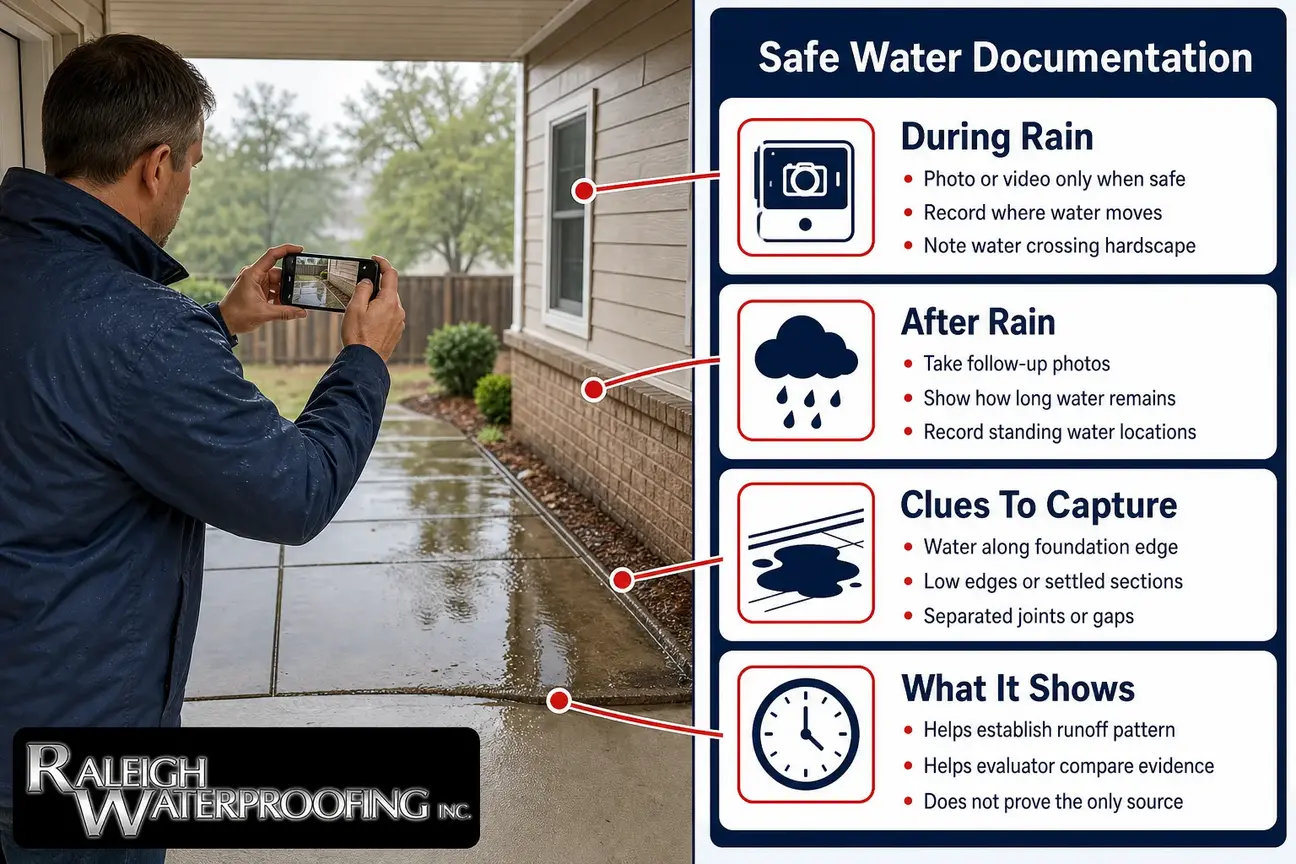
Good documentation helps an evaluator understand the pattern without asking you to diagnose it. Take photos or short videos during rainfall when it is safe to do so. Then take follow-up photos after the rain stops to show how long the water remains. The goal is to record what happens, where it happens, and when it happens.
| What to observe | What it may help establish | What it cannot prove by itself |
|---|---|---|
| Water moving across a patio, driveway, or walkway | Whether surface runoff is traveling toward the house | That the hardscape is the only source |
| Standing water along a foundation edge | Where water is collecting after rain | Whether the foundation wall is admitting water |
| Low edges, settled sections, or separated joints | Whether slope or settlement may be changing flow | Whether a slab or foundation issue is structural |
| Downspouts near the same area | Whether roof runoff may be adding water | Whether downspouts alone explain the symptom |
| Erosion channels or washed mulch | Where repeated flow is cutting a path | Which drainage system should be installed |
| Interior dampness at the same time | Whether outside water and inside symptoms may be related | Whether the entry point is the original water source |
Keep safety simple. Do not enter a flooded basement if wiring, outlets, appliances, or equipment may be energized. Do not excavate beside the foundation to inspect the wall. Before any digging, use NC 811 utility notification. Open trenches can be dangerous; never enter or work in an unshored trench.
Documentation is not a repair plan. A video of hardscape drainage can show that water is flowing toward the house. It cannot confirm outlet feasibility, buried utilities, soil behavior, foundation-wall condition, existing drainage components, or local discharge limits.
How does an on-site evaluation distinguish runoff from foundation water?
An on-site evaluation connects the outside drainage pattern to the inside evidence. The evaluator looks at hardscape pitch, low points, slab-to-soil transitions, roof drainage, downspout discharge, grade around the foundation, soil erosion, existing drains, and possible discharge routes. Inside, the evaluation may consider basement stains, crawl-space moisture, damp framing areas, wall cracks, slab edges, or water under a vapor barrier.
PNNL / Building America site-drainage guidance identifies practices such as final grade sloping away from the foundation as part of reducing standing water and localized flooding risk. That principle helps frame the evaluation, but the repair still depends on the individual property.
An evaluator may check whether water appears only during rain, shortly after rain, or during extended wet periods. If it appears quickly during rainfall, surface flow may be a stronger clue. If seepage appears later, saturated soil or subsurface drainage may be more involved. If water appears without rain, plumbing should be considered.
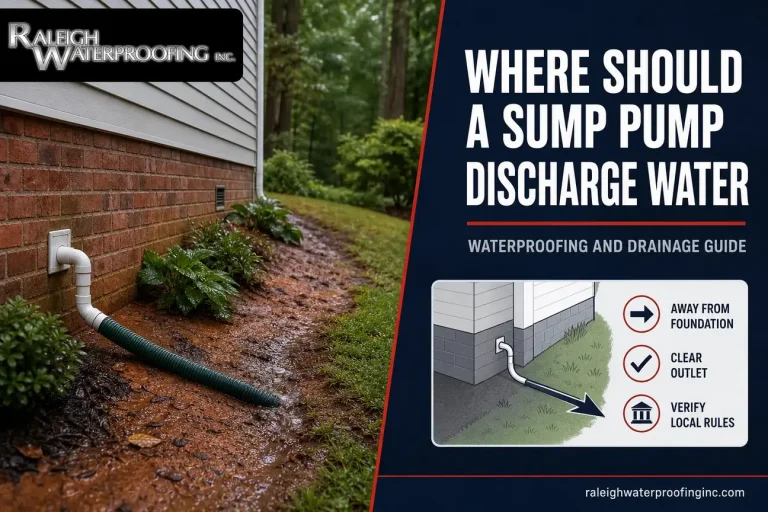
The evaluation should also consider outlets. A drain is only useful if water has a lawful, practical place to go. Discharge should not be directed onto a neighbor’s property, across a sidewalk, or into a sanitary sewer unless the connection is permitted. Property boundaries, grades, hardscape, landscaping, and local stormwater requirements can limit what is feasible.
This is where the phrase “waterproofing is only as good as its drainage” matters. A foundation coating, interior system, channel drain, or French drain can be the wrong answer if the main water path is not understood. The evaluation should match the repair to the water source and the outlet, not just the puddle.
Which evaluated response fits water pooling foundation conditions?
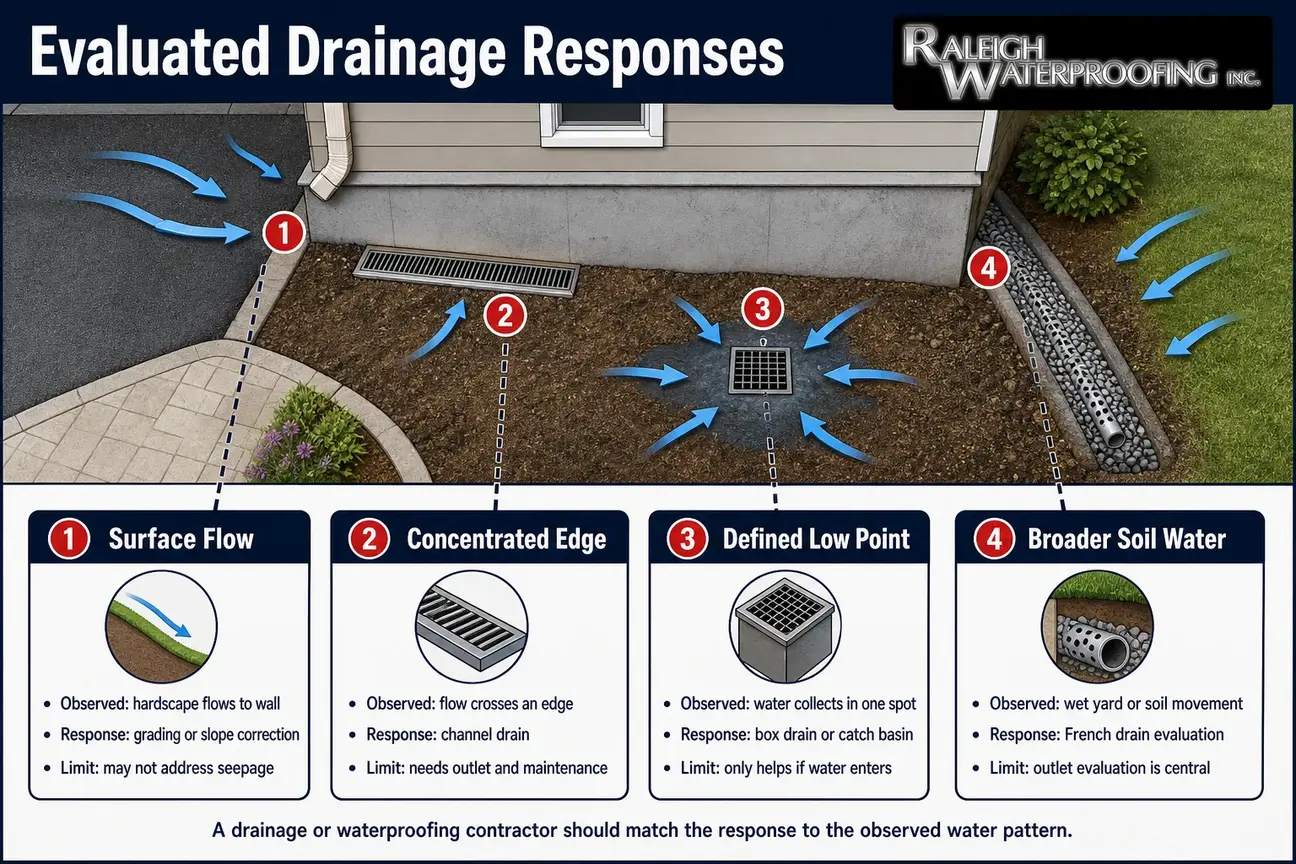
Different observations point toward different possible responses, but none should be selected from a photo alone. The following comparison shows how a drainage or waterproofing contractor may think through water collecting beside a foundation during an on-site evaluation.
| Observed condition | Possible evaluated response | Important limitation |
|---|---|---|
| Surface water flows from hardscape toward the foundation | Grading-related drainage or correction of hardscape slope | May not address groundwater or wall seepage |
| Concentrated flow crosses a driveway or patio edge | Channel drain | Requires proper elevation, outlet, and maintenance |
| Water collects in one defined low point | Box drain or catch basin | Captures surface water only where located and discharged correctly |
| Water moves through soil across a broader area | French drain or other subsurface drainage | Depends on soil, route, depth, utility conflicts, and outlet |
| Water reaches or penetrates the foundation wall | Foundation waterproofing, crack injection, or another foundation response | Depends on source, wall condition, crack behavior, and drainage |
| Water enters a basement or crawl space despite exterior collection | Interior drain system and possibly a sump station | Manages collected water but does not automatically correct exterior runoff |
Grading-related hardscape drainage
Grading-related hardscape drainage may be considered when water stays on the surface or is directed toward the home by slope, settlement, or a low edge. This may involve correcting soil transitions, redirecting surface flow, or addressing the relationship between pavement and grade. It should also account for the outlet, property boundaries, utilities, and existing structures.
Raleigh Waterproofing Inc. provides yard drainage solutions for surface water patterns such as low areas, hardscape runoff, and drainage around the home. The important first step is identifying whether the water is mainly surface runoff, subsurface water, or a combination.
Where a channel drain might fit
A channel drain may be considered when water concentrates along a hardscape line, such as a driveway apron, patio edge, or walkway crossing. The phrase channel drain often comes up when homeowners see a sheet of water moving across concrete and want to intercept it before it reaches the foundation.
A channel drain is not a cure-all. It needs the right elevation, enough capacity for the observed flow, a maintainable grate, and a suitable discharge point. Leaves, sediment, and debris can reduce performance if the drain is not maintained. It also captures surface water; it does not automatically solve subsurface seepage, wall cracks, or water already moving through soil.
In a driveway runoff situation, a channel drain may be one evaluated option if the low line is clear and water can be carried away appropriately. If the water is coming through soil or appearing inside later, other responses may need to be considered.
Box drains and low-point collection
A box drain or catch basin may be considered where water collects at a defined low point. This can be a low corner of a patio, a depression beside a walkway, or a spot where hardscape and soil meet. The drain only helps if water can enter it and be discharged to a suitable location.
Box drains are often surface-water tools. They do not automatically lower groundwater, repair a foundation crack, or resolve water that is moving through saturated soil below the surface. They are most useful when the evaluation confirms a clear collection point and an acceptable outlet.
French drains for broader soil movement
French drains may be considered when water is moving through soil or across a broader yard area rather than only across the hardscape surface. If walkway drainage sends water into a side yard and the soil stays wet, a French drain may be evaluated along with grading, outlets, utilities, and foundation conditions.
PNNL / Building America guidance on drain and sump systems describes drainage components that direct water away from foundations and notes that outlets may include daylight, drywell, permitted storm sewer connection, or sump discharge depending on the installation and local requirements. That makes outlet evaluation central to any French drain installation.
A French drain is not automatically the right response to every hardscape drainage problem. If the main issue is water flowing across the top of a driveway, a surface collection approach may be more relevant. If water is reaching the foundation wall, subsurface drainage may need to be considered with waterproofing conditions.
Foundation waterproofing when water reaches the wall
Foundation waterproofing may be evaluated when water is reaching the foundation wall, when exterior wall drainage or waterproofing has failed, or when water is entering through the foundation. That does not mean every “patio slopes foundation” observation calls for exterior waterproofing. The water source, wall condition, depth, access, existing drains, and interior evidence all matter.
Raleigh Waterproofing Inc.’s described exterior re-waterproofing method includes excavating to the footer, cleaning and parging the wall, applying the Tuff-N-Dry system, installing a foundation drain daylighted away from the house, backfilling, and restoring landscaping. That type of work is evaluated when foundation-wall conditions call for it; it should not be chosen solely because a puddle appears outside.
Interior drains, sump stations, and water intrusion repair
An interior drain system may be evaluated when water reaches the basement or crawl-space interior, especially where exterior collection is not practical or does not address the whole condition. A sump station may be part of an interior drainage approach when collected water needs to be pumped away.
Interior systems manage water that reaches the interior perimeter. They do not automatically correct driveway runoff, patio runoff, downspouts, or grading outside. If the hardscape is still sending water toward the foundation, the exterior pattern remains part of the diagnosis.
For general water entry where the source is not obvious, water intrusion repair starts with determining how water is getting in and what conditions are contributing. That may involve exterior drainage, foundation work, interior drainage, or referral to another professional if the source is plumbing or structural movement.
What is especially relevant around Raleigh, Cary, and the Triangle?
Local conditions can affect how long water stays beside a foundation. In the Raleigh area, many homes sit on Piedmont soils that may drain slowly, and newer construction can include compacted fill around the foundation. Heavy summer thunderstorms and tropical-storm rainfall can also reveal drainage paths that are not obvious during light rain.
NC State Extension’s soil guidance notes that soil texture, compaction, and organic matter affect how soil supports plant growth and handles water around a home. For a homeowner in Cary or elsewhere in the Triangle, that means a hardscape problem may be tied to the surrounding soil, not just the concrete or pavers.
Crawl-space homes add another clue. Water may collect beside a foundation, then show up as damp soil, water under a vapor barrier, musty odors, or moisture around a crawl-space perimeter. If mold is a concern, the practical priority is moisture control first; Raleigh Waterproofing Inc. does not provide mold testing or remediation, and moisture control should be handled separately from health claims.
Local stormwater rules and discharge paths also matter. Some properties have limited fall to daylight, neighboring lots close by, sidewalks, streets, or existing drainage infrastructure. A hardscape drainage plan must respect those limits rather than simply moving water to another problem area.
How much does repair depend on access, outlet, and scope?
Cost should not be guessed from a photo, and no reliable article can price a drainage or waterproofing repair without seeing the property. The main drivers include access, wall length, depth, hardscape removal or replacement, landscaping restoration, outlet location, utilities, interior finishes, and whether the work is surface drainage, subsurface drainage, foundation waterproofing, or interior water management.
A small surface collection point can be very different from a long drainage route with limited fall. A channel drain at a driveway edge is different from excavation along a foundation wall. A French drain through a side yard is different from an interior perimeter drain. The right scope follows the diagnosis.
Permits and local requirements may also affect planning. Excavation work can involve jurisdiction-specific requirements, and discharge rules should be confirmed before routing collected water. Any project involving digging should begin with utility locating and safe excavation planning, not guesswork.
When should a homeowner request an evaluation?
Request an evaluation when water repeatedly reaches the foundation, when the pattern began after hardscape installation or settlement, or when the source remains unclear after you document rainfall patterns. It is also time to ask for help when water enters a basement or crawl space, a crack or wall-floor joint becomes damp after rain, erosion removes soil beside the slab, or driveway runoff appears to discharge toward the house.
If you are in the greater Raleigh area and want the pattern evaluated before choosing a repair, you can request a free estimate from Raleigh Waterproofing Inc. You can also call 919-877-9969, email [email protected], or contact Raleigh Waterproofing. The goal is not to sell one system for every property; it is to diagnose the water source before choosing a repair.
What should you avoid doing before the evaluation?
Avoid sealing over the symptom without understanding the source. Waterproof paint, surface caulk, or extra mulch may hide a clue while water continues to move along the same path. Avoid digging beside the foundation, cutting concrete, or adding drains without knowing the outlet and utility locations.
Avoid assuming that one visible puddle proves the hardscape is the only cause. Water pooling foundation conditions can involve several sources at once. A patio may direct runoff toward the wall, while a downspout adds water, compacted soil slows drainage, and a foundation crack becomes the entry point.
Also avoid directing water toward a neighbor’s property, across a sidewalk, or into an unapproved connection. Drainage should move water to a suitable location, and local stormwater rules may affect what is allowed. A repair that simply relocates water can create a new problem.
Bottom line for hardscape-related water pooling
Hardscaping can absolutely change drainage. A driveway, patio, walkway, porch slab, or settled edge can redirect surface runoff toward a foundation, create low spots, and concentrate flow where water should not collect. PNNL / Building America guidance supports keeping hard surfaces and final grade sloped away from the house, and considering appropriate drainage where surfaces slope toward the foundation.
Still, the visible low spot is a clue, not a final diagnosis. Water may be coming from hardscape slope, roof runoff, soil saturation, a foundation drainage issue, subsurface flow, plumbing, or a combination. The most reliable next step is to document the pattern safely and have the property evaluated before selecting yard drainage, a channel drain, a box drain, French drains, foundation waterproofing, interior drainage, or another response.
General homeowner information. The right waterproofing or drainage solution depends on an on-site evaluation of the property.
Frequently Asked Questions
Can a new driveway cause water to pool beside the foundation?
Yes, a new driveway can redirect surface runoff if its slope, edge, or connection to surrounding grade sends water toward the house. The driveway may be one contributing factor rather than the only cause, so downspouts, soil, foundation conditions, and interior symptoms should also be checked.
How can I tell whether a patio is sloping toward the foundation?
Observe the direction of runoff during rain from a safe location. Document low areas, standing water, settlement, separated joints, and erosion. A reliable repair decision still requires checking the whole drainage pattern and the available outlet on site.
Is a channel drain better than a French drain for patio or driveway runoff?
A channel drain is generally considered for concentrated surface flow along a hardscape. A French drain may be considered for water moving through soil or a broader yard area. Neither should be selected without evaluating elevations, soil, outlet, utilities, and the foundation.
Does pooling beside the foundation mean the foundation needs waterproofing?
Not necessarily. Pooling may reflect grading, hardscape settlement, erosion, downspout discharge, saturated soil, or another drainage condition. Foundation waterproofing is one possible evaluated response when the foundation itself is receiving or admitting water.
What should I photograph before requesting an evaluation?
Photograph the hardscape, low edges, flow direction during rain, downspouts, erosion, standing water, and any interior dampness. Include timing notes, such as whether the water appears during rain, shortly afterward, or remains long after the storm ends.
Can a French drain solve water beside a foundation?
It may help in some site conditions, but the result depends on where water is moving, the soil, grade, route, outlet, and relationship to the foundation. A French drain is not automatically the correct response to every hardscape-related pooling pattern.
Should I dig beside the foundation to inspect the problem?
No. Foundation excavation and trench work involve utility and safety risks. Call NC 811 before any digging, and never enter an unshored trench. If water appears to involve plumbing or sewer lines, contact a plumber for that portion of the evaluation.
Sources
- PNNL / Building America Solution Center: Water Management of Existing Crawlspace Floor
- PNNL / Building America Solution Center: Site Drainage Practices to Minimize Localized Flooding
- PNNL / Building America Solution Center: Drain or Sump Pump Installed in Basements or Crawlspaces
- NC State Extension: Modifying Soil for Plant Growth Around Your Home
- NC 811