Is Raleigh yard flooding caused by public stormwater or private drainage?
Raleigh yard flooding can come from public-street runoff, public property, private grading, roof and downspout discharge, a neighboring lot, saturated soil, or a drainage feature on the property. The key is to watch where water starts, which way it moves, how long it remains, and whether it reaches the foundation, crawl space, basement, window wells, doors, or sump area.
Quick Answer: If water clearly crosses from a public street, curb, sidewalk, ditch, or public property, review the City’s drainage guidance and document the pattern before contacting Raleigh stormwater. If the water begins at a downspout, low yard area, driveway, patio, private swale, or the grade beside the house, a private drainage evaluation is usually the more relevant next step. Either way, do not choose a French drain, box drain, channel drain, grading change, or waterproofing repair until the water source is evaluated on site.
Raleigh yard flooding: 7 clues that separate public runoff from private drainage
Flooding in the lowest spot of the lawn is not always the true source. Water often travels across hard surfaces, compacted fill, swales, mulch beds, and foundation backfill before it becomes visible. Treat the low spot as a clue, not a diagnosis.
These seven clues help sort the pattern before you decide whether to call the City, document a neighbor-to-neighbor concern, or request a private drainage and waterproofing evaluation:
- Starting point: Does water first appear at the street, curb, ditch, sidewalk, downspout, driveway, patio, roof valley, swale, or property line?
- Direction: Does the flow move toward the house, away from the house, along the side yard, or across the property from a public area?
- Timing: Does the problem happen only during intense storms, or does it appear during ordinary rainfall too?
- Duration: Does standing water drain soon after the rain stops, or does it remain long after nearby areas have cleared?
- Foundation contact: Does water touch the foundation, crawl-space access, basement stairs, window wells, garage slab, or doors?
- Inside symptoms: Does seepage, dampness, a musty crawl space, water under a vapor barrier, or sump pump activity occur at the same time?
- Public infrastructure: Is a public inlet, curb opening, drainage structure, or pipe visibly blocked, overwhelmed, or backing up?
Those clues do not prove responsibility or identify the repair by themselves. They simply help you describe the condition accurately. A waterproofing problem diagnosis looks at the water path, elevation, soil, outlet options, and symptoms inside or under the house before recommending work.
When is public stormwater Raleigh a clue near streets, curbs, and public property?
A possible public stormwater Raleigh issue is worth investigating when the water appears to originate from a public street, public right-of-way, public drainage structure, or public property before entering your yard. Common clues include a sheet of water crossing the curb, water flowing down a sidewalk or street edge and then onto the lawn, a public inlet that appears clogged during rain, or a consistent path from a public ditch or drainage feature.
The City of Raleigh Drainage Assistance page says the program funds drainage projects intended to reduce stormwater runoff coming from public streets, and its listed program requirements include property in Raleigh, stormwater runoff from public streets or public property onto the property, and willingness to donate a permanent drainage easement. Those are City program criteria, not a private contractor’s determination.
That distinction matters. Public-runoff observations can support a call to the City, but they do not automatically establish eligibility, project scope, timing, legal responsibility, or whether the City will approve work. The property owner’s role is to document the condition clearly and contact the proper public stormwater office when the evidence points to a public source.
If a public storm drain or pipe appears clogged, document it from a safe location. Do not remove covers, enter structures, stand in moving water, or attempt to modify public drainage features. Public systems are not private yard-drainage projects, and Raleigh Waterproofing Inc. does not handle public infrastructure.
When does private drainage Raleigh fit the pattern around the house and yard?
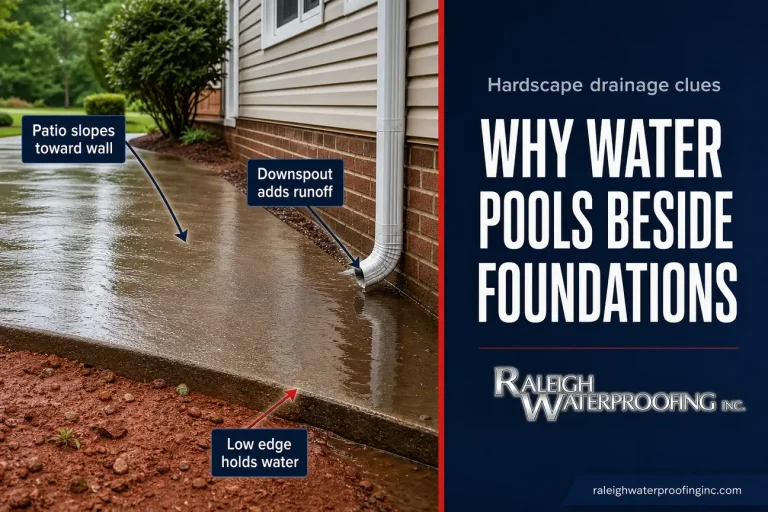
A private drainage Raleigh concern is more likely when water begins on the lot itself or on nearby private property. That can include downspouts dumping beside the foundation, a driveway sloping toward the house, patio runoff moving toward a back door, a low side yard that traps water, a private swale that has filled with sediment, or grading that has settled since construction.
The Building America Solution Center site drainage guidance says to grade the site to control stormwater runoff on site and help prevent soil saturation around the foundation, and it states that surfaces should slope away from the house. That is useful general guidance, but it is not a site-specific design for every yard.
In a private drainage Raleigh evaluation, the question is not simply “Where is the puddle?” The better question is, “What is feeding this puddle, where can it safely discharge, and is the water also affecting the foundation or crawl space?” A low area may be collecting roof runoff, runoff that has already crossed a private driveway, water from a higher private lot, or groundwater rising into already-saturated soil.
Private fixes depend on access, elevation, discharge location, buried utilities, soil, hardscape, landscaping, and the relationship between surface water and the structure. A yard drainage solution may involve a surface-drainage approach, box drains, channel drains, grading-related work, or another method, but the right choice depends on the actual water path.
yard flooding after rain: what to watch during the storm
Yard flooding after rain is easiest to understand if you observe it while the water is still moving. A dry-day inspection may show stains, silt, mulch movement, or erosion, but it may not reveal the true flow direction. During active rainfall, stay in a safe location and look for the first visible movement of water.
Start with the street and curb. If runoff is flowing across the curb, down a sidewalk, or out of a public drainage area, you may be seeing a public stormwater Raleigh pattern. Then look at the house side of the property. If the wet area begins at a downspout, patio edge, driveway, roof valley, or mulch bed, the pattern may fit a private drainage Raleigh concern instead.
Next, compare storm intensity. If flooding appears only during unusually heavy rain, the outlet may be overwhelmed for a short period. If standing water appears after ordinary rainfall, that can point toward grading, downspout discharge, clogged private drains, compacted soil, or a low area that cannot drain well. Yard flooding after rain that remains long after nearby areas have drained deserves closer attention, especially if the water sits against the house.
Watch whether the water is clean sheet flow, concentrated flow, bubbling up from a drain, spilling from an underground pipe outlet, or backing up from an inlet. A street runoff yard pattern may begin at the curb but then be redirected by a driveway, walkway, edging, or landscaping. That is why photos and videos should show the whole path, not only the deepest puddle.
What street runoff yard signs should be documented carefully?
A street runoff yard concern usually has a repeatable path. Water may cross the curb at the same point, follow the driveway apron, run along the sidewalk, enter a front swale, or jump a clogged curb inlet during heavier rain. It may leave sediment, leaves, trash, or erosion along a narrow route from the public edge of the property toward the yard.
Do not assume every street runoff yard pattern is automatically a City-approved project. Public runoff may be one part of the picture while private grading, roof discharge, a blocked private pipe, or low foundation backfill makes the problem worse. Document the public-to-private transition carefully so the City or a private evaluator can see what is happening.
Helpful photos include a wide shot from the street toward the house, a second view from the house toward the street, and close images of the curb, inlet, ditch, sidewalk, property line, driveway apron, and the area where water enters the yard. If water moves quickly, a short video can show direction and speed better than a still photo.
If the street runoff yard path reaches the foundation, crawl-space access, basement stairs, window well, or garage opening, treat that as more than a lawn nuisance. The yard condition may be tied to water intrusion or crawl-space moisture, even though the visible indoor entry point may be somewhere else.
Could roof runoff or downspouts mimic a bigger drainage problem?
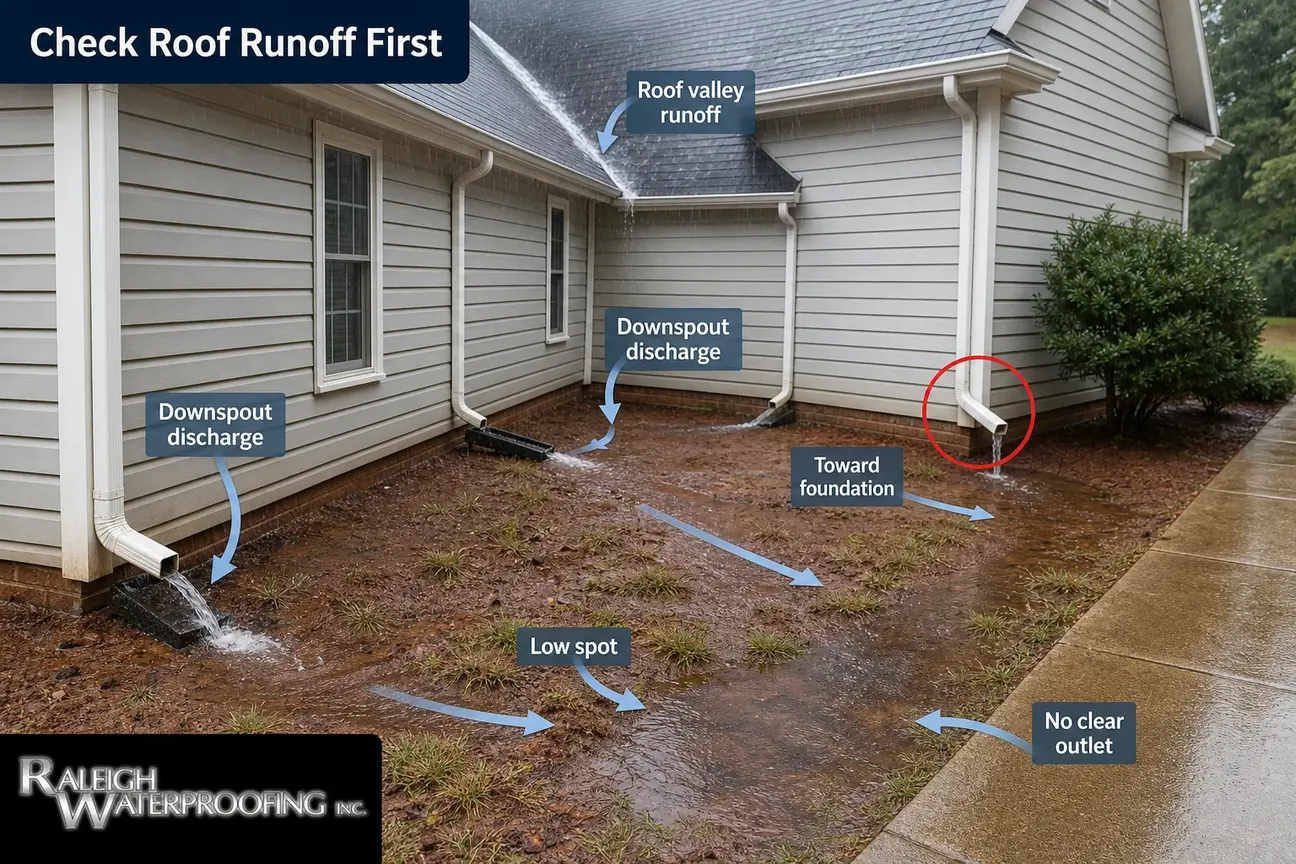
Yes. Roof runoff can look like general yard flooding when several downspouts discharge into the same low side yard, when extensions are missing or too short, or when underground downspout piping is clogged or poorly routed. Water can appear to come from “the yard” even though much of it began on the roof.
During rain, check whether the first ponding appears below a downspout, at the end of an extension, below a roof valley, beside a porch, or near a splash block. Also watch whether water from the roof is being sent toward the foundation, across a sidewalk, toward a neighboring property, or into a low spot with no clear outlet.
Gutters and downspouts should be considered before assuming the source is public stormwater or groundwater. That does not mean every downspout issue requires the same fix. It means roof discharge, grading, soil saturation, and the available outlet all need to be considered together.
Never route water onto a neighbor’s property, into the sanitary sewer, or across a sidewalk. Discharge locations may be limited by local requirements, property slope, existing drainage, and available outlets. If a private drain is involved, its condition and destination matter as much as its location.
What should you observe and record before calling anyone?
A good drainage record helps everyone. It helps the City understand a possible public stormwater Raleigh concern, and it helps a contractor evaluate private drainage Raleigh conditions without relying only on a dry-day snapshot. The goal is not to prove a legal conclusion. The goal is to show the pattern clearly.
| Observation | What it may suggest | What it cannot prove |
|---|---|---|
| Water crosses from a street, curb, sidewalk, ditch, or public property | Possible public runoff or a public-system capacity or blockage issue | City eligibility, legal responsibility, or approved project scope |
| Water begins at a downspout, roof valley, or extension outlet | Concentrated roof runoff near the house | That the downspout is the only source |
| Water flows from a higher private lot | Neighboring runoff, grading, or private drainage influence | A legal violation or the correct repair |
| Water ponds at the foundation | Grade, roof runoff, soil saturation, footing drainage, or surface-drainage issue | That exterior waterproofing or an interior system is automatically required |
| Water appears inside after yard ponding | Possible connection between surface water and foundation or crawl-space conditions | The exact entry path or source without evaluation |
| Standing water remains after nearby yards have drained | Low area, compacted soil, limited outlet, or drainage restriction | That a specific drain type will solve it |
For each event, record the approximate start time of rainfall, whether it was ordinary rain or a severe storm, where water first appeared, the flow direction, how long ponding lasted after rain stopped, and whether similar flooding appeared on nearby properties or public areas. Yard flooding after rain that repeats across several storms is more useful to document than a single isolated puddle.
What should you photograph and video?
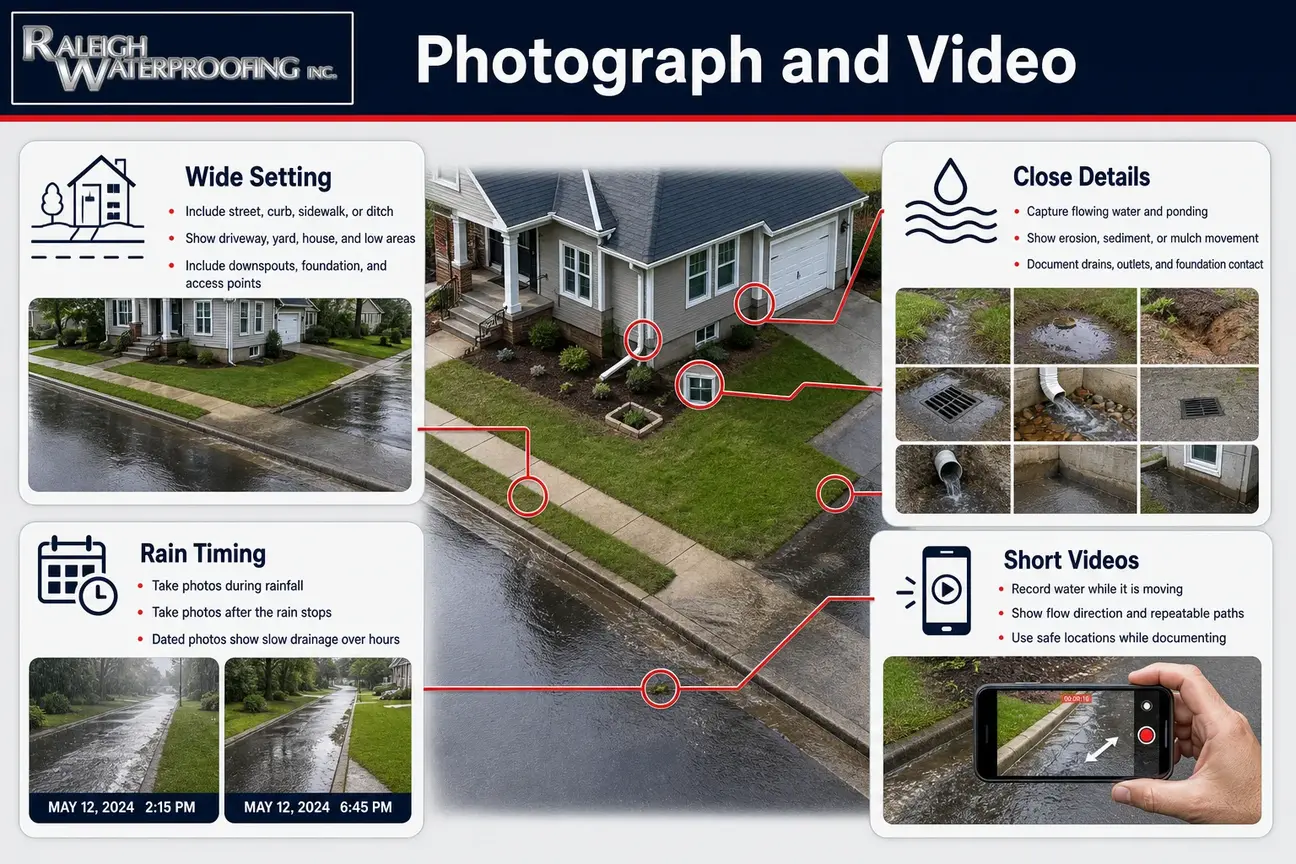
Photograph the broad setting first. Include the street, curb, sidewalk, ditch or inlet if present, driveway, property line, yard, house, downspouts, foundation, crawl-space access, basement stairs, window wells, doors, and low areas. Wide photos show relationships that close photos miss.
Then take close photos of flowing water, ponding, erosion, sediment, mulch movement, blocked inlets, downspout discharge, low spots, surface drains, pipe outlets, and water touching the foundation. Take photos during rainfall and again after the rain stops. If yard flooding after rain remains for several hours, a series of dated photos can show how slowly the area drains.
Short videos are especially helpful when water is moving. Pan slowly from the suspected source to the collection area. If the condition looks like a street runoff yard issue, show the public edge and the point where water enters private property. If it looks like a private drainage Raleigh issue, show the downspout, hardscape, slope, and low area in one continuous view if possible.
Do not enter floodwater, approach electrical equipment, step into unstable soil, open public drainage structures, or inspect a flooded basement where wiring or equipment may be energized. Safe documentation from a distance is better than a risky close-up.
When does yard water become a foundation, basement, or crawl-space concern?
Yard water becomes a building concern when it repeatedly reaches the foundation, enters window wells or basement stairs, flows toward crawl-space access, or coincides with interior dampness. The surface puddle may be outside, but the water source, pressure, or drainage restriction can affect below-grade areas.
Waterproofing is only as good as its drainage. If the ground beside a foundation stays saturated, water may exploit cracks, cold joints, wall penetrations, porous masonry, gaps around openings, or the wall-floor area. If water enters below grade, foundation waterproofing, interior drainage, or a sump station may be discussed only after the source and entry conditions are evaluated.
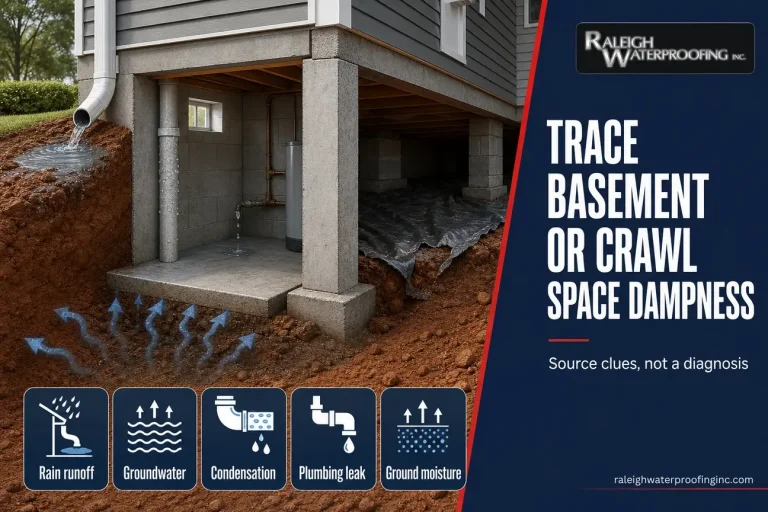
Crawl spaces need the same source-first thinking. Water under a vapor barrier, damp soil, musty conditions, or wet perimeter areas may be tied to grading, roof discharge, groundwater, poor exterior drainage, or another cause. The evaluation should separate bulk water from ground moisture, then consider whether drainage, vapor barrier work, encapsulation, or sealing fits the conditions.
If the issue is a damp or wet crawl space, a crawl space repair evaluation may consider bulk water, ground moisture, ventilation or sealing conditions, a vapor barrier, drainage, and access. Crawl-space encapsulation, a sealed crawl space, and a vapor barrier are not interchangeable fixes; they address different conditions and may have different permit considerations.
Call a structural engineer for bowing, displacement, widening cracks, settlement, or movement that appears structural. Call a plumber for suspected supply, sewer, or septic leaks. A drainage contractor should not diagnose those issues remotely from a puddle or photo.
How does Raleigh’s Drainage Assistance Program differ from private work?
The City program is aimed at a narrow public-runoff situation, while a private evaluation looks at water behavior on and around the property. This is the central distinction for homeowners comparing public stormwater Raleigh with private drainage Raleigh.
According to the City’s Drainage Assistance page, the program requirements include property in Raleigh, stormwater runoff coming from public streets or public property onto the applicant’s property, and willingness to donate a permanent drainage easement. A permanent drainage easement is a property-rights issue, so homeowners should read the City information carefully and ask the City questions before assuming the program is the right path.
The same City page also separately identifies issues such as nuisance yard flooding, standing water, landscaping or grading drainage problems, adjacent private property runoff, and roof or gutter problems. Those conditions should not be presented as automatic public drainage projects. They may belong in a private drainage evaluation, a neighbor discussion, a roofing or gutter correction, or another pathway depending on the source.
Raleigh Waterproofing Inc. can help evaluate private water concerns tied to yard drainage, foundation seepage, crawl-space moisture, water intrusion, or related drainage conditions. It does not evaluate, approve, repair, or control City stormwater infrastructure. If your evidence points to a public drain, public pipe, or public-street runoff, contact the appropriate City stormwater resource.
public stormwater Raleigh versus private drainage Raleigh: what are the next steps?
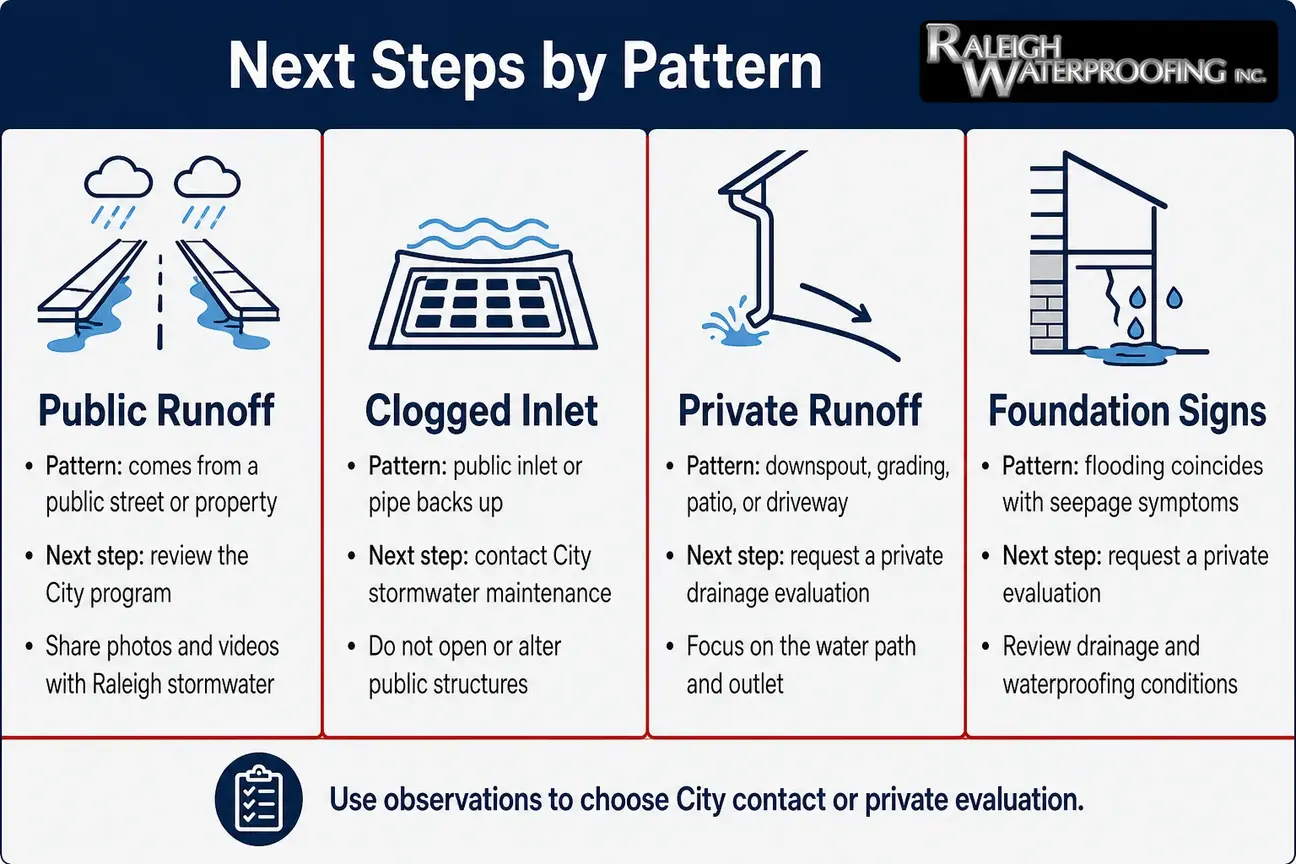
The next step depends on what your observations show. Use this table as a practical sorting tool, not a legal conclusion and not a promise of any particular repair.
| Situation | Appropriate next step |
|---|---|
| Runoff appears to come from a public street or public property | Review the City program and contact Raleigh stormwater with photos and videos |
| A public stormwater inlet or pipe appears clogged or backing up | Contact City stormwater maintenance; do not open or alter public structures |
| Downspout, grading, low spot, patio, driveway, or private runoff appears to feed the flooding | Request a private drainage evaluation focused on the water path and outlet |
| Yard flooding after rain coincides with foundation seepage | Evaluate surface drainage and foundation water entry together |
| Wet or musty crawl space appears after storms | Evaluate bulk water, ground moisture, drainage, vapor barrier conditions, and crawl-space moisture control |
| Movement, bowing, widening cracks, displacement, or settlement is visible | Contact a structural engineer |
| Supply, sewer, or septic leak is suspected | Contact the appropriate plumbing or septic professional |
If your notes point toward private drainage Raleigh and the water is affecting the house, Raleigh Waterproofing can evaluate the exterior and interior symptoms together. Homeowners in the greater Raleigh area can request a free estimate, call 919-877-9969, or email [email protected]. Areas outside the Triangle may require a trip fee, and the appropriate solution depends on the on-site findings.
Which private drainage or waterproofing fix might be considered?
No single system fits every yard. A French drain, box drain, channel drain, grading correction, catch basin, sump station, crack injection, exterior waterproofing, or crawl-space moisture-control approach should be matched to the source, elevation, outlet, soil, and structure. Choosing the system before confirming the water path can miss the cause.
For surface ponding or concentrated flow in a lawn or hardscape area, drainage work may be considered. Box drains or channel drains can be relevant in certain surface-water situations, while French drains may be discussed where subsurface collection and a usable discharge point make sense. Those are possible categories, not automatic recommendations.
If water is collecting at a below-grade wall, the evaluation may consider whether the exterior foundation drainage, wall waterproofing, or footing conditions are involved. If water is entering at or below the basement level, basement waterproofing, an interior drain system, or a sump station may be discussed depending on where water appears and where it can be discharged.
If a crack leaks, foundation crack injection may be relevant only after the crack and the water source are evaluated. If the wall is bowing, displaced, widening, or showing settlement concerns, that is a structural-engineer question before a waterproofing repair is selected.
If the crawl space is damp or has water beneath a vapor barrier, the evaluation may consider exterior runoff, ground moisture, bulk water, vapor barrier condition, crawl-space access, and whether encapsulation or sealing is appropriate. Closed crawl-space work can carry permit requirements, so it should not be treated as a simple cosmetic upgrade.
What happens during an on-site drainage evaluation?
An on-site evaluation starts with your observations. Photos, videos, rainfall dates, duration of standing water, and notes about interior symptoms help narrow the inspection. The evaluator may look at the street edge, curb, driveway, sidewalks, patios, downspouts, grading, low areas, swales, existing drains, foundation, crawl-space access, basement conditions, sump area, and available discharge points where safely accessible.
The goal is to separate the visible entry point from the likely source. For example, water at a basement crack may begin as roof runoff that saturates the soil near the foundation. A soggy side yard may be fed by a downspout and a driveway slope. A street runoff yard path may be visible at the curb but made worse by private grading near the house.
Cost is driven by conditions, not a generic price list. Important drivers include access, depth, wall length, soil, existing utilities, interior finishes, outlet location, landscaping or hardscape restoration, drainage length, sump requirements, and whether foundation, basement, crawl-space, or yard work must be coordinated. A careful evaluation explains those drivers without promising a one-size-fits-all system.
Raleigh Waterproofing Inc. has served homeowners since 2001 and focuses on diagnosing the water source before choosing a repair. That diagnosis-first approach is especially important when the same storm produces lawn ponding, foundation dampness, and crawl-space symptoms.
What safety and permit issues should homeowners know?
Do not enter a flooded basement if there may be energized wiring, outlets, appliances, panels, or equipment in or near the water. Do not stand in moving runoff, inspect unstable ground, open public stormwater structures, or climb into a drainage pipe. Drainage diagnosis should not put the homeowner at risk.
Before any digging for a private drainage project, contact NC 811 so underground utilities can be marked. Do not work in an unshored trench or attempt excavation work beyond safe homeowner observation. Drainage work often involves buried utilities, slopes, and discharge questions that need proper planning.
Permits and drainage-discharge rules vary by jurisdiction and project type. Excavation and drainage requirements should be confirmed with the applicable building department. For crawl spaces, the North Carolina Office of the State Fire Marshal closed crawl space interpretation states that a permit is required to convert a conventional crawl space to a closed crawl space regardless of cost.
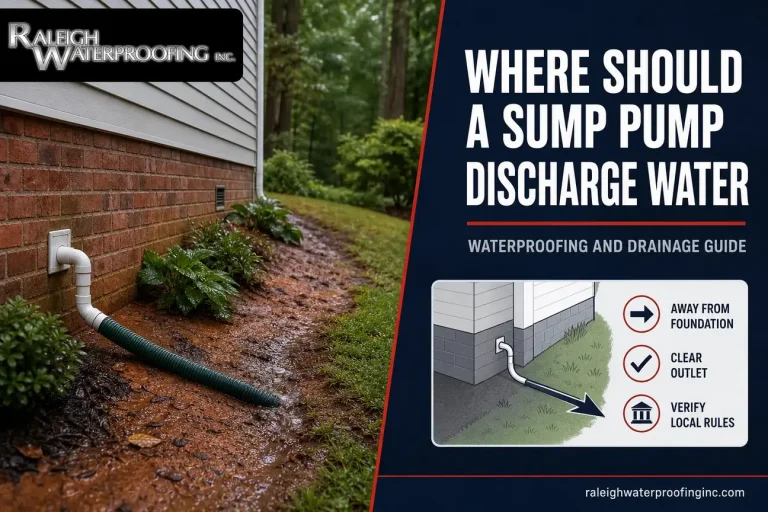
Discharge location matters. Water should not be directed onto a neighbor’s property, into the sanitary sewer, across a sidewalk, or into an unauthorized location. A private drainage Raleigh plan should consider where water can legally and practically go after it is collected.
When should you request a private evaluation?
Request an evaluation when flooding repeats after ordinary rainfall, when water reaches the foundation, when the yard stays wet long after surrounding areas drain, or when exterior flooding coincides with basement, crawl-space, vapor-barrier, or sump symptoms. The more repeatable the pattern, the more important it is to trace the source instead of guessing.
A private evaluation is also useful when you are comparing possible fixes. If you are unsure whether a French drain, box drain, channel drain, grading correction, exterior waterproofing, interior drainage, sump station, crack injection, vapor barrier, or crawl-space work is appropriate, the site conditions should decide the recommendation.
In the North Carolina Piedmont, slow-draining clay subsoils and compacted fill around newer homes can make surface drainage and foundation moisture harder to separate. NC State Extension’s soil guidance for areas around homes explains that clayey soils drain more slowly than sandy soils, which is one reason a dry-day photo rarely tells the whole story.
If your documentation points to public stormwater Raleigh, start with the City. If it points to private drainage Raleigh or the source remains unclear and the home is affected, Raleigh Waterproofing can evaluate private-property drainage and waterproofing concerns. For homeowners in the greater Raleigh area, request an estimate, call 919-877-9969, or email [email protected].
Raleigh yard flooding is best handled by tracing the source first, then matching the next step to the evidence. That may mean City drainage assistance, a private drainage evaluation, foundation waterproofing, crawl-space work, or another path based on the on-site findings.
General homeowner information. The right waterproofing or drainage solution depends on an on-site evaluation of the property.
Frequently Asked Questions
Does yard flooding qualify for Raleigh’s Drainage Assistance Program?
Not automatically. The City program has specific requirements tied to runoff from public streets or public property, property location, and a permanent drainage easement. Nuisance yard flooding, roof runoff, grading problems, or runoff from adjacent private property may need a different path.
How can I tell if runoff is coming from the street or my own property?
Watch the first place water appears during rainfall. Water crossing from a curb, sidewalk, public ditch, or public property points toward a possible public runoff concern. Water beginning at a downspout, driveway, patio, low spot, private swale, or foundation grade points more toward private drainage, though an on-site evaluation may still be needed.
Should I install a French drain for a flooded yard?
Maybe, but not before the source, slope, soil, outlet, and water path are evaluated. A French drain is only one possible approach. Some sites involve surface drains, box drains, channel drains, grading-related work, foundation waterproofing, interior drainage, sump equipment, or crawl-space moisture control instead.
What photos are most helpful before a drainage evaluation?
Take wide photos that show the street, curb, yard, house, driveway, downspouts, property line, and low areas. Also take close photos of flowing water, ponding, erosion, blocked inlets, downspout discharge, water touching the foundation, and any basement or crawl-space symptoms. Short videos showing flow direction are often helpful.
Can Raleigh Waterproofing Inc. fix public stormwater infrastructure?
No. Public stormwater infrastructure belongs with the appropriate public authority. Raleigh Waterproofing Inc. evaluates private-property drainage, waterproofing, water intrusion, foundation, basement, and crawl-space water concerns. If the evidence points to a public drain, public pipe, or public-street runoff, contact the City.
When is yard flooding a foundation or crawl-space concern?
It becomes more concerning when water repeatedly reaches the foundation, basement stairs, window wells, doors, crawl-space access, or garage slab, or when exterior flooding coincides with seepage, damp crawl-space conditions, water under a vapor barrier, or increased sump activity. The outside puddle may be only one clue in a larger water-source pattern.
What if a neighbor’s yard seems to send water onto mine?
Document the pattern with dated photos and videos from your property, including where the water appears to enter and how it moves. A private drainage evaluation can help identify grading and water-path conditions, but it should not be treated as a legal ruling about responsibility.