
Why Is There Water Under My Crawl Space Vapor Barrier?
Finding water underneath the plastic in your crawl space can be confusing—especially if the vapor barrier was installed specifically to help control moisture.
A crawl space vapor barrier primarily helps reduce moisture vapor moving upward from the soil. It is not automatically a drainage or waterproofing system for active liquid water.
The U.S. Environmental Protection Agency recommends covering exposed crawl-space soil to help control ground moisture while separately addressing leaks, seepage, drainage, groundwater and other liquid-water sources in its home moisture-control guidance.
If rainwater, groundwater, foundation seepage or another water source is entering the crawl space, plastic installed over the soil can sometimes make the problem more noticeable because water becomes trapped or visible beneath the liner.
That does not automatically mean the vapor barrier itself failed.
The more important question is:
Where is the water coming from, and why is it reaching the area beneath the vapor barrier?
For Raleigh-area homes, possible causes include exterior drainage problems, foundation water intrusion, groundwater, runoff toward the house, insufficient interior drainage or a sump system that is not receiving or removing the water effectively.
Raleigh Waterproofing Inc. provides water intrusion correction for properties where the source of unwanted water needs to be identified before the correct repair can be selected.
If you have water collecting underneath your crawl-space liner, call 919-877-9969 or contact Raleigh Waterproofing Inc. to have the water source evaluated before simply installing more plastic.
Is Water Under a Crawl Space Vapor Barrier Normal?
Some ground moisture beneath a vapor barrier is different from visible standing water.
Soil naturally contains moisture. One purpose of the vapor barrier is to reduce the amount of that moisture evaporating into the crawl-space air.
However, puddles, flowing water or significant accumulation beneath the liner can indicate that liquid water is reaching the crawl space.
Possible sources include:
- Surface runoff
- Foundation seepage
- Saturated soil
- Groundwater
- Downspout discharge
- Poor grading
- Drainage-system problems
- Water entering through foundation walls
- Water migrating beneath the liner from another location
- Plumbing or mechanical leaks
A liner can conceal where water first entered, so the puddle you see is not necessarily directly below the source.
What Does a Crawl Space Vapor Barrier Actually Do?
A vapor barrier helps reduce moisture vapor moving from exposed soil into the crawl-space environment.
Raleigh Waterproofing provides vapor barrier installation as part of its crawl-space moisture-management services.
The distinction between vapor and liquid water is important.
Ground Moisture Vapor
Moisture in the soil can evaporate upward into the crawl-space air.
A vapor barrier reduces that transfer.
Active Liquid Water
Rainwater, runoff, groundwater or foundation seepage physically enters or moves through the crawl space.
That usually requires identifying and managing the water pathway.
EPA's broader Moisture Control Guidance for Building Design, Construction and Maintenance treats site drainage, foundations, plumbing, condensation and other moisture pathways as separate issues that must be managed appropriately.
A vapor barrier can therefore be an important part of a crawl-space moisture-control system without being the entire water-management system.
Why Can Water Get Trapped Under the Plastic?
A vapor barrier covers the crawl-space soil.
If liquid water enters below or behind the liner, the plastic can reduce evaporation and make the accumulated water more visible.
You may notice:
- Puddles beneath clear or white liner
- Areas that feel like a waterbed when pressed
- Dark wet soil visible beneath plastic
- Water moving under the liner after rain
- Bubbles or raised sections of plastic
- Water concentrated along foundation walls
- Moisture appearing around piers
- Water collecting near seams or edges
The plastic may simply be revealing that water is present.
The repair should not begin with:
“How do we get the water off the plastic?”
It should begin with:
“How is the water getting underneath the plastic?”
What Are the Most Common Causes of Water Under a Crawl Space Liner?
Several different problems can create similar symptoms.
| What You Notice | Possible Cause | What It Does Not Prove |
|---|---|---|
| Water near an exterior foundation wall | Foundation seepage, runoff, saturated soil | Does not automatically mean the liner failed |
| Water appears after heavy rain | Exterior drainage or groundwater | Does not automatically mean a sump pump is required |
| Water beneath liner in one low area | Drainage path, groundwater or grading | Does not identify the original entry point |
| Water throughout much of crawl space | Significant water load or inadequate drainage | Does not automatically mean exterior excavation is needed |
| Water near plumbing | Plumbing or condensate source may be involved | Does not prove foundation waterproofing is needed |
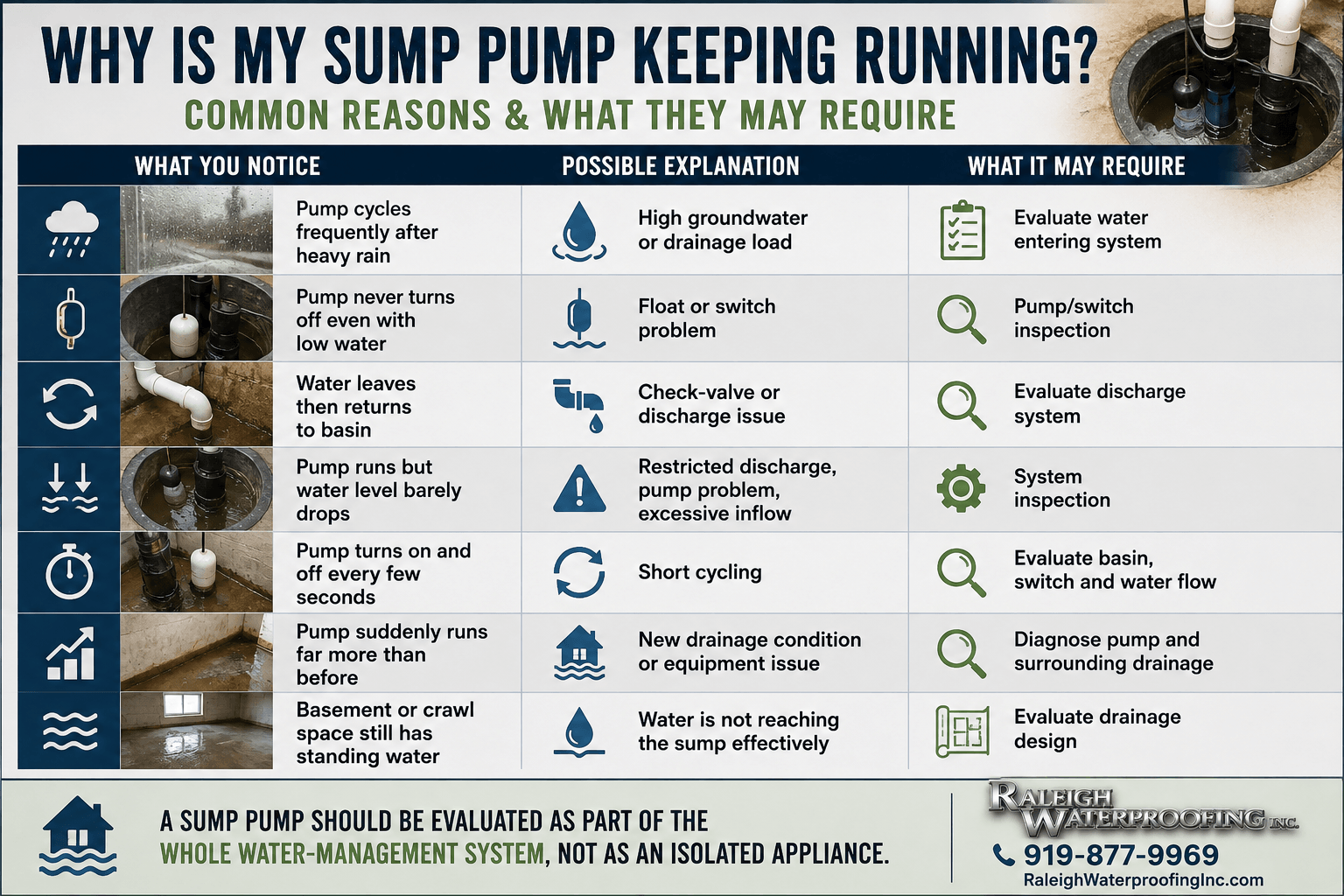
| Sump runs but water remains elsewhere | Water may not have a drainage path to basin | Does not necessarily mean the pump is defective |
| Moisture is on top of liner rather than below | Humidity or condensation may contribute | Does not prove groundwater intrusion |
The correct repair depends on identifying the actual water pathway.
Can Rainwater Get Under a Crawl Space Vapor Barrier?
Yes.
Heavy rainfall increases the amount of water moving across and through the soil surrounding a house.
The City of Raleigh provides dedicated drainage assistance information for flooding, erosion and stormwater concerns and distinguishes several private-property drainage issues, including grading, standing water and roof or gutter problems.
During storms, water can potentially reach the crawl space through:
- Foundation walls
- Foundation joints
- Wall penetrations
- Low exterior grades
- Areas receiving concentrated runoff
- Drainage pathways that cannot manage the water
- Other below-grade entry points
The rain may even stop before water becomes obvious inside because saturated soil can continue releasing water after the storm passes.
That makes the homeowner's observation:
“It only happens after a really heavy rain”
valuable diagnostic information.
Could Bad Grading Be Causing Water Under the Liner?
Possibly.
If portions of the property slope toward the house, runoff can become concentrated beside the crawl-space foundation instead of moving away.
Walk around the exterior and look for:
- Ground sloping toward the house
- Low areas beside foundation walls
- Standing water
- Erosion
- Mulch beds retaining water
- Patios draining toward the house
- Driveways directing runoff toward the foundation
- Downspouts terminating beside the house
The City of Raleigh notes that nuisance yard flooding, landscaping and grading problems, standing water and roof/gutter issues are among the private-property drainage conditions homeowners may need to address.
Correcting surface drainage can reduce the water load reaching a foundation in some situations.
But grading alone does not correct every groundwater or foundation-water problem.
Can Downspouts Cause Water Under a Vapor Barrier?
They can contribute.
Your roof collects a large amount of rainwater and concentrates it at the gutters and downspouts.
If downspouts release that water immediately beside the foundation, the amount of moisture entering the surrounding soil can increase significantly during storms.
When it rains, look at the discharge area and ask:
- Is water moving away from the house?
- Is it pooling beside the foundation?
- Is the ground directing it back toward the house?
- Is an underground drain backing up?
- Does runoff cross the affected foundation wall?
- Is the gutter overflowing?
A downspout problem may be relatively straightforward.
But if crawl-space water continues after surface runoff is managed, the property may have another drainage or waterproofing condition that needs diagnosis.
Could Groundwater Be Coming Up From Beneath the Crawl Space?
Yes.
Not all crawl-space water enters horizontally through a foundation wall.
Under some site conditions, water can move through saturated soil beneath the crawl space and collect in lower areas.
That distinction matters because waterproofing one visible foundation wall may not address water originating from below.
A contractor evaluating the condition may need to consider:
- Where the water first becomes visible
- Whether it follows rainfall
- Where the exterior grade sits
- Whether water appears around the perimeter or toward the center
- Whether an interior drainage system exists
- Whether water reaches the sump basin
- Where lower points on the property are located
The visible puddle does not prove where the water originated.
Why Is the Water Mostly Around the Foundation Walls?
That pattern can suggest water is reaching the crawl space near the perimeter.
Possible causes include:
- Exterior water against the foundation
- Foundation-wall penetration
- Failed or inadequate exterior waterproofing
- Water moving down a wall
- Perimeter drainage problems
- Concentrated surface runoff
If the water repeatedly begins near a foundation wall after rainfall, the exterior side of that foundation should be part of the investigation.
Raleigh Waterproofing's foundation waterproofing repair service addresses below-grade water problems when the diagnosed water pathway involves the foundation.
The solution could involve drainage, foundation waterproofing, interior collection or another method depending on what is found.
Does Water Under the Vapor Barrier Mean I Need a French Drain?
Not automatically.
A French drain is designed to collect and redirect water.
It can be appropriate when the diagnosed condition involves water that needs to be intercepted and moved toward a suitable discharge location.
Raleigh Waterproofing provides French drain installation when the site's drainage conditions support that type of solution.
But installing a French drain without understanding the source can result in a system that:
- Is installed in the wrong location
- Does not capture the problem water
- Has no effective discharge route
- Treats a symptom rather than the source
- Fails to address foundation seepage
The diagnosis should come before the drain design.
Do I Need an Interior Crawl Space Drain?
Possibly.
An interior perimeter drainage system can be considered when water enters near the foundation perimeter and needs a controlled route to a collection or discharge point.
A simplified water-management path might look like:
Without the collection portion of the system, a sump pump located in one area can remove only the water that physically reaches its basin.
This distinction matters.
You can have a fully functioning sump pump while standing water remains on the opposite side of the crawl space.
The pump cannot pull water across the crawl-space soil.
The water needs a drainage pathway.
Why Isn't My Sump Pump Removing the Water Under the Vapor Barrier?
Because a sump pump removes water only after that water reaches the sump basin.
If water is sitting beneath the liner on the opposite side of the crawl space, the pump may never receive it.
Possible causes include:
- No drainage pathway
- Crawl-space grade
- A drainage channel that does not connect to the sump
- Water entering beyond the collection area
- Basin location
- Drain obstruction
- Incoming water exceeding the system's ability to manage it
Replacing the pump may accomplish very little when the real problem is water collection rather than pumping capacity.
Raleigh Waterproofing provides sump station installation and service when a sump system is appropriate as part of the overall water-management design.
Should I Add Another Sump Pump?
Not until the water pathway is understood.
A second sump may be appropriate for some properties, but adding pumps without correcting water collection can create a more expensive system while wet areas remain.
Before installing another pump, answer:
- Where is the water entering?
- Where does it naturally flow?
- Is there an existing drainage system?
- Can the water reach the current sump?
- Is the current pump operating correctly?
- Where does the pump discharge?
- Is discharged water remaining away from the foundation?
- Is exterior drainage contributing to the water load?
The goal is not to install the greatest number of pumps.
It is to manage the water effectively.
Could the Vapor Barrier Itself Be Installed Incorrectly?
Possibly, but water underneath the liner does not prove poor installation.
Installation details still matter.
Potential problems can include:
- Torn material
- Open seams
- Gaps
- Poor wall termination
- Insufficient coverage
- Liner movement
- Material punctures
- Improper ground preparation
Those conditions can reduce the vapor barrier's ability to control ground moisture.
However, even a properly installed vapor barrier does not replace a drainage system when active liquid water is entering the crawl space.
Should I Replace the Vapor Barrier if Water Is Underneath It?
Not necessarily as the first step.
If the liner is torn, contaminated, badly installed or no longer serviceable, repair or replacement may eventually be appropriate.
But installing new plastic before correcting active water can result in the same problem appearing beneath the new material.
That reduces the chance of covering the same water problem with new material.
What If My Crawl Space Was Already Encapsulated?
An encapsulated crawl space can still experience an active-water problem.
Encapsulation and waterproofing should not automatically be treated as the same service.
A sealed liner can help control ground vapor and crawl-space environmental conditions, but water entering from the foundation, surrounding soil or another source still needs an appropriate drainage or waterproofing solution.
Look for:
- Liner lifting or bubbling
- Water movement beneath the liner
- Damp foundation walls
- Persistent musty odors
- Sump activity after storms
- Water showing at liner edges
- Wet areas around penetrations or piers
The response should address the water source rather than simply resealing the visible liner.
Can I Just Pump the Water Out From Under the Plastic?
Removing accumulated water may be necessary, but pumping it out does not explain why it arrived.
If the source remains active, the same condition may return after the next heavy rain.
Think of pumping the water out as handling the immediate symptom.
The long-term question remains:
What drainage or waterproofing condition allowed the water to accumulate?
Should I Cut the Vapor Barrier to Let the Water Out?
Avoid randomly cutting a professionally installed liner before you understand the system.
Cutting it may:
- Damage the vapor-control layer
- Create another pathway for ground moisture
- Make proper resealing more difficult
- Affect the design of the existing system
- Expose additional soil
If substantial water is trapped beneath a liner, the existing installer or an experienced waterproofing contractor can determine how the area should be accessed.
Can Water Under the Vapor Barrier Cause a Musty Smell?
Persistent moisture beneath or around a crawl-space liner can contribute to damp conditions and musty odors.
But the smell alone does not identify the source.
Musty conditions can also be associated with:
- Elevated humidity
- Wet wood
- Damp insulation
- Condensation
- Plumbing leaks
- Organic debris
- Microbial growth
EPA explains that water can enter a home from multiple sources and emphasizes controlling the underlying moisture source rather than addressing only the resulting symptom in its moisture-control recommendations.
If significant mold-like growth is present, an appropriately qualified mold professional may be needed.
Raleigh Waterproofing's role is to evaluate relevant waterproofing and drainage conditions rather than diagnose health effects.
What If There Is Water on Top of the Vapor Barrier Instead?
That provides a different diagnostic clue.
Water on top of a liner could potentially come from:
- Foundation-wall seepage
- Plumbing leaks
- HVAC condensation
- Crawl-space humidity and condensation
- Water entering through openings
- Another interior source
Water beneath a liner often shifts more attention toward soil, foundation, drainage or water migration beneath the system, although exceptions are possible.
Document exactly where you see the moisture.
How Can I Tell if It Is Condensation or Liquid Water Intrusion?
Look at the pattern rather than relying on one symptom.
Conditions More Consistent With Condensation
- Moisture droplets on cool pipes or ducts
- Dampness on exposed surfaces
- Problems that correspond with hot, humid weather
- No obvious path of flowing water
- Moisture primarily above the liner
Conditions More Consistent With Active Water Intrusion
- Puddles appearing after rainfall
- Flowing or visibly migrating water
- Wet soil beneath the liner
- Foundation-wall staining
- Water concentrated near exterior walls
- Sump activity during storms
EPA explains that condensation occurs when moisture in the air contacts cooler surfaces, while leaks and seepage represent separate moisture pathways.
A crawl space can also experience both problems simultaneously.
What Should I Look for Outside the House?
If the crawl space becomes wet after rainfall, inspect exterior conditions when it is safe.
Look for:
- Standing water beside the house
- Gutters overflowing
- Downspouts terminating near the foundation
- Ground sloping toward the house
- Low areas
- Erosion
- Patio or driveway runoff
- Water arriving from uphill areas
- Sump or drainage discharge releasing water too close to the house
The City of Raleigh's Drainage Assistance information distinguishes public stormwater concerns from private-property issues such as standing water, grading, landscaping and roof/gutter drainage.
Take photographs during or shortly after rain.
What is happening outside can help explain what is happening beneath the crawl-space liner.
What Should a Professional Crawl Space Water Evaluation Look For?
A useful evaluation should focus on where the water originates and how it travels rather than starting with a predetermined product.
Depending on the property, relevant conditions can include:
- Where the water appears beneath the liner
- Whether foundation walls are wet
- Whether the problem corresponds with rainfall
- Exterior grading
- Gutter and downspout discharge
- Standing water outside
- Existing French drains
- Existing interior drainage
- Sump-basin location
- Sump operation
- Discharge location
- Foundation cracks or penetrations
- Crawl-space grade
- Whether a plumbing or mechanical source is possible
Raleigh Waterproofing offers professional problem diagnosis for situations where homeowners can see the water problem but do not yet know what is causing it.
When Is Foundation Waterproofing Needed?
Foundation waterproofing may be considered when evaluation indicates that water is penetrating or moving through the foundation assembly.
Conditions that can justify closer evaluation include:
- Wet foundation walls
- Water stains following storms
- Damp foundation cracks
- Recurring perimeter seepage
- Moisture movement through below-grade walls
- Mineral deposits associated with recurring moisture
The appropriate solution depends on the foundation, access, water source, drainage conditions and extent of the problem.
A wet foundation wall does not automatically mean excavation is required.
When Could Waterproofing Excavation Be Necessary?
Exterior work may be considered when the diagnosed condition requires access to the outside of the foundation.
Raleigh Waterproofing provides waterproofing excavation for conditions where exterior access is appropriate.
Depending on the property, excavation may provide access to:
- Foundation walls
- Exterior cracks
- Failed exterior waterproofing
- Below-grade penetrations
- Exterior drainage
- Areas requiring membrane or waterproofing work
But excavation is a significant project.
Finding water beneath a vapor barrier by itself does not establish that excavation is necessary.
The diagnosed water pathway should justify the scope.
Is Water Under the Vapor Barrier an Emergency?
Not every wet crawl space is an emergency.
However, arrange evaluation sooner when:
- Water is actively flowing
- Large areas are flooded
- Electrical equipment is exposed to water
- A sump system cannot keep up
- The water level continues rising
- Building materials remain persistently saturated
- You cannot determine where the water is coming from
Safety note: Avoid entering a crawl space with significant standing water when electrical hazards may be present.
How Much Does It Cost to Fix Water Under a Crawl Space Liner?
There is no useful universal price because water beneath the liner is a symptom, not a repair scope.
One property may need a drainage correction.
Another may need a sump-system adjustment.
Another may require an interior perimeter drain.
Another may involve foundation waterproofing.
Another may have a plumbing or condensate problem that is outside the waterproofing contractor's scope.
Cost can depend on:
- Water source
- Crawl-space size
- Drainage-system length
- Foundation conditions
- Excavation requirements
- Sump requirements
- Discharge design
- Access
- Existing vapor-barrier condition
- Restoration needs
An accurate estimate usually requires evaluating the water source, property conditions and system design.
What Should I Do if I Find Water Under My Crawl Space Vapor Barrier?
Use a diagnostic sequence rather than immediately installing more material.
1. Document the Water
Take photographs or video if you can safely observe the crawl space.
2. Note the Weather
Determine whether the water appeared following heavy rain or during dry weather.
3. Inspect Exterior Conditions
Look for runoff, downspout, grading and standing-water problems.
4. Observe the Sump System
If a sump exists, determine whether it operates and whether the problem water is actually reaching the basin.
5. Do Not Simply Cover the Problem
Another layer of plastic does not identify the water source.
6. Diagnose the Water Path
Determine where the water begins and how it reaches the crawl space.
7. Match the Repair to the Cause
Depending on the findings, an appropriate response could involve drainage, a sump station, foundation waterproofing, vapor-barrier repair or another professional entirely.
That sequence reduces the likelihood of paying for work that does not address the actual problem.
Why Diagnosing the Water First Can Save Money
Replacing a wet or damaged liner may make the crawl space look cleaner.
But if active water is still entering beneath it, the new material may simply conceal the same condition again.
The same principle applies to:
- Adding a pump without adequate drainage
- Installing drainage without an effective outlet
- Sealing a foundation area without understanding the water pathway
- Adding a dehumidifier while liquid water continues to enter
The most useful question is not:
“Which waterproofing product should I buy?”
It is:
“What is the water doing on this property?”
Once that is understood, the appropriate repair becomes much easier to determine.
Water Under Your Crawl Space Vapor Barrier in Raleigh?
Water underneath a crawl-space liner deserves investigation before additional plastic, encapsulation or finish work is installed.
The goal is to determine:
- Whether you are seeing ground vapor or active liquid water
- Where the water originates
- How it reaches the crawl space
- Whether exterior drainage contributes
- Whether interior drainage is needed
- Whether water reaches the sump
- Whether foundation waterproofing is involved
- Whether the liner needs repair or replacement after the water problem is corrected
Raleigh Waterproofing Inc. provides residential and commercial waterproofing, drainage and water-management services for Raleigh and surrounding Triangle communities.
If you see standing water, wet soil or water moving underneath your crawl-space vapor barrier, call 919-877-9969 or request an evaluation from Raleigh Waterproofing Inc..
A vapor barrier helps control moisture vapor from the ground. Active liquid water should be diagnosed and managed before it is simply covered.
Frequently Asked Questions
Why is there water underneath my crawl-space vapor barrier?
Water beneath a vapor barrier can come from foundation seepage, groundwater, surface runoff, drainage problems or another liquid-water source. The liner helps reduce moisture vapor from exposed soil, but it does not automatically stop active water intrusion. The source should be identified before the liner is simply replaced or resealed.
Does water under the plastic mean the vapor barrier failed?
Not necessarily. The vapor barrier may still be reducing ground-vapor movement. Liquid water underneath it can indicate a separate drainage or waterproofing problem. Tears, gaps, poor seams and installation issues should still be inspected, but water beneath the liner does not prove the liner caused the problem.
Can I put another vapor barrier over the wet one?
That is generally not the best first step when active water is present. Another layer can hide the symptom without addressing the source. Determine why water is reaching the crawl space, correct the appropriate drainage or waterproofing condition, and then evaluate whether the existing liner needs repair or replacement.
Will a sump pump remove water from underneath the vapor barrier?
Only if the water has an effective drainage path to the sump basin. A pump cannot collect standing water located across the crawl space simply because it is running. Depending on the water source and crawl-space layout, a drainage system may be needed to direct water toward the sump.
Do I need a French drain if water is under my crawl-space liner?
Maybe, but water beneath the liner alone does not establish that a French drain is the correct repair. The contractor should first determine where the water originates, where it needs to be intercepted and where the collected water can be safely discharged.
Can an encapsulated crawl space still have water problems?
Yes. Encapsulation can help manage ground vapor and crawl-space environmental conditions, but it does not automatically correct active foundation seepage, groundwater or drainage problems. Water underneath an encapsulation liner should be diagnosed rather than simply hidden beneath additional material.
Is water under the crawl-space liner caused by humidity?
Humidity can create condensation, particularly on cooler surfaces, but visible water beneath the liner following rainfall may indicate active liquid-water movement. The timing, location, soil conditions, foundation walls, drainage and weather pattern can help distinguish between condensation and water intrusion.
Who should inspect water underneath a crawl-space vapor barrier?
A contractor experienced with both waterproofing and drainage can evaluate whether the problem involves surface runoff, foundation seepage, groundwater, drainage, sump performance or the vapor-barrier system. If the evidence points toward plumbing, structural, mold-remediation or other specialized work, the appropriate professional should be involved.