
7 Signs You May Need a French Drain Installed on Your Raleigh Property
Standing water after every storm. A side yard that stays soggy for days. Water repeatedly collecting beside the foundation. A crawl space that gets wet whenever Raleigh receives heavy rain.
These are more than landscaping annoyances. They can be signs that water is not moving through or away from your property effectively.
One potential solution is a professionally designed French drain.
A French drain is a subsurface drainage system that collects water moving through saturated soil and redirects it toward an appropriate discharge point.
Raleigh Waterproofing Inc. provides French drain installation for Raleigh-area properties where site conditions make this type of drainage system appropriate.
But a French drain is not the correct solution for every wet yard or foundation-water problem.
The real question is:
Does your property have the type of water problem a French drain is designed to manage?
Here are seven signs that it may be time to have your drainage evaluated.
1. Water Keeps Pooling in the Same Area of Your Yard
One of the clearest reasons to investigate a drainage problem is standing water that repeatedly collects in the same location after rain.
The issue is especially worth evaluating when the puddle:
- Returns after most significant storms
- Remains long after surrounding areas have dried
- Creates persistently soggy soil
- Prevents grass from growing normally
- Leaves muddy areas around walkways or landscaping
- Appears to be growing larger over time
A French drain can be useful when the problem involves water moving through saturated soil toward a low area.
The perforated drainpipe and surrounding stone create a controlled path where subsurface water can collect and travel toward a suitable discharge point.
However, the location of the puddle does not automatically identify where the drain should go.
Water may be arriving from:
- An uphill section of the property
- A neighboring area
- Roof runoff
- Saturated soil
- A slope
- A foundation drainage problem
- Another concentrated source
That is why professional drainage design should begin with the movement of the water rather than simply digging a trench through the wettest spot.
2. Water Repeatedly Collects Next to Your Foundation
Water pooling beside the house deserves attention because the soil immediately surrounding the foundation is becoming repeatedly saturated.
Possible contributors include:
- Poor grading
- Low areas beside the house
- Downspouts releasing water too close to the foundation
- Runoff from a driveway or patio
- Water moving downhill toward the structure
- Saturated soil that drains too slowly
The City of Raleigh provides stormwater and drainage information for property owners dealing with standing water, erosion and drainage concerns.
A French drain may be considered when subsurface water needs to be collected before it continues accumulating near the foundation.
Water beside the foundation does not automatically mean a French drain alone will solve the problem.
If water is also entering through a below-grade wall, crack or another foundation pathway, the property may need foundation waterproofing repair in addition to—or instead of—a yard drainage system.
The system should match the diagnosed source.
3. Your Side Yard Stays Wet for Days After Rain
Narrow side yards are common drainage trouble spots.
They may receive water from:
- Roof runoff
- Neighboring properties
- Sloped grading
- Air-conditioning condensate
- Downspouts
- Backyard drainage
- Front-yard runoff
Because side yards can also be relatively flat or confined between structures, water may have nowhere obvious to go.
If the soil remains saturated long after a storm, a properly placed French drain may help intercept water moving through that area and redirect it.
Signs of a persistent side-yard drainage problem can include:
- Soft or muddy ground
- Standing puddles
- Moss or moisture-loving vegetation
- Erosion
- Washed-out mulch
- Water moving toward the crawl space
- Repeated wet areas near foundation walls
The drainage outlet matters just as much as the collection point.
A French drain that collects water but has nowhere appropriate to discharge it is not a complete solution.
4. Your Crawl Space Gets Wet After Heavy Rain
A wet crawl space can be connected to exterior drainage.
If water repeatedly appears after rainfall, possible contributors include:
- Saturated soil near the foundation
- Water entering through foundation walls
- Exterior grading
- Surface runoff
- Missing or inadequate drainage
- Water entering beneath the crawl space
- A drainage system that does not reach the sump basin
A French drain may be part of the solution when water needs to be intercepted or collected before it reaches the crawl-space foundation.
But Raleigh Waterproofing's diagnostic approach is important here because a French drain and a vapor barrier do different jobs.
A vapor barrier primarily helps control ground moisture vapor.
A drainage system manages active liquid water.
If standing water is already entering the crawl space, simply covering the soil with plastic does not correct the source.
Likewise, installing a French drain without understanding whether the water is coming from outside, beneath the crawl space, a plumbing source or somewhere else can lead to the wrong repair.
5. Water Runs Toward Your House From a Slope
A Raleigh property does not need to be on a dramatic hillside to have a slope-related drainage problem.
Even gradual grading can direct water toward the house.
After a strong rain, look at how water actually moves across the property.
Watch for:
- Water flowing downhill toward the foundation
- Erosion lines
- Mulch washing toward the house
- Channels forming in the lawn
- Water collecting at the bottom of a slope
- Saturated soil near the lower side of the home
This is where choosing the correct type of drainage system becomes especially important.
A French drain is generally designed to collect water moving through the soil.
If large quantities of surface water are rushing down a hill, another drainage approach may be more appropriate or may need to work together with the French drain.
A professional evaluation helps determine which type of water is actually causing the problem.
6. Water Keeps Returning Even After You Extended the Downspouts
Extending downspouts away from the foundation is often a sensible first step when roof runoff is contributing to wet areas.
But what if you have already done that and the yard still stays wet?
That can suggest the drainage problem is larger than one downspout.
Possible reasons include:
- The soil is already saturated
- Water is arriving from another part of the yard
- The property has a low area
- Water moves through the soil toward the house
- The downspout outlet itself has no drainage path
- Another slope directs water into the same area
At this point, continuing to add inexpensive surface fixes may not address the full problem.
A French drain can create a dedicated underground route for water when the diagnosed condition involves subsurface drainage.
Raleigh Waterproofing also provides professional problem diagnosis when homeowners know they have a water problem but cannot determine the source.
That distinction should be made before a system is installed.
7. Basement or Foundation Water Appears After the Yard Becomes Saturated
This is one of the strongest reasons to evaluate the drainage around the property.
If the sequence is consistently:
the exterior water load may be contributing to the problem.
Possible signs include:
- Damp basement walls
- Water along a wall-floor joint
- Seepage through a crack
- Efflorescence or mineral staining
- Moisture around penetrations
- Water appearing at the basement perimeter
However, a French drain should not automatically be prescribed just because the basement is wet.
There are two separate questions:
1. Why is so much water reaching the foundation?
2. How is that water entering the building?
A French drain may help with the first question.
Foundation waterproofing, crack treatment, interior drainage or another water-management service may be necessary for the second.
Raleigh Waterproofing provides water intrusion correction to identify how water is reaching the structure before recommending the appropriate system.
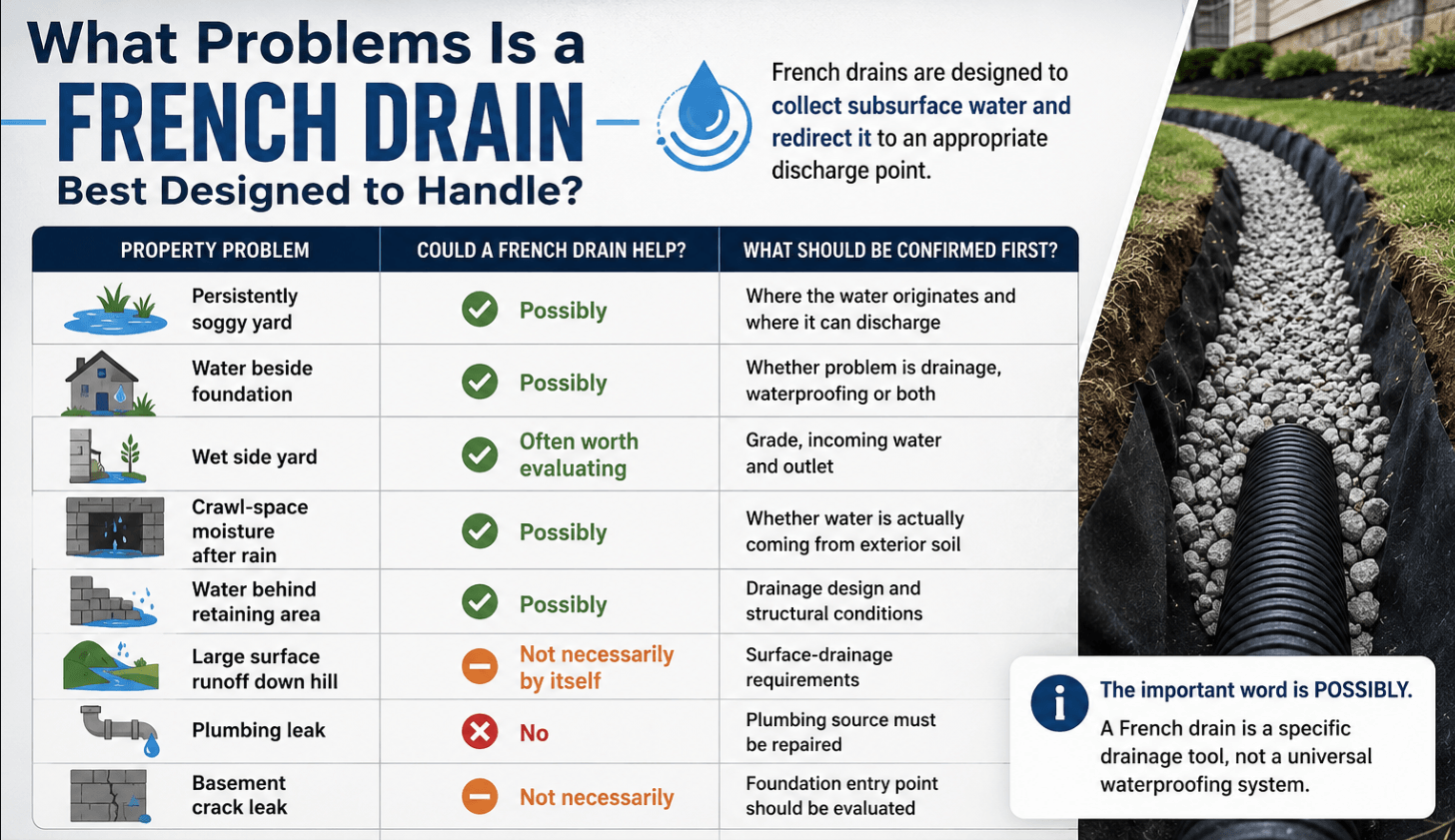
What Problems Is a French Drain Best Designed to Handle?
French drains are particularly useful when the diagnosed problem involves subsurface water that needs to be collected and redirected.
| Property Problem | Could a French Drain Help? | What Should Be Confirmed First? |
|---|---|---|
| Persistently soggy yard | Possibly | Where the water originates and where it can discharge |
| Water beside foundation | Possibly | Whether problem is drainage, waterproofing or both |
| Wet side yard | Often worth evaluating | Grade, incoming water and outlet |
| Crawl-space moisture after rain | Possibly | Whether water is actually coming from exterior soil |
| Water behind retaining area | Possibly | Drainage design and structural conditions |
| Large surface runoff down hill | Not necessarily by itself | Surface-drainage requirements |
| Plumbing leak | No | Plumbing source must be repaired |
| Basement crack leak | Not necessarily | Foundation entry point should be evaluated |
The important word is possibly.
A French drain is a specific drainage tool, not a universal waterproofing system.
When Is a French Drain NOT the Right Solution?
This is just as important as knowing when one may help.
A Plumbing Leak
A drainage contractor cannot correct a leaking supply or waste line.
Gutter Failure
If water is pouring over a clogged or damaged gutter directly beside the house, the gutter problem needs attention.
Large Volumes of Surface Runoff
Fast-moving surface water may require a surface collection system rather than relying only on a subsurface French drain.
A Localized Foundation Crack
If the main problem is water entering through one confirmed crack, crack treatment may be more appropriate.
Failed Exterior Foundation Waterproofing
When water is penetrating a below-grade wall because the exterior waterproofing system has failed, the foundation itself may need repair.
Water That Has No Suitable Drainage Outlet
A French drain needs somewhere for collected water to go.
If gravity drainage is not practical, a sump station may need to be considered as part of the overall system.
French Drain vs. Catch Basin: What's the Difference?
Homeowners often use “French drain” to describe almost every yard drain, but different systems manage different types of water.
French Drain
A French drain typically collects water through the surrounding soil and stone into a perforated pipe.
It is useful for managing subsurface saturation over an area.
Catch Basin or Box Drain
A grated surface drain collects water that is already flowing across the ground.
It is often more appropriate for concentrated surface runoff.
Water rushing across the surface → surface drain may be more appropriate
Some properties require both.
That is why identifying the type of water movement matters before installation begins.
French Drain vs. Sump Pump: Do You Need One or Both?
A French drain and sump pump perform different jobs.
French Drain
Collects and directs water.
Sump Pump
Pumps collected water to another location.
A sump pump cannot pull water across the yard or crawl space.
Water must reach the sump basin first.
For some properties, the drainage system may carry water to a sump station when there is no practical gravity outlet.
For others, the French drain may discharge by gravity.
The correct design depends on:
- Elevation
- Drain location
- Water volume
- Available outlet
- Property slope
- Foundation layout
How Does Professional French Drain Installation Work?
The exact design should be based on the property, but professional installation generally begins with understanding the water.
1. Identify the Problem Area
Where does water collect?
2. Determine Where the Water Is Coming From
The wettest area may not be the origin.
3. Determine Where the Water Can Go
A drain is only useful if there is an appropriate outlet.
4. Establish the Drain Route and Slope
Water must be able to move through the system.
5. Excavate the Drainage Trench
The trench location and depth depend on the intended application.
6. Install Drainage Components
A French drain generally incorporates drainage stone, filter fabric and perforated pipe.
7. Connect the System to the Discharge
The outlet is a critical part of the system.
8. Restore the Work Area
The disturbed ground is restored based on the project scope.
A properly designed drain is much more than buried pipe.
Its performance depends on location, elevation, materials and discharge.
Why Does the Drain Outlet Matter So Much?
A French drain does not eliminate water.
It moves it.
That means the water must ultimately be discharged somewhere appropriate.
A poor discharge location can send the same water:
- Back toward the foundation
- Into another low spot
- Toward neighboring property
- Onto a driveway or walkway
- Back into the drainage system
That is a drainage system.
Simply burying perforated pipe is not.
Can a French Drain Protect My Foundation?
A French drain can be part of a foundation water-management strategy when excess groundwater or saturated soil is contributing to water accumulation near the foundation.
The goal is to reduce or redirect the water load before it creates additional problems.
However, a drainage system does not repair:
- Failed waterproofing membranes
- Foundation cracks
- Structural defects
- Plumbing leaks
- Every source of basement seepage
When foundation water intrusion already exists, Raleigh Waterproofing may need to evaluate both drainage and foundation waterproofing.
The two services can complement each other, but they solve different parts of the problem.
Can I Install a French Drain Myself?
A homeowner can physically dig a trench and install drainage pipe.
The harder part is designing the system correctly.
Common design questions include:
- Where should the drain begin?
- How deep should it be?
- What slope is required?
- Which type of pipe is appropriate?
- What stone should surround it?
- Where should filter fabric be placed?
- Where will the water discharge?
- Will the outlet remain usable during heavy rainfall?
- Will the system affect another part of the property?
A poorly placed drainage system can fail to collect the intended water or simply move the problem somewhere else.
Professional installation becomes particularly valuable when the water affects:
- A foundation
- Basement
- Crawl space
- Large yard area
- Neighboring property
- Significant landscaping
- A difficult discharge route
How Much Does French Drain Installation Cost in Raleigh?
There is no reliable universal price because drainage systems are highly property-specific.
Cost can depend on:
- Drain length
- Excavation depth
- Access
- Soil conditions
- Amount of stone
- Pipe requirements
- Discharge distance
- Whether a sump is needed
- Landscaping
- Hardscape
- Restoration
- Other drainage work
A short drainage run in an accessible yard is a very different project from a long system around a foundation with limited access.
The estimate should be based on the actual drainage design.
Will a French Drain Solve My Yard Drainage Problem Permanently?
A properly designed drainage system can provide long-term water management, but no responsible contractor should claim that one drain solves every possible future water problem.
Conditions can change because of:
- Landscaping
- New construction
- Soil movement
- Drain maintenance
- Changes on neighboring property
- Extreme rainfall
- Changes in roof drainage
The objective is to install an appropriate system for the diagnosed water problem and maintain the drainage path over time.
When Should You Call Raleigh Waterproofing About a French Drain?
Consider having your property evaluated when:
- Standing water returns after storms
- The yard remains soggy for days
- Water collects near the foundation
- A crawl space gets wet after rain
- Water moves toward the house from a slope
- Downspout corrections have not solved the problem
- Basement seepage corresponds with saturated exterior soil
- You are unsure whether you need a French drain, surface drain or another solution
You do not need to decide in advance that you need a French drain.
The more useful approach is to identify the drainage problem first.
Raleigh Waterproofing Inc. can then determine whether French drain installation, another drainage system, foundation waterproofing, a sump station or another water-management solution is appropriate.
French Drain Installation in Raleigh, NC Starts With the Water Problem
A French drain can be an excellent solution when unwanted subsurface water repeatedly collects in the yard or near a foundation.
But the value of the system depends on whether it is installed for the right water problem, in the right location, with an effective discharge path.
If your property has:
- Persistent standing water
- Soggy landscaping
- Foundation-side pooling
- Crawl-space moisture after rain
- Recurring drainage problems
- Water moving downhill toward the home
Raleigh Waterproofing Inc. provides professional French drain and drainage services for Raleigh and surrounding Triangle communities.
Call 919-877-9969 or contact Raleigh Waterproofing Inc. to have your drainage problem evaluated.
The goal is not simply to install a French drain. The goal is to determine where the water is coming from, where it needs to go, and which drainage system will manage it correctly.
Frequently Asked Questions
What are the clearest signs that I need a French drain?
Recurring standing water, persistently soggy soil, water pooling beside the foundation, wet side yards and subsurface water moving toward the house are common reasons to evaluate a French drain. The symptoms do not prove that a French drain is the correct solution, so the water source and discharge route should be identified first.
Will a French drain fix standing water in my yard?
It can when the standing water is connected to saturated soil or subsurface water that can be intercepted and redirected. Large amounts of fast-moving surface runoff may require a different drainage system or a combination of systems.
How close should a French drain be to my foundation?
There is no universal distance that is correct for every property. Placement depends on the water source, foundation, grading, elevation, drain depth and intended discharge. A drainage system should be designed around how water actually moves across and through the site.
Do I need a French drain or a sump pump?
They perform different functions. A French drain collects and redirects water, while a sump pump mechanically removes water that has reached its basin. Some properties use both when gravity drainage is not sufficient.
Can a French drain stop water from entering my basement?
A French drain may reduce water accumulating near a foundation when exterior drainage is contributing to the problem. It does not automatically repair cracks, failed exterior waterproofing or other foundation entry paths. Existing basement water intrusion should be evaluated separately.
Is a French drain good for Raleigh's heavy rain?
A French drain can help manage appropriate subsurface drainage problems that become more noticeable during heavy rain. However, large volumes of surface runoff may need catch basins, surface drainage or another approach. The system should be selected based on the type of water movement.
Where does the water from a French drain go?
The collected water travels through the drain toward an appropriate discharge location. Depending on the property, the system may use gravity or another collection and discharge method. The outlet is one of the most important parts of the design.
Who installs French drains in Raleigh, NC?
Raleigh Waterproofing Inc. provides French drain installation and other drainage and waterproofing services for Raleigh and surrounding Triangle communities. The company can evaluate whether a French drain or another drainage approach matches the property's water problem.