
Efflorescence on Basement Walls: Causes, Identification, and the Right Next Step
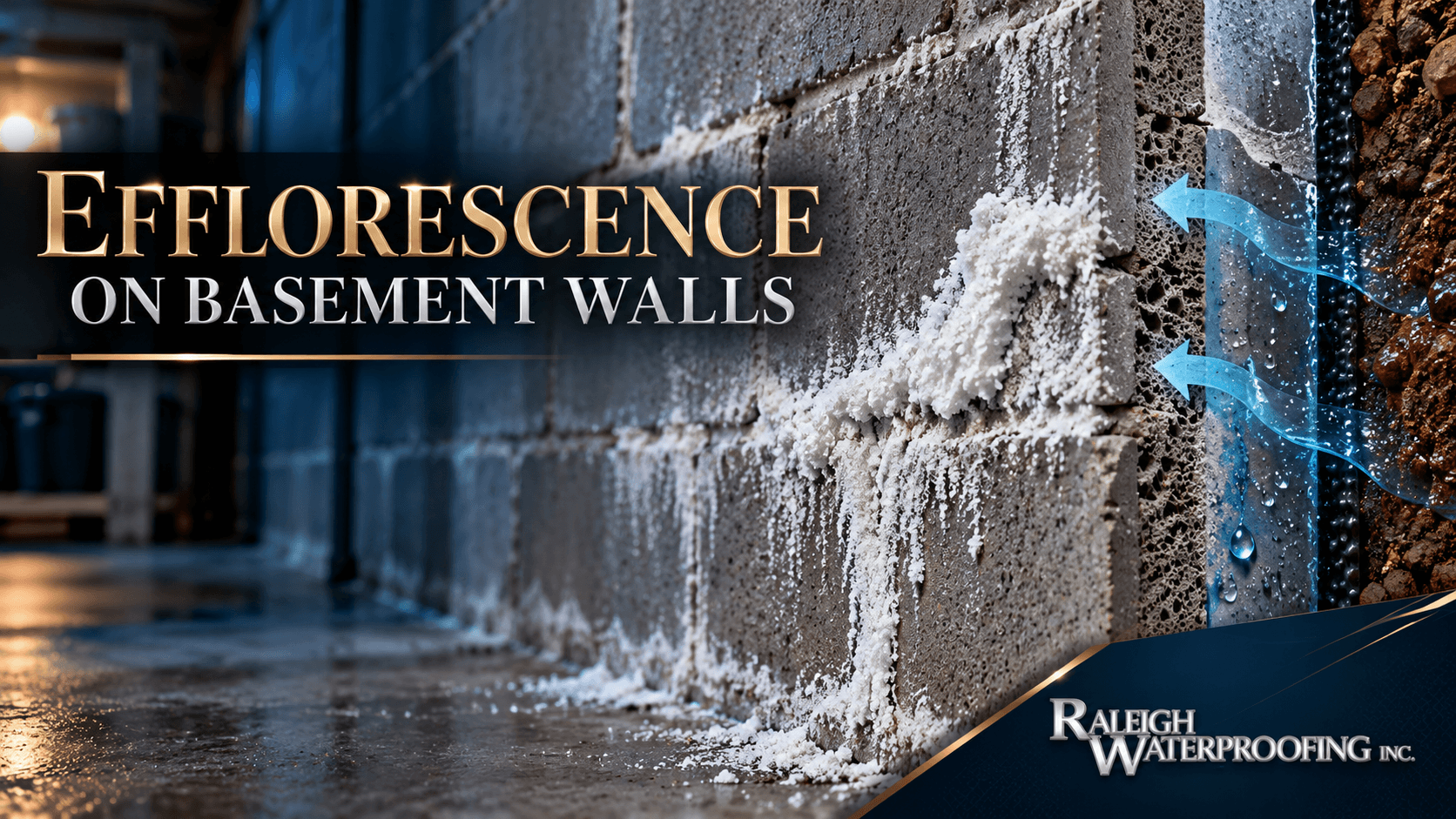
Finding a white powder on a basement wall can be alarming. Homeowners may mistake it for mold, assume the foundation is failing, or immediately cover it with waterproof paint. None of those conclusions should be made from appearance alone.
Efflorescence is evidence that moisture and soluble minerals have interacted within a masonry assembly. The deposit can remain after an old moisture event, or it can continue forming while water is still entering or passing through the wall. The correct response is to identify the material, document the pattern, and investigate the moisture source before selecting a repair.
What Is Efflorescence on Basement Walls?
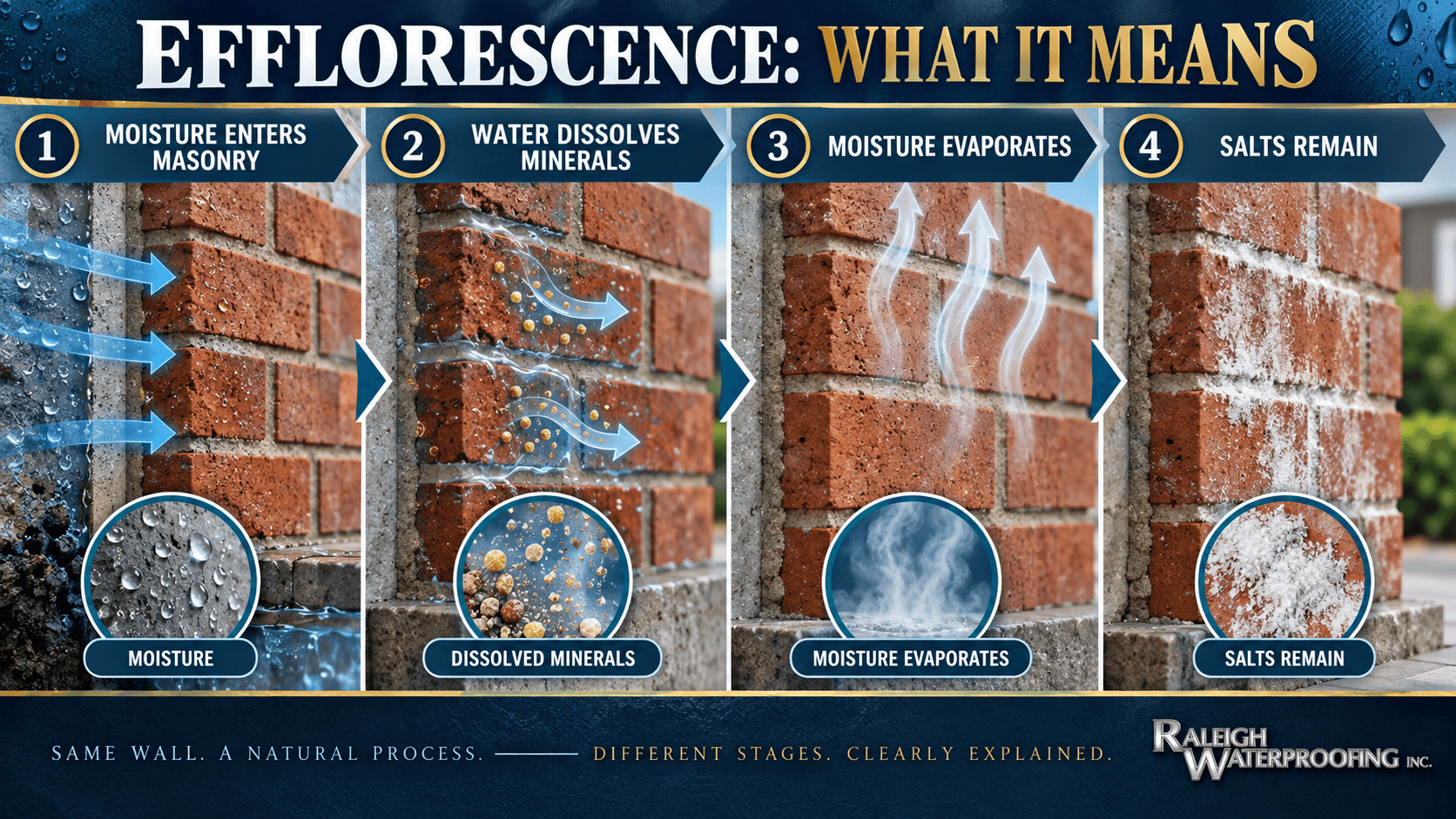
Efflorescence forms when water dissolves naturally occurring salts within masonry, mortar, concrete, soil, or adjacent construction materials. As that moisture travels toward an exposed surface and evaporates, the water disappears but the dissolved minerals remain.
The resulting deposit commonly looks powdery, chalky, crystalline, or feathery. It may appear along mortar joints, across concrete-block faces, near cracks, around penetrations, or close to the wall-floor joint.
Three conditions are generally needed for efflorescence to form:
- A source of soluble minerals
- Enough moisture to dissolve and transport those minerals
- A path that allows the moisture to reach an exposed surface and evaporate
Removing the visible deposit addresses the third condition only after evaporation has occurred. It does not automatically eliminate the water source or the route through the wall.
Does Efflorescence Mean Your Basement Is Leaking?
Efflorescence confirms that moisture moved through or across the affected material at some point. It does not, by itself, prove that water is actively leaking at the time of inspection.
An older deposit may remain long after a wall dries. On the other hand, deposits that return after cleaning, grow following rain, or appear beside damp masonry provide stronger evidence of continuing moisture movement.
Efflorescence vs. Mold: How Are They Different?
Efflorescence and mold can both appear on damp basement surfaces, but they are fundamentally different. Efflorescence is a mineral deposit. Mold is biological growth.
| Characteristic | Efflorescence | Possible Mold or Other Growth |
|---|---|---|
| Typical appearance | White or gray powder, crystals, or feathery mineral deposits | May be black, green, brown, gray, or white and can appear fuzzy, spotted, or irregular |
| Common surface | Concrete, brick, block, stone, and mortar | Often grows on organic material, dust, paint, drywall paper, wood, insulation, or stored belongings |
| What produces it | Moisture transports dissolved salts and leaves them after evaporation | Moist conditions support biological growth on a suitable food source |
| What it indicates | Past or continuing moisture movement through or across masonry | A moisture condition plus material capable of supporting growth |
| Appropriate next step | Document the pattern and investigate the moisture pathway | Avoid disturbing unidentified growth and obtain qualified guidance when necessary |
Color and texture can provide clues, but homeowners should not identify an unknown substance solely from an online photograph. Dark, fuzzy, odorous, widespread, or uncertain material should receive an appropriate professional evaluation before it is disturbed.
What Else Can Look Like Efflorescence?
Not every white substance on masonry is efflorescence. Similar-looking conditions include:
- Concrete or mortar dust: Loose surface material produced by deterioration, abrasion, cutting, or incomplete cleanup
- Lime deposits: Harder deposits associated with water carrying calcium-containing compounds
- Paint failure: Chalking, blistering, or peeling coatings that may conceal moisture movement
- Mineral scale: Deposits associated with recurring water flow or plumbing leakage
- Surface deterioration: Flaking or spalling material that represents loss of the masonry surface rather than a removable salt deposit
- Biological growth: Mold or mildew growing on dust, paint, wood, drywall, or other organic material
The distinction matters because cleaning methods and repair priorities differ. Material loss, damaged mortar, widening cracks, or wall movement requires more than routine surface cleaning.
Why Efflorescence Develops in Raleigh-Area Basements
Raleigh properties do not all have the same soil, grade, foundation, or drainage conditions. However, several regional and property-specific factors can contribute to basement-wall moisture.
Rainwater concentrated near the foundation
Roof valleys and downspouts can release substantial water near one section of a foundation. Short extensions, disconnected buried piping, overflowing gutters, or an obstructed outlet may repeatedly wet the soil beside the wall.
Ground sloping toward the house
Settled backfill, raised landscape beds, low areas, and hard surfaces can direct runoff toward the foundation. Water may collect beside the wall even when the broader yard appears to drain correctly.
Slow-draining or compacted soil
Clay-rich soil and compacted construction fill can retain moisture, but soil conditions vary by property. The relevant issue is how quickly the soil beside the particular foundation accepts, stores, and releases water.
Foundation cracks, joints, and penetrations
Water may travel through cracks, mortar joints, form-tie locations, pipe penetrations, porous masonry, or the connection between the wall and floor. Efflorescence can outline these pathways after the visible water evaporates.
Condensation or plumbing-related moisture
A cool basement wall can collect condensation during humid conditions. Plumbing supply lines, drains, HVAC condensate, and exterior faucets can also introduce moisture. These sources must be considered before assuming groundwater is responsible.
How the Location of Efflorescence Helps Identify the Source
The pattern does not prove the cause, but it can help narrow the inspection.
- Deposits near one downspout corner: Inspect gutters, roof-water discharge, grading, and buried piping in that area.
- Deposits along the wall-floor joint: Investigate water accumulating beside the footing or beneath the slab.
- Deposits around a crack: Determine whether the crack is stable, actively leaking, or showing movement.
- Deposits around a pipe penetration: Examine the seal, pipe condition, and exterior water loading.
- Widespread deposits across a block wall: Evaluate broader wall moisture, exterior drainage, coatings, and masonry condition.
- Deposits below a window or opening: Inspect flashing, wells, seals, drainage, and runoff above the affected area.
Timing is equally important. A deposit or damp area that changes quickly after a short storm may have a different source from moisture that becomes visible only after several days of rain.
Can Efflorescence Damage a Basement Wall?
A light surface deposit does not automatically mean the wall is structurally damaged. However, continuing moisture and salt movement should not be ignored.
Repeated wetting, crystallization within pores, freeze-thaw exposure in applicable locations, deteriorating mortar, and failed coatings can contribute to masonry damage over time. The concern increases when efflorescence appears with:
- Flaking or spalling concrete, brick, or block
- Soft, missing, or deteriorated mortar
- Active water seepage
- Horizontal, stair-step, widening, or displaced cracks
- Bowing or leaning foundation walls
- Rusting metal components
- Recurring damage to drywall, trim, flooring, or stored belongings
Can You Clean Efflorescence From a Basement Wall?
Loose surface deposits may often be removed after the wall is dry, but the material and masonry condition should be identified first.
- Photograph the deposits before cleaning.
- Check for active water, loose masonry, damaged mortar, and unidentified growth.
- Protect nearby belongings and avoid creating airborne dust.
- Start with the least aggressive masonry-appropriate method, such as gentle dry brushing where suitable.
- Collect the loosened residue instead of spreading it through the basement.
- Allow the wall to remain visible so you can monitor whether the deposit returns.
Avoid mixing cleaning products or applying strong acids without product-specific instructions and suitable professional guidance. Aggressive cleaning can discolor masonry, damage mortar, corrode nearby metal, or create safety hazards.
The National Park Service recommends matching masonry cleaning methods to the substrate and beginning with the gentlest effective approach. Historic, painted, deteriorated, or decorative masonry may require specialized treatment.
Why Waterproof Paint May Not Solve the Problem
Waterproof or masonry paint may improve appearance or resist limited surface moisture in an appropriate application. It does not remove water accumulating outside the wall or beneath the slab.
If moisture continues moving through the masonry, mineral deposits can form behind the coating. The coating may then blister, peel, discolor, or separate from the wall. Water may also become visible at an adjacent crack, joint, or uncoated area.
Before applying a coating, determine:
- Whether moisture is still active
- Whether efflorescence has been properly removed
- Whether the wall surface is sound
- Whether the selected coating is compatible with the masonry
- Whether exterior drainage or foundation repairs are needed first
How Professionals Diagnose Recurring Efflorescence
A useful basement-moisture assessment connects the interior deposit with conditions outside and around the foundation.
The evaluation may include:
- Mapping the location and elevation of deposits
- Reviewing photographs and rainfall timing
- Checking gutters, downspouts, grading, window wells, and hard surfaces
- Examining cracks, mortar joints, penetrations, and the wall-floor connection
- Looking for plumbing or HVAC moisture sources
- Reviewing previous coatings and repairs
- Checking existing drains, sump equipment, and discharge routes
- Evaluating whether masonry deterioration or structural movement is present
Moisture readings can support the inspection, but a single reading should not be treated as conclusive. Masonry type, salts, coatings, temperature, instrument limitations, and recent weather can affect results.
Which Repairs May Be Appropriate?
The right repair depends on the confirmed moisture pathway. Possible recommendations may include:
- Correcting gutters or downspout discharge
- Improving surface grading around the foundation
- Repairing a leaking penetration or suitable nonstructural crack
- Correcting plumbing or HVAC condensate problems
- Installing or repairing exterior drainage
- Using an exterior waterproofing system where source control and access justify excavation
- Installing an interior drainage and sump system where interior collection is the appropriate strategy
- Repairing deteriorated masonry after the moisture source is controlled
Learn more about professional water-intrusion repair in Raleigh and basement waterproofing options.
What Raleigh Homeowners Should Document
Before cleaning or covering the wall, record:
- The exact location and approximate size of the deposit
- Whether the wall feels or appears damp
- Recent rainfall and how soon the condition appeared
- Whether the deposit returns after cleaning
- Nearby cracks, joints, windows, pipes, or downspouts
- Any history of flooding, seepage, plumbing repairs, or waterproofing work
- Whether a sump pump or drainage system was operating
- Changes to landscaping, gutters, grading, or exterior construction
This record gives a waterproofing professional better evidence than a cleaned and freshly painted wall on a dry day.
Frequently Asked Questions
Is efflorescence on basement walls mold?
No. Efflorescence is a crystalline mineral deposit left when moisture travels through masonry and evaporates. Mold is biological growth. Because appearance alone is not always conclusive, avoid disturbing dark, fuzzy, odorous, widespread, or unidentified material until it has been appropriately evaluated.
Is basement efflorescence dangerous?
The mineral deposit itself is generally a building-moisture indicator rather than proof of a structural or health hazard. The underlying moisture deserves attention. Recurring deposits, active leakage, damaged masonry, peeling coatings, or foundation movement require further investigation.
Can I paint over white powder on a basement wall?
Painting over active efflorescence is unlikely to provide a durable result. Moisture and minerals can interfere with adhesion and cause blistering, peeling, or recurring deposits. Identify and correct the moisture source, clean the masonry appropriately, and verify coating compatibility first.
Why does efflorescence return after cleaning?
Cleaning removes the deposited minerals but not the water pathway. Efflorescence can return while moisture continues moving through the wall from saturated soil, surface drainage, cracks, penetrations, plumbing, or another source.
Does efflorescence always mean there is an active leak?
No. Deposits can remain after an older moisture event. Fresh growth, damp masonry, darkening after rain, repeated accumulation, or associated material damage provides stronger evidence that moisture movement is continuing.
Who should inspect recurring basement efflorescence?
A waterproofing professional can evaluate exterior drainage and foundation moisture pathways. Plumbing or HVAC sources should be examined by the appropriate trade. Significant cracking, bowing, displacement, or masonry deterioration may require an appropriately qualified structural professional.
Sources and Editorial Standards
This article provides general educational information. The cause of efflorescence and the appropriate repair must be determined from the construction, drainage, masonry condition, and moisture evidence at the individual property.
Request a Basement Moisture Assessment in Raleigh
If efflorescence keeps returning, appears after rain, or accompanies active seepage or deteriorating masonry, Raleigh Waterproofing Inc. can evaluate the surrounding drainage and foundation moisture pathways.
Call 919-877-9969 or request a waterproofing assessment online.