
Recurring water in a basement is a symptom—not a complete diagnosis. Raleigh Waterproofing Inc. identifies where the water is entering, what is driving it toward the foundation, and which repair will address the actual problem. Solutions may include interior drainage, sump stations, crack injection, exterior waterproofing, excavation, or drainage improvements around the property.
Established in May 2001 by David Hawkins II, Raleigh Waterproofing Inc. serves Raleigh and surrounding Triangle communities.
Request a Free Basement Waterproofing Estimate or call 919-877-9969.–
Effective basement waterproofing begins by finding the source and path of the water. A puddle at the edge of the floor could come from a wall-floor joint, a leaking foundation crack, saturated soil, a failed footing drain, poor exterior grading, a short downspout, a plumbing leak, or a sump system that cannot keep up. Because these conditions require different repairs, covering a damp wall or sealing the place where water becomes visible may not solve the underlying problem.
Raleigh Waterproofing Inc. provides water-intrusion diagnosis and basement waterproofing services for poured-concrete, concrete-block, finished, and unfinished basements. The goal is to understand how water moves around and through the property, then design a system appropriate for the foundation, drainage conditions, access, and intended use of the basement.
If water is entering through the foundation, collecting along the perimeter, passing through a crack, or overwhelming an existing drainage system, the repair may involve one targeted service or several coordinated components. The correct plan depends on the property—not on a one-size-fits-all product.
A basement does not have to contain standing water to have a moisture problem. Early signs often appear after rain, during prolonged wet weather, or in isolated areas near foundation joints and penetrations.
These signs help narrow the investigation, but they do not always reveal the original entry point. Water can move along a crack, behind a finished wall, through hollow block, or across the top of a footing before it appears on the floor. A professional basement-water evaluation can distinguish a localized leak from a broader drainage or groundwater problem.
Raleigh is in North Carolina’s Piedmont, where local soil and development conditions can make water management around a basement especially important. NC State Extension explains that much of the Piedmont subsoil has high clay content and that soil moved and compacted during construction can drain slowly and remain wet for extended periods. Around a basement, that can leave rainwater in the disturbed backfill beside the foundation instead of allowing it to move away quickly.
Soil is only one part of the diagnosis. The City of Raleigh separately identifies severe flooding, erosion, standing water, landscaping and grading, and roof or gutter problems as distinct drainage concerns. A basement-water evaluation therefore needs to consider the foundation, the surrounding lot, roof runoff, hard surfaces, existing drainage, and the route water takes during Raleigh’s heavier storms.
Heavy clay subsoil contains small pore spaces that can slow water movement. Construction can further compact the soil used around a foundation. When water remains in this zone after rain, pressure can build against below-grade walls and beneath the slab. The appropriate repair may require foundation waterproofing, drainage, a sump system, or a combination; adding surface soil or installing an isolated pipe does not automatically correct the complete water path.
During prolonged or intense rainfall, soil around a Raleigh home can become saturated. Water pressure increases against basement walls and beneath the slab, making cracks, joints, penetrations, porous masonry, and failed waterproofing more likely to leak. A basement that remains dry during light rain but leaks during major storms often needs an evaluation of both the foundation and the drainage system. The timing matters: water appearing immediately during a downpour may suggest a different route than seepage that develops hours after the rain ends.
Ground that slopes toward the house, low areas beside the foundation, clogged gutters, and downspouts that discharge too close to the structure can add unnecessary water beside basement walls. Patios, additions, driveways, retaining features, and landscaping changes can also alter the direction or concentration of runoff. Depending on the site, yard drainage improvements may be part of the basement solution.
Water may enter through shrinkage cracks, settlement-related openings, pipe penetrations, tie holes, mortar joints, or the joint between a wall and floor. Some isolated leaks are candidates for professional crack injection. Cracks associated with movement, bowing, displacement, or other structural warning signs may require evaluation beyond waterproofing alone.
Exterior coatings, membranes, drains, and sealants can be damaged, omitted, clogged, or no longer suited to current site conditions. Landscaping changes, additions, patios, driveways, and altered drainage patterns can also change where water travels years after a home was built.
In Raleigh-area basement evaluations, the wettest spot is not necessarily the original entry point. Water can follow a foundation joint, move through hollow concrete block, travel behind finished walls, or cross the top of a footing before reaching the floor. The inspection should connect the interior evidence with the exterior drainage pattern instead of assuming that the first visible stain identifies the entire problem.
An interior or exterior drain is only useful when water can move through it to a suitable collection and discharge point. Blocked lines, poor slope, an undersized basin, pump failure, power loss, or an unsuitable discharge location can allow water to return. Raleigh Waterproofing Inc. evaluates the drainage route as a system rather than treating the pump as an isolated component.
The best basement waterproofing method depends on where the water originates, how it enters, the type and condition of the foundation, exterior access, drainage capacity, and whether the basement is finished. Raleigh Waterproofing Inc. may recommend one of the following approaches or a combination designed to work together.
An interior drain system collects water at or below the perimeter of the basement floor and directs it toward a sump basin. This approach is often considered when water enters at the wall-floor joint, beneath the slab, through porous block, or at multiple points along the basement perimeter.
The layout must account for the entry pattern, foundation construction, drainage route, basin location, discharge path, finished surfaces, utilities, and access. An interior drain manages incoming water; it should not be represented as an exterior barrier or as a substitute for every exterior drainage problem.
A sump station receives water from an interior or exterior drainage system and pumps it to an appropriate discharge location. Pump capacity, basin size, check-valve performance, discharge routing, electrical supply, maintenance access, and backup planning all affect how reliably the system performs.
FEMA notes that sump pumps can direct rain-related groundwater away from a home. The pump is one part of the water-management system: the collection lines, basin, controls, and discharge location must also function correctly.
Injection can be appropriate for certain non-structural cracks that allow water through a poured-concrete wall. The crack must first be evaluated for location, width, movement, previous repairs, and the water conditions behind it. A localized crack repair may stop one entry point, but it will not correct widespread hydrostatic pressure, failed perimeter drainage, or water entering elsewhere. If a wall is bowing, rotating, offset, or showing significant movement, the condition may require a qualified structural professional before or alongside waterproofing work.
Exterior waterproofing addresses the outside face of the basement wall. Depending on the problem, work may involve carefully excavating beside the foundation, preparing the wall, repairing defects, applying an appropriate waterproofing system, protecting the treated surface, reviewing footing drainage, and restoring the excavated area.
Exterior work may be considered when the outside wall or existing waterproofing has failed, when water must be controlled before it passes through the wall, or when the construction and access make an exterior repair appropriate. Utilities, porches, decks, landscaping, driveways, property boundaries, soil conditions, and foundation depth can affect feasibility and cost.
When surface water or subsurface drainage contributes to basement seepage, the plan may include grading corrections, downspout extensions, catch basins, swales, surface drains, or French-drain and yard-drainage solutions. These improvements are intended to reduce the amount of water accumulating beside the structure and direct it toward a suitable outlet. Drainage work must be designed for the actual site. A trench or pipe placed without adequate slope, filter materials, capacity, or a workable discharge point can move the problem rather than solve it.
Some basements have more than one water source. A property may have a leaking crack on one wall, wall-floor seepage on another, and exterior runoff collecting near a low corner. In these cases, water-intrusion repair should address the sources as a coordinated system. This avoids paying for disconnected repairs that leave another entry path untreated.
Interior and exterior waterproofing are not interchangeable, and neither method is automatically best for every basement. Interior systems collect and manage water that reaches the foundation or slab. Exterior systems address water at the outside wall and may reduce direct exposure before water enters the structure.
| Consideration | Interior Waterproofing | Exterior Waterproofing |
|---|---|---|
| Primary function | Collects and redirects water from inside the basement perimeter | Addresses water at the exterior face of the foundation wall |
| Common components | Perimeter drain, collection channel, sump basin, pump, discharge line | Excavation, wall preparation, crack repair, membrane or coating, protection layer, drainage review |
| Often evaluated for | Wall-floor seepage, under-slab water, multiple interior entry points, block-wall drainage | Failed outside waterproofing, exterior wall leaks, accessible foundation areas, outside drainage defects |
| Access considerations | Finished walls, flooring, utilities, interior workspace, dust control | Foundation depth, utilities, landscaping, porches, decks, driveways, property lines |
| Important limitation | Does not create an exterior barrier or correct every outside drainage condition | May not address under-slab water or eliminate the need for an interior collection system |
Some properties need only a localized repair. Others benefit from interior drainage, exterior work, or a combination of water-management measures. The recommendation should follow the diagnosis, not the other way around.
Raleigh Waterproofing Inc. evaluates the basement and the conditions outside it before recommending a repair. The visible wet area is documented, but the investigation also considers how water could have reached that location.
If the source is unclear or prior repairs have failed, schedule a waterproofing problem diagnosis before investing in another surface treatment.
Expert attribution: David Hawkins II, President of Raleigh Waterproofing Inc., established the company in May 2001. He is a North Carolina-licensed general contractor and an East Carolina University graduate. Public licensing information identified Raleigh Waterproofing Inc.’s North Carolina Building license as active when verified in June 2026.
David’s published approach emphasizes professional evaluation, clear communication, and treating each property according to its individual conditions rather than forcing every basement into the same repair package.
“We treat each project as special, important and worthy of our best work.”
David Hawkins II, President, Raleigh Waterproofing Inc.
For a wet basement, that principle means following the water from the visible symptom back through the foundation, drainage, grading, runoff, and sump conditions before defining the repair scope.
Basement waterproofing cost depends on the cause of the water, the repair method, the size and configuration of the basement, and the access required to complete the work. A realistic price cannot be determined from the size of the wet spot alone.
Important cost factors include:
A smaller targeted crack repair and a full exterior excavation solve very different problems and should not be compared as if they were equivalent services. Raleigh Waterproofing Inc. provides project-specific recommendations and estimates after evaluating the basement and surrounding conditions.
Raleigh Waterproofing Inc. has served residential and commercial properties across Raleigh and the Triangle since May 2001. That history is corroborated by the company’s public profile and Better Business Bureau record, which lists the business start and incorporation date as May 3, 2001. The company provides basement waterproofing as part of a broader water-management service line, allowing the recommendation to account for the foundation, interior drainage, sump system, exterior waterproofing, and site drainage when those conditions interact.
“You haven’t seen expensive until you hire an amateur.”
Raleigh Waterproofing Inc. company motto
Established in May 2001, Raleigh Waterproofing Inc. completed 25 years of operation in May 2026.
President David Hawkins II is identified as a North Carolina-licensed general contractor, and the company’s Building license was reported active when independently checked in June 2026.
Raleigh Waterproofing Inc. has been BBB-accredited since November 7, 2003, and held an A+ BBB rating when verified in August 2026.
The company has received the Million Square Foot Award from Tremco Barrier Solutions and the Total Quality Contractor Award from John Wieland Homes.
The repair is based on how and why water is entering—not only on where the stain appears.
Services include interior drains, sump stations, crack injections, waterproofing excavations, water-intrusion repair, foundation waterproofing, and yard drainage.
Solutions are available for homes, finished and unfinished basements, multifamily properties, and commercial buildings.
The team works throughout Raleigh, Cary, Apex, Durham, Garner, Knightdale, Wake Forest, and surrounding Triangle communities.
Homeowners receive a recommendation based on the observed conditions, access, drainage needs, and repair objective.
At the August 2026 verification date, Birdeye displayed a 4.7-star rating across 38 reviews, while Porch displayed a 4.9-star rating based on 69 online reviews. Because third-party ratings can change, current totals should be checked periodically.
View examples of completed work in the Raleigh Waterproofing Inc. project gallery or learn more about David Hawkins II and the company.
A well-designed system can reduce recurring water entry and make the basement easier to maintain, but the outcome depends on correcting the relevant source and maintaining pumps, drains, gutters, and discharge areas.
Waterproofing cannot guarantee that a property will never experience water under every possible storm, plumbing failure, flood, or maintenance condition. A responsible plan defines what the installed system is designed to manage and what the property owner must maintain.
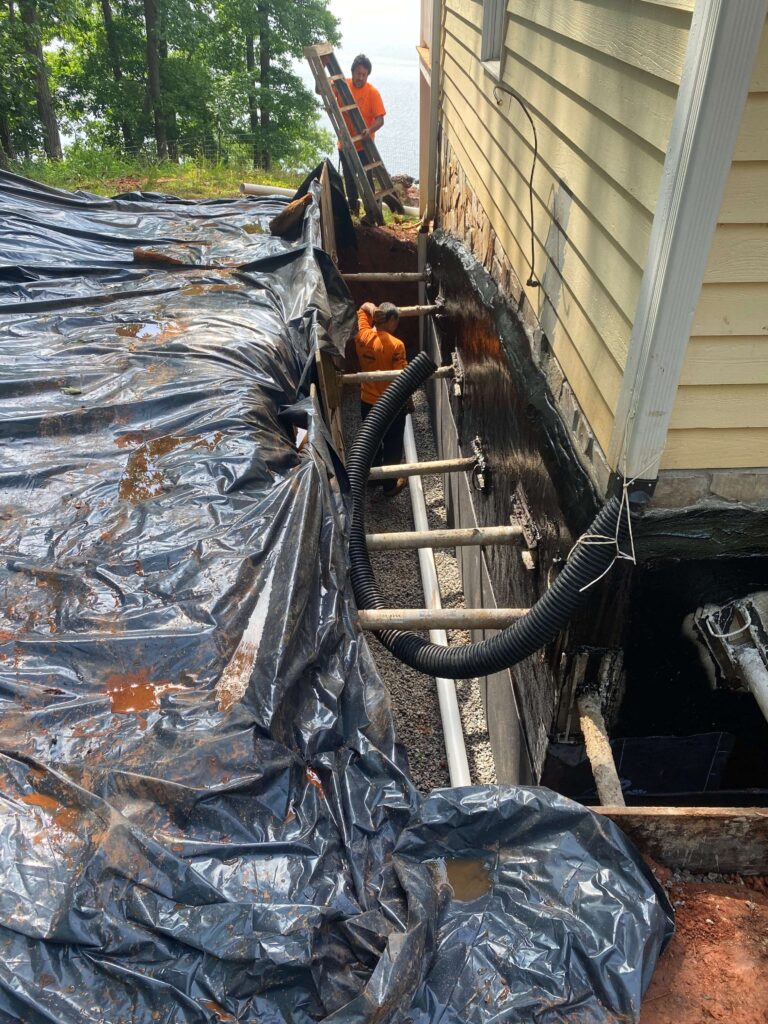
Basement waterproofing is a critical service that protects your home from the damaging effects of water infiltration. At Raleigh Waterproofing Inc., we are dedicated to providing top-notch waterproofing solutions that ensure your basement remains dry and safe. Whether you need interior waterproofing, exterior waterproofing, or crack repair, our expert team is here to help. Contact us today to schedule a consultation and take the first step towards a dry, healthy basement.