
Quick answer: Hydrostatic pressure develops when water accumulates in the soil beside or beneath a basement foundation. As saturated soil and groundwater press against the foundation, water may enter through cracks, penetrations, porous masonry, or the joint where the foundation wall meets the floor. The correct repair depends on where the water originates, how it reaches the foundation, where it enters, and whether it can drain away by gravity or must be pumped.
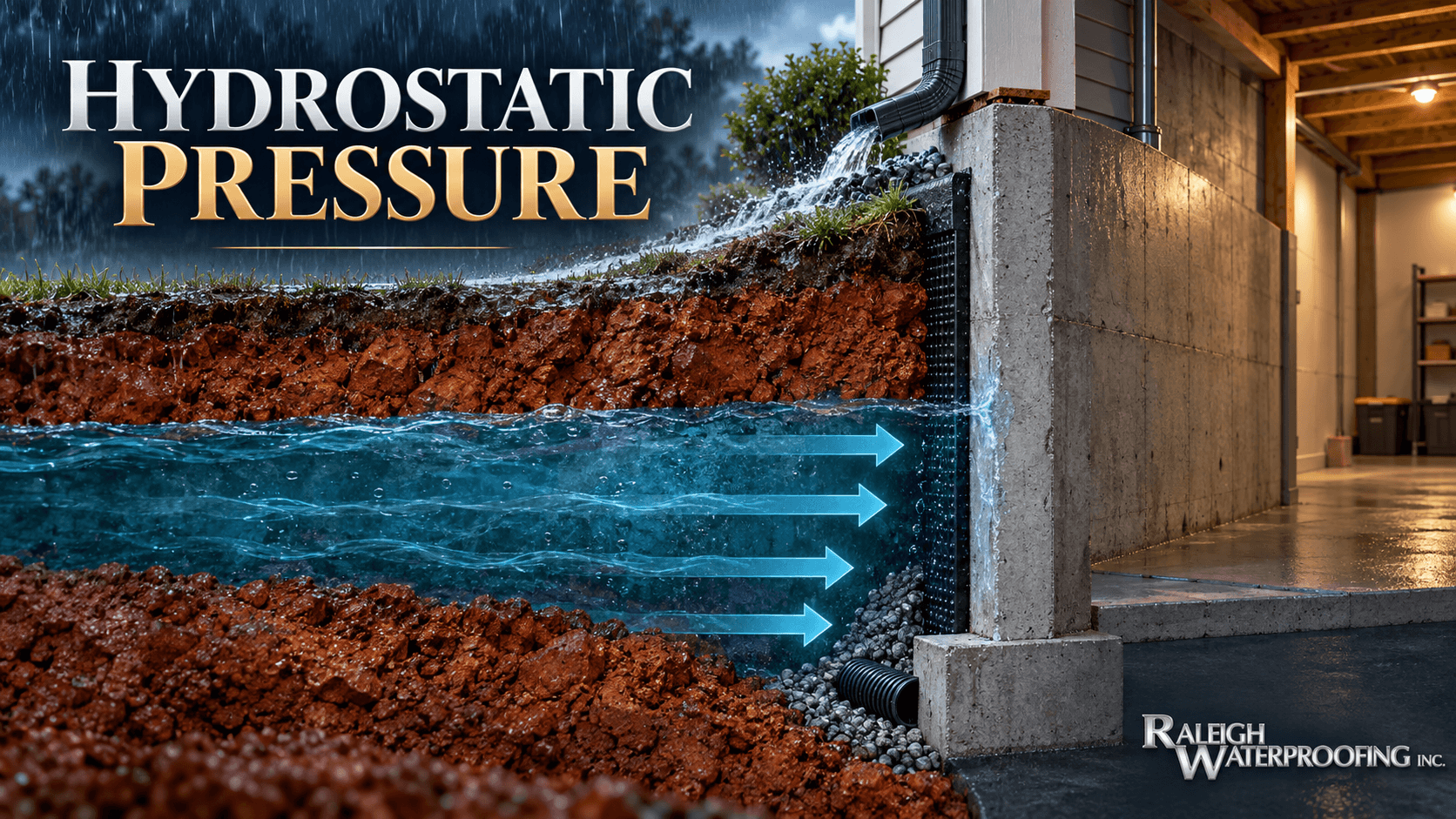
Water appearing in a Raleigh basement after heavy or prolonged rain is often blamed on a visible crack or an unfinished section of concrete. The opening may be where the water becomes visible, but it is not necessarily the underlying cause.
The larger problem may be water accumulating around the foundation faster than the surrounding soil and drainage system can carry it away. That water can increase pressure against below-grade walls and beneath the basement slab. Understanding that process is essential because waterproof paint, surface caulk, crack injection, exterior excavation, interior drains, and sump systems address different conditions.
What Is Hydrostatic Pressure?
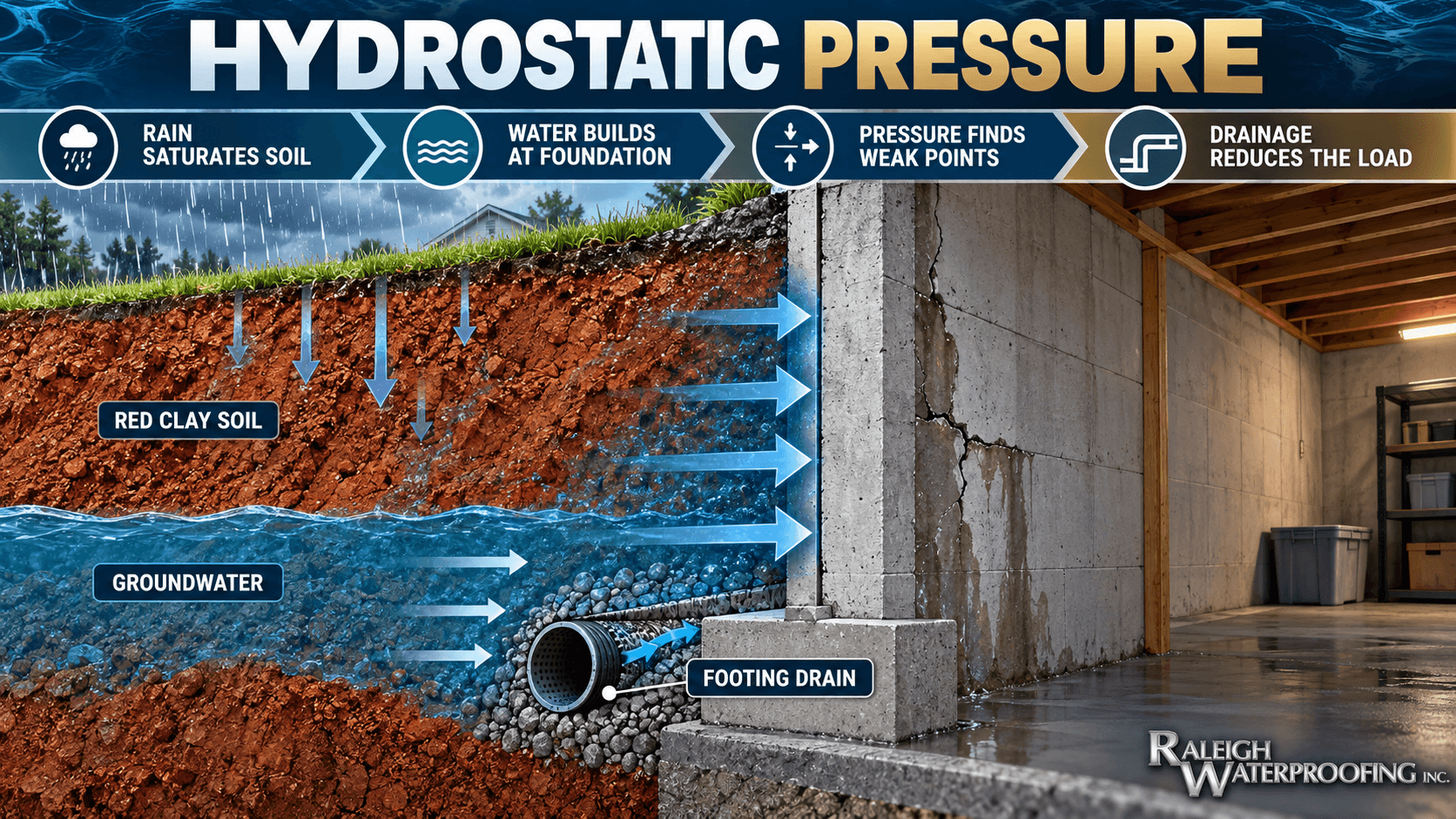
In basement waterproofing, hydrostatic pressure refers to the pressure exerted by water resting against a foundation wall or beneath a concrete floor. After the soil becomes saturated, water fills spaces within the soil and seeks a lower-pressure path.
If the foundation interrupts that path, water may press against the structure until it reaches a crack, construction joint, pipe penetration, porous section of masonry, or another opening. Water beneath a basement slab may also move upward through cracks, penetrations, or the slab perimeter.
This does not mean every basement leak is caused by hydrostatic pressure. Water can also enter because of:
- Roof runoff discharging too close to the foundation
- Soil or landscaping sloping toward the house
- Water flowing across a driveway, patio, or walkway
- A leaking plumbing line or HVAC condensate drain
- Condensation forming on cool basement surfaces
- A localized foundation crack
- Missing, damaged, or deteriorated exterior waterproofing
- A clogged or overwhelmed foundation drainage system
A professional diagnosis should separate these possibilities before a repair method is selected.
Why Raleigh-Area Soil and Rainfall Matter
Many properties across Raleigh and the North Carolina Piedmont contain soil with substantial clay content. According to NC State Extension, high-clay Piedmont subsoil can move water slowly and remain wet for extended periods. Construction activity may also compact soil around a home, further reducing water movement.
This does not mean every Raleigh property has the same soil or requires the same drainage system. Fill material, lot slope, foundation depth, additions, retaining walls, landscaping, and previous construction can substantially change drainage conditions from one property to another.
A brief thunderstorm may expose a concentrated roof-runoff problem near one corner of a home. Several days of rain may saturate a larger area and produce slower seepage along a wall or beneath the floor. Those different timelines are valuable diagnostic evidence.
Local field principle: Raleigh Waterproofing Inc. emphasizes that waterproofing performance depends on drainage. A membrane, interior drain, crack repair, or sump system must be evaluated together with the route water follows before and after it reaches the foundation.
Hydrostatic Pressure vs. Surface-Water Intrusion
Surface water and hydrostatic pressure can produce similar symptoms, but they are not identical problems.
| Condition | Common evidence | Likely timing | Diagnostic priority |
|---|---|---|---|
| Concentrated surface runoff | Water near a downspout, low grade, stairwell, window well, or one exterior corner | May appear quickly after intense rain begins | Trace gutters, downspouts, grading, drains, and paved surfaces |
| Saturated soil beside a wall | Seepage through masonry, cracks, penetrations, or several locations on one wall | May develop after continued or repeated rainfall | Evaluate exterior water loading, wall condition, membrane, and footing drainage |
| Water pressure beneath the slab | Water through floor cracks, penetrations, or the wall-floor perimeter | Often becomes evident as surrounding soil remains saturated | Determine whether sub-slab or perimeter drainage can collect and discharge the water |
| Condensation | Moisture on cool pipes, ducts, walls, or other surfaces without a defined entry path | Often follows warm, humid weather rather than rainfall alone | Measure humidity and surface conditions while ruling out liquid-water entry |
| Plumbing or mechanical leak | Moisture near supply lines, drains, appliances, or HVAC equipment | May occur without rain | Inspect plumbing and mechanical systems before waterproofing work |
Common Signs of Water Pressure Around a Basement
No single symptom proves that hydrostatic pressure is the cause. The following conditions, especially when they recur after prolonged rain, justify further investigation:
- Water appearing where the foundation wall meets the basement floor
- Seepage through floor cracks or utility penetrations
- Damp concrete block, poured concrete, brick, or mortar joints
- Recurring white mineral deposits known as efflorescence
- Water entering through an existing foundation crack
- Peeling coatings or blistered paint on below-grade walls
- A sump pump cycling frequently during or after rainfall
- Standing water or sediment near the basement perimeter
- Recurring dampness despite recent surface sealing
If the principal symptom is water at the basement perimeter, see the related guide explaining why water can appear where a basement wall meets the floor. That article retains the wall-floor-joint search intent, while this page focuses on the broader mechanics and diagnosis of hydrostatic pressure.
Where Water Commonly Enters a Basement
The Wall-Floor Joint
The junction between the foundation wall, footing, and basement slab is a common location for water to become visible. The slab and wall are separate parts of the foundation assembly. When water accumulates beside the footing or beneath the slab, it may reach the interior at this perimeter joint.
Applying caulk to the visible joint does not necessarily remove the water or relieve the underlying pressure. Water may reappear nearby if the drainage condition remains unchanged.
Foundation Cracks
A crack can provide a direct path through an otherwise intact wall. Some nonstructural cracks may be suitable for professional injection repair. However, crack injection is not a universal solution for widespread water pressure, multiple entry points, moving cracks, or structural concerns.
Learn more about when foundation crack injection may be appropriate. Cracks with displacement, bowing, continuing movement, or other structural warning signs may require evaluation beyond waterproofing alone.
Porous Masonry and Mortar Joints
Concrete and masonry are not automatically waterproof. Moisture may move through porous material or deteriorated joints, particularly when water remains against the exterior for extended periods.
Pipe and Utility Penetrations
Openings created for water lines, sewer connections, electrical conduits, and other utilities can become leakage points if the surrounding seal fails or exterior water concentrates in that area.
Floor Cracks and Penetrations
Water beneath the basement floor may reach the interior through cracks, plumbing openings, sump-basin gaps, or other penetrations. This pattern requires investigation of sub-slab conditions and the property’s available drainage path.
Can Hydrostatic Pressure Cause Foundation Cracks?
Water and saturated soil can increase lateral loading against foundation walls, but a visible crack should not automatically be blamed on hydrostatic pressure. Concrete shrinkage, settlement, construction joints, soil movement, structural loading, and other conditions can also cause cracks.
In many cases, water uses a crack that already exists rather than creating the crack by itself. The direction, width, displacement, location, and history of the crack help determine whether the concern is primarily water intrusion, structural movement, or both.
Important: A waterproofing article cannot determine whether a particular crack is structurally significant. Obtain an appropriate professional evaluation when a wall is bowing, shifting, displaced, or showing progressive cracking.
How a Waterproofing Professional Diagnoses the Source
A useful basement-water assessment should examine the exterior and interior as one connected system.
Exterior Inspection
The exterior review may include:
- Roof size, gutter condition, and downspout locations
- Downspout discharge distance and direction
- Soil and landscape grade beside the foundation
- Low areas where stormwater collects
- Driveways, patios, walks, and retaining walls that redirect runoff
- Window wells, stairwells, porches, and utility penetrations
- Existing drains and their discharge locations
- Erosion, sediment, and recurring wet-soil patterns
The EPA’s homeowner moisture guidance recommends maintaining roof gutters and making sure the ground slopes away from the foundation so water does not enter or accumulate around the building. Review the EPA’s moisture-control guidance.
Interior Inspection
The interior review should map:
- The exact elevation and location of staining
- Efflorescence and other mineral deposits
- Wall, floor, and joint cracks
- Pipe and utility penetrations
- Previous coatings, patches, drains, or repairs
- Sump-basin condition and pump operation
- Evidence of condensation or plumbing leaks
- Odors and moisture-damaged materials
Rainfall and Timing
Homeowners can improve the diagnosis by documenting when the condition appears. Water that enters within minutes near one downspout suggests a different path than seepage that begins after hours or days of rain.
Record whether the condition occurs during intense rainfall, after prolonged rainfall, during snow or ice melt, when irrigation operates, or even when the weather is dry.
Not Sure Where the Basement Water Starts?
Raleigh Waterproofing Inc. can evaluate the foundation, drainage conditions, visible entry points, and available discharge options before recommending a repair.
Request an Estimate Call 919-877-9969Which Repairs Can Address Hydrostatic Pressure?
The correct approach depends on the diagnosed source, foundation construction, exterior access, severity, and available outlet. A property may need one method or a coordinated combination.
Improve Grading and Roof-Water Discharge
When surface water is being directed toward the house, correcting gutters, downspouts, and grading can reduce the volume of water reaching the foundation. Raleigh Waterproofing’s yard-drainage services may include solutions designed around the property’s runoff pattern and outlet conditions.
Surface corrections are important, but they may not resolve established subsurface water or a failed below-grade waterproofing system.
Exterior Foundation Waterproofing
Exterior waterproofing generally involves exposing the affected foundation wall, preparing and repairing the substrate, applying the specified waterproofing system, addressing foundation drainage, and restoring the excavated area.
This approach is intended to stop or reduce water before it crosses the wall. It may be appropriate when the source is clearly associated with an accessible exterior wall. Porches, utilities, driveways, landscaping, depth, and structural conditions can affect feasibility and cost.
Learn more about foundation waterproofing and repair and basement excavation.
Interior Perimeter Drainage
An interior drainage system is designed to collect water that reaches the inside perimeter or sub-slab area and direct it to a suitable outlet or sump basin. It manages water after it reaches the foundation assembly rather than making the exterior wall itself waterproof.
Interior drainage can be effective when excavation is impractical or when water needs to be collected around multiple areas. Its performance depends on proper elevation, capacity, installation, outlet, and maintenance.
Sump Pump or Sump Station
A sump system receives collected water and pumps it to an appropriate discharge point when gravity drainage is unavailable. A sump pump does not draw water evenly from an entire basement unless an effective drainage system carries water to the basin.
The system should be evaluated for pump capacity, vertical lift, check-valve operation, discharge routing, electrical supply, alarm options, service access, and backup protection.
Crack Injection
Crack injection may seal a suitable nonstructural foundation crack that acts as a defined entry path. It does not correct widespread water accumulation, failed footing drainage, multiple leakage points, or every structural crack.
Interior vs. Exterior Waterproofing
| Consideration | Exterior approach | Interior approach |
|---|---|---|
| Primary function | Blocks and drains water before or as it reaches the exterior wall | Collects and manages water that reaches the interior perimeter or sub-slab area |
| Access | Requires practical access to the exterior wall and excavation area | Requires interior access and removal or restoration of affected finishes |
| Discharge | Typically relies on correctly designed foundation drainage and a viable outlet | Requires a gravity outlet or sump-and-discharge system |
| Best application | Depends on source, wall condition, access, and project objectives | Depends on the entry pattern, drainage path, and ability to collect water reliably |
Neither method is automatically best for every basement. The diagnosis should determine whether the priority is exterior source control, interior water management, localized repair, surface-drainage correction, or a combined plan.
Why Waterproof Paint Usually Is Not Enough
A masonry coating may improve appearance or resist limited dampness when the substrate and application conditions are appropriate. However, paint does not remove saturated soil, restore a failed footing drain, redirect a downspout, correct negative grade, or create a reliable discharge route.
If water pressure and moisture remain behind the coating, it may blister, peel, discolor, or allow water to appear at an adjacent opening. Cosmetic treatment should follow diagnosis rather than replace it.
What Homeowners Should Document
- Photograph the affected area before cleaning, painting, or covering it.
- Record the date and approximate rainfall conditions.
- Note how quickly the water appears after rain begins.
- Check whether the problem occurs in one area or around multiple walls.
- Observe where gutters and downspouts discharge.
- Look for exterior puddling, erosion, low grade, and saturated soil.
- Record whether the sump pump runs and how frequently it cycles.
- Collect invoices, warranties, and plans from previous waterproofing or drainage work.
Do not enter a flooded basement when electrical equipment or wiring may be energized. Follow current emergency guidance from Ready.gov and contact the appropriate emergency or utility professionals when electrical hazards are possible.
Questions to Ask Before Approving a Waterproofing Proposal
- What evidence identifies the primary water source?
- Is the proposal stopping water outside or managing it after entry?
- Where will collected water discharge?
- Does the outlet have adequate elevation and capacity?
- Does the system depend on electrical power?
- What maintenance and testing will the homeowner need to perform?
- How will landscaping, flooring, walls, porches, or hardscape be restored?
- What conditions are excluded from the scope and warranty?
- What happens if water appears in a different location?
Frequently Asked Questions About Hydrostatic Pressure
Can hydrostatic pressure crack a basement wall?
Water and saturated soil can increase pressure against a foundation wall, but not every crack is caused by hydrostatic pressure. Shrinkage, settlement, construction joints, soil movement, and structural loading can also produce cracks. Water frequently enters through an existing crack because it provides a lower-resistance path. Bowing, displacement, widening, or recurring movement should receive an appropriate professional evaluation.
Will waterproof paint stop hydrostatic pressure?
Waterproof paint does not remove the water accumulating outside the wall or beneath the slab. It may resist limited surface dampness when properly applied, but it cannot correct failed drainage, poor grading, concentrated runoff, or significant water pressure. If the source remains, the coating may eventually blister, peel, or redirect water to another opening.
Why does water appear where the basement wall meets the floor?
The wall, footing, and floor slab are separate components of the foundation assembly. Water accumulating beside the footing or beneath the slab may become visible at the perimeter joint between the wall and floor. The visible joint is the entry point, but the underlying cause may involve surface drainage, saturated soil, foundation drainage, or sub-slab water.
Can a sump pump solve hydrostatic-pressure problems by itself?
A sump pump only removes water that reaches its basin. If there is no properly designed drainage path carrying water to the sump, water may remain beneath the slab or enter elsewhere. An effective system must consider collection, pump capacity, lift, check-valve operation, power, backup protection, maintenance, and final discharge.
Does Raleigh’s clay soil make basement water problems worse?
Many Piedmont soils contain substantial clay and may move water slowly, especially when construction has compacted the soil. This can allow wet conditions to persist around some foundations. However, soil varies by property. A site-specific assessment should consider soil, fill, grading, roof runoff, foundation type, drainage components, and outlet conditions.
Is hydrostatic pressure the same as a basement flood?
No. Hydrostatic pressure is one mechanism that can contribute to basement seepage or flooding. A flooded basement may also result from surface runoff, sewer backup, plumbing failure, failed sump equipment, overflowing window wells, or water entering through an exterior opening. The source must be identified before a repair is selected.
Should I seal a leaking foundation crack myself?
A surface patch may conceal the opening without addressing crack depth, movement, exterior water loading, or structural conditions. A suitable nonstructural crack may be repairable with professional injection, but widespread seepage or active movement requires broader evaluation. Document the crack and surrounding water pattern before covering it.
When should I request a professional basement inspection?
Request an inspection when water recurs after rain, staining or efflorescence returns, a sump system cannot keep up, a crack is actively leaking, or the water source remains uncertain. Seek more urgent assistance for electrical hazards, contaminated water, significant flooding, wall movement, bowing, or rapidly changing cracks.
Request a Basement-Water Assessment in Raleigh
Raleigh Waterproofing Inc. diagnoses basement, crawl-space, foundation, and property-drainage problems throughout Raleigh and surrounding Triangle communities. The objective is to identify the water path before recommending a repair.
Request an Estimate Call 919-877-9969