
Why Is Water Coming In Where My Basement Wall Meets the Floor?
If water is appearing where your basement wall meets the floor, the visible seam may be the entry point—but it is not necessarily the underlying cause.
If you notice water along the edge of your basement floor where the concrete floor meets the foundation wall, the visible seam may be the entry point—but it is not necessarily the underlying cause.
Water at the basement wall-floor joint can be associated with saturated soil around or beneath the foundation, exterior drainage problems, foundation drainage that is not managing the water load, cracks or other entry paths, or water moving down the wall and collecting at the floor.
The important question is not simply:
“How do I seal this seam?”
It is:
“Why is enough water reaching this part of the foundation to enter the basement?”
That distinction matters because caulking or coating the visible joint may not address the actual water-management problem.
Raleigh Waterproofing Inc. provides foundation waterproofing repair and water intrusion correction for Raleigh and Triangle-area properties where water is entering through or around below-grade foundations.
If water repeatedly appears along your basement perimeter after rain, call 919-877-9969 or contact Raleigh Waterproofing Inc. to have the source evaluated before choosing a repair.
Why Does Water Leak Where the Basement Wall Meets the Floor?
The wall-floor joint is where the basement slab meets the foundation wall.
Because the floor slab and foundation wall are separate parts of the foundation assembly, the perimeter creates a natural junction where water can become visible when moisture reaches the basement from outside or below.
Water may reach that location because:
- Soil around the foundation becomes saturated
- Water accumulates beneath or beside the slab
- Exterior drainage is inadequate
- Roof or surface runoff is reaching the foundation
- Existing foundation drainage cannot handle the water
- A foundation crack or penetration is allowing water inward
- Exterior waterproofing has deteriorated or is incomplete
- Water enters higher on the wall and runs down to the floor
The visible location does not prove which cause is responsible.
A reliable waterproofing recommendation should begin by tracing the water pathway.
Does Water at the Wall-Floor Joint Mean I Have Hydrostatic Pressure?
It can, but the symptom alone does not prove it.
Hydrostatic pressure refers to pressure created by water within the soil around or beneath a structure. When the soil becomes highly saturated, water can move toward available openings and joints in a below-grade foundation.
However, homeowners should avoid treating “hydrostatic pressure” as a universal diagnosis for every basement leak.
Similar-looking water may also be connected with:
- Poor surface drainage
- Downspout discharge
- Foundation cracks
- Wall penetrations
- Failed exterior drainage
- Plumbing leaks
- Water entering farther up the wall
- Other site-specific conditions
The repair should match the confirmed source—not a label applied from a photograph.
Why Does the Problem Usually Show Up After Heavy Rain?
Heavy rainfall can place a much greater water load on the property than normal dry-weather conditions.
Rain falling on roofs, driveways, patios, compacted areas, and other surfaces must drain somewhere.
The City of Raleigh defines stormwater runoff as rainwater flowing off surfaces such as streets, sidewalks, and rooftops into drainage systems, creeks, and streams. The city also notes that drainage infrastructure on many private properties remains the responsibility of the property owner. Raleigh Stormwater provides additional information about private-property drainage responsibilities.
If water is directed toward the house rather than away from it, the soil around the foundation can receive a much greater water load during storms.
That can expose a drainage or waterproofing weakness that is not noticeable during lighter rainfall.
Does Raleigh Soil Make Basement Water Problems Worse?
Soil type can affect how quickly water drains.
NC State Extension explains that clayey soils have small pore spaces and generally drain more slowly than sandy soils. NC State Extension provides additional information about how soil texture influences drainage.
That does not mean every Raleigh property has the same soil conditions or that clay automatically causes a basement leak.
But on a property where water drains slowly and repeatedly accumulates around the foundation, soil conditions can be one part of the overall water-management problem.
The actual property still needs to be evaluated.
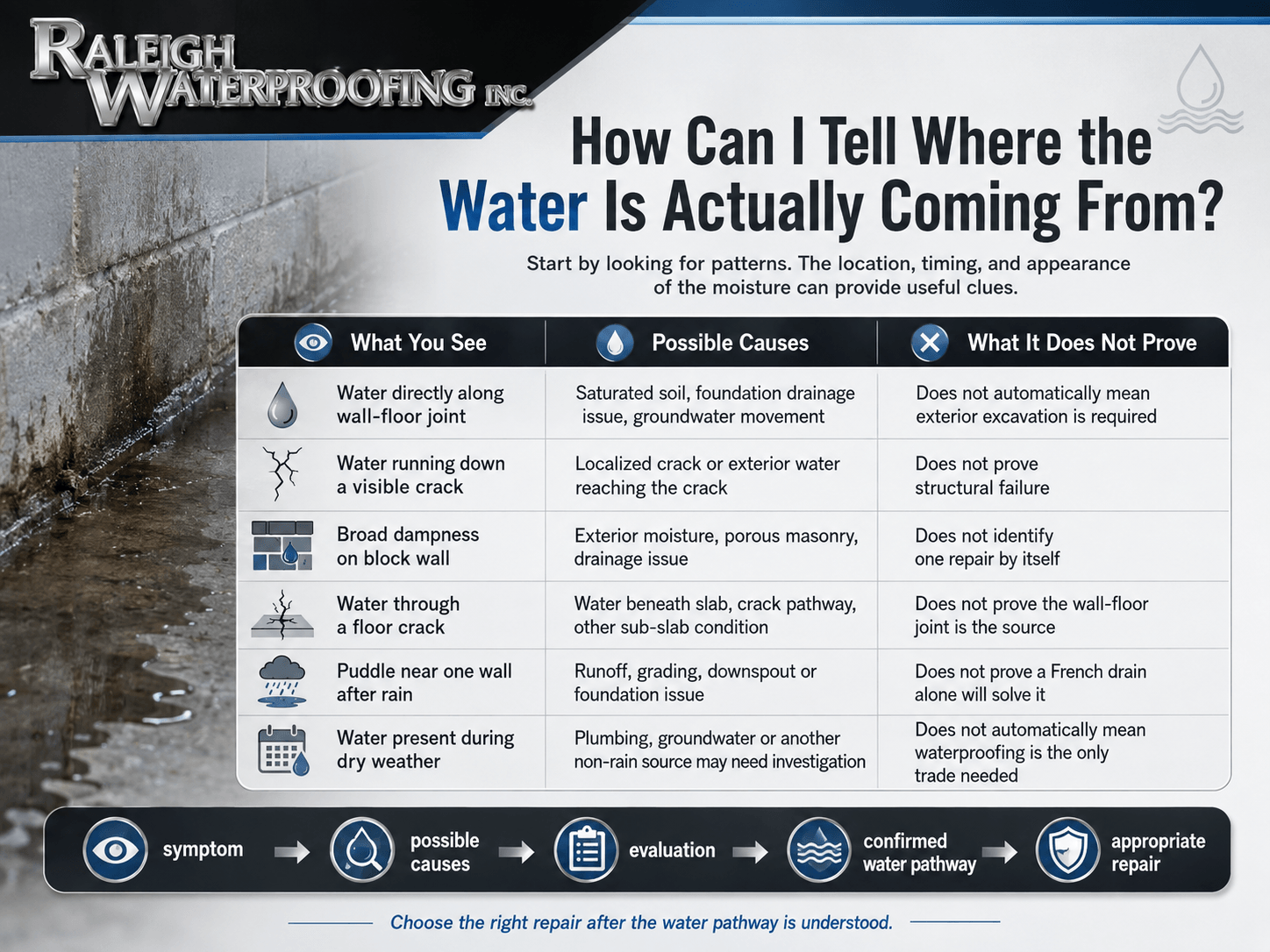
How Can I Tell Where the Water Is Actually Coming From?
Start by looking for patterns.
The location, timing, and appearance of the moisture can provide useful clues.
| What You See | Possible Causes | What It Does Not Prove |
|---|---|---|
| Water directly along wall-floor joint | Saturated soil, foundation drainage issue, groundwater movement | Does not automatically mean exterior excavation is required |
| Water running down a visible crack | Localized crack or exterior water reaching the crack | Does not prove structural failure |
| Broad dampness on block wall | Exterior moisture, porous masonry, drainage issue | Does not identify one repair by itself |
| Water through a floor crack | Water beneath slab, crack pathway, other sub-slab condition | Does not prove the wall-floor joint is the source |
| Puddle near one wall after rain | Runoff, grading, downspout or foundation issue | Does not prove a French drain alone will solve it |
| Water present during dry weather | Plumbing, groundwater or another non-rain source may need investigation | Does not automatically mean waterproofing is the only trade needed |
Should I Just Seal the Wall-Floor Joint?
Usually, sealing the visible seam without identifying the source is not a reliable diagnostic strategy.
If water is reaching the joint because the surrounding soil or sub-slab area is carrying too much water, simply covering the visible entry point may not resolve the underlying water load.
Water may:
- Reappear through another section of the joint
- Find a nearby crack
- Move through porous masonry
- Appear elsewhere along the perimeter
- Continue accumulating beneath or beside the foundation
Surface sealing can sometimes be appropriate for specific localized conditions, but it should not automatically be treated as the solution to recurring basement perimeter seepage.
Could the Water Actually Be Coming From Higher on the Wall?
Yes.
Water moves downward.
A leak around a crack, pipe penetration, window, or another opening higher on the wall can travel downward and collect at the floor.
That can make the wall-floor joint appear to be the source when it is really only where the water becomes most visible.
When the leak is active, look for the highest wet point you can safely observe.
Check for:
- Damp streaks
- Water trails
- Mineral staining
- Cracks
- Pipe penetrations
- Window areas
- Wet masonry higher on the wall
This is one reason a professional inspection should evaluate more than the puddle itself.
Could Exterior Drainage Be Causing the Basement Leak?
Yes.
Exterior water management is often part of the diagnostic picture.
Check the area outside the affected wall.
Look for:
- Ground sloping toward the foundation
- Standing water
- Low spots beside the house
- Downspouts releasing water close to the wall
- Overflowing gutters
- Driveways or patios directing water toward the structure
- Erosion patterns
- Concentrated runoff
- Drainage paths that terminate near the foundation
The City of Raleigh maintains an extensive public stormwater system, but many drainage conditions on private property remain the owner’s responsibility.
Correcting exterior drainage can sometimes reduce the amount of water reaching the foundation.
However, not every below-grade leak can be corrected through grading or downspout changes alone.
Do I Need a French Drain?
Maybe—but a wet basement perimeter does not automatically mean a French drain is the correct solution.
A French drain is designed to collect and redirect water through a gravel-filled trench and perforated drainpipe.
Raleigh Waterproofing Inc. provides French drain installation when drainage conditions make that type of system appropriate.
A French drain may be useful for certain:
- Yard drainage problems
- Concentrated groundwater
- Foundation drainage conditions
- Low areas where water repeatedly collects
- Water-management systems requiring controlled conveyance
But a French drain should not be prescribed merely because water appeared inside the basement.
The source and intended drainage path need to be understood first.
Do I Need an Interior Drainage System?
Interior drainage may be considered when water reaching the foundation perimeter needs to be collected and directed toward a controlled discharge point.
Depending on the building and water pathway, a properly designed interior drainage system may help capture water entering at or near the perimeter before it spreads across the basement floor.
A sump station may then be used as part of the system to collect and discharge that water.
Raleigh Waterproofing provides sump station installation as one component of appropriate water-management systems.
A sump pump by itself, however, only removes water that actually reaches the sump basin.
If water is entering around a different section of the basement and has no drainage pathway to the pump, installing or replacing a pump alone may not address the complete problem.
Do I Need Exterior Foundation Waterproofing?
Exterior foundation waterproofing may be appropriate when the diagnosed problem involves water reaching the outside of the foundation wall, failed or inadequate exterior waterproofing, cracks accessible from the exterior, or another condition requiring work from outside.
That can sometimes involve waterproofing excavation to expose the affected foundation.
But excavation is not the automatic answer to every wall-floor joint leak.
Before recommending exterior work, a contractor should consider:
- Where water is entering
- Exterior grading
- Existing drainage
- Foundation construction
- Accessibility
- The extent of the affected area
- Whether an interior or exterior water-management approach better matches the problem
The least invasive option is not always the correct option, and the most extensive option is not automatically the best one.
What Is the Difference Between Drainage and Waterproofing?
They work together, but they solve different parts of a water problem.
Drainage
Drainage controls where water goes.
- French drains
- Interior perimeter drainage
- Surface drainage
- Sump systems
- Proper discharge paths
Waterproofing
Waterproofing helps protect the structure from water entering through the building envelope or foundation assembly.
- Exterior membranes
- Foundation waterproofing
- Crack treatment
- Below-grade waterproofing systems
A property may need one, the other, or a combination.
The correct choice depends on the water source and pathway.
Could a Foundation Crack Be Causing the Water?
Yes.
A foundation crack can become a localized water-entry path.
But the presence of a crack does not automatically mean the foundation is structurally failing.
Cracks can develop for several reasons, and their significance depends on characteristics such as:
- Location
- Width
- Direction
- Movement
- Foundation material
- Whether water is actively passing through
- Whether other signs of movement exist
Waterproofing contractors can evaluate the moisture pathway.
If the crack or surrounding conditions suggest possible structural movement, an appropriately qualified structural professional may also be needed.
What About White Powder or Staining Near the Joint?
White mineral deposits on masonry or concrete are often described as efflorescence.
They can form when moisture moves through masonry or concrete, dissolves salts, and leaves those salts behind as the moisture evaporates.
Efflorescence can be an important clue that moisture has been moving through the material.
However, it does not tell you:
- Exactly where the water began
- How much water is present
- Whether structural damage exists
- Which waterproofing system is required
Treat it as evidence that moisture movement deserves investigation—not as a complete diagnosis.
Should I Be Concerned if It Only Happened Once?
One isolated event does not always mean a major waterproofing project is necessary.
First document what happened.
Take photographs and note:
- Date
- Approximate rainfall conditions
- Location of the water
- Whether the wall was wet
- Whether water came through a crack
- Whether gutters overflowed
- Where downspouts discharged
- Whether the yard had standing water
- How long the area remained wet
Then monitor the area during the next significant rain.
However, professional evaluation makes sense sooner when:
- Water is actively entering
- The problem repeats
- Water spreads across finished areas
- Materials remain persistently damp
- A sump system cannot keep up
- Significant cracks are involved
- The source cannot be identified
What Should I Check Outside Before Calling a Waterproofing Contractor?
You can perform a basic visual inspection without digging around the foundation.
Check the Gutters
Look for overflowing or damaged areas.
Check the Downspouts
See where roof water is being discharged.
Look at the Grade
Determine whether the ground appears to direct water toward or away from the house.
Look for Standing Water
Pay attention to puddles that remain near the affected foundation wall.
Check Hard Surfaces
Driveways, patios, sidewalks, and other surfaces can influence where rainfall flows.
Photograph the Problem During Rain
If it is safe, pictures taken while water is actively entering can provide useful diagnostic information later.
Do not excavate beside the foundation or make major changes before the water pathway is understood.
What Does a Professional Waterproofing Evaluation Look For?
A useful evaluation should focus on finding the source rather than selling a predetermined product.
Depending on the property, the contractor may evaluate:
- Where the water is visible
- Whether the wall itself is wet
- Cracks or penetrations
- The wall-floor joint
- Exterior grading and drainage
- Downspout discharge
- Standing water around the foundation
- Existing drainage systems
- Existing sump equipment
- Foundation construction
- Patterns associated with rainfall
- Whether the issue appears to involve another trade
Raleigh Waterproofing also offers professional problem diagnosis for homeowners who know they have water but are unsure what is causing it.
When Might a Plumber Be the Right Professional Instead?
Not every basement puddle originates outside the foundation.
A plumbing professional may be more appropriate when:
- Water appears regardless of weather
- A supply pipe is leaking
- A drain line appears involved
- Water is located near plumbing equipment
- A water heater is leaking
- A condensate or appliance line is involved
A waterproofing system cannot fix a plumbing leak.
This is why identifying the source should come before choosing the repair.
What If the Basement Is Finished?
A finished basement can make diagnosis more difficult because walls, insulation, trim, and flooring can hide the original entry path.
Signs may include:
- Damp carpet edges
- Swollen baseboards
- Discolored drywall
- Peeling paint
- Musty odors
- Water emerging from beneath trim
- Flooring damage near exterior walls
The visible wet spot may be several feet away from the actual entry point.
If water repeatedly appears in a finished basement, avoid repeatedly replacing cosmetic materials without determining why they are getting wet.
Will a Dehumidifier Stop Water Coming Through the Joint?
No.
A dehumidifier can help manage moisture in the air, but it does not stop liquid water from entering through a foundation joint, crack, wall, or floor.
Dehumidification can be useful as part of moisture management after the source of active water is addressed.
It should not be treated as a substitute for drainage or waterproofing when actual water intrusion is occurring.
Can Waterproof Paint Fix a Wall-Floor Joint Leak?
Waterproof coatings can have appropriate uses, but coating the interior surface does not automatically address the water source outside or beneath the foundation.
If water pressure or repeated saturation is driving the leak, simply covering the visible surface may not control the underlying water pathway.
The repair should be chosen after determining why the water is reaching the foundation.
What Repair Options Might Be Considered?
There is no single repair for every wall-floor joint leak.
Depending on the confirmed cause, possible approaches may include:
- Exterior drainage improvements
- French drains
- Interior perimeter drainage
- Sump station installation
- Foundation crack treatment
- Exterior foundation waterproofing
- Waterproofing excavation
- Surface-water corrections
- A combination of drainage and waterproofing
The appropriate solution depends on the property.
That is why diagnosis has more value than simply asking, “What product seals this joint?”
How Much Does Basement Wall-Floor Joint Repair Cost?
There is no reliable single price without knowing the source and required system.
Cost can be affected by:
- Length of the affected foundation
- Interior versus exterior access
- Excavation requirements
- Foundation depth
- Drainage-system length
- Need for a sump station
- Discharge location
- Landscaping or hardscape restoration
- Existing foundation conditions
- Repair complexity
A small localized crack repair and a full perimeter drainage or exterior waterproofing project are completely different scopes.
An accurate estimate usually requires evaluating the water source, property conditions, and proposed system design.
How Long Does the Repair Take?
The project duration depends on the selected repair.
Variables can include:
- Scope
- Excavation
- Access
- Weather
- Foundation depth
- Interior demolition
- Drain length
- Sump requirements
- Restoration work
- Unexpected site conditions
Avoid choosing a contractor based on a generic timeline before the actual scope is known.
Why Diagnosis Matters More Than the Visible Puddle
The puddle is the symptom. The water pathway is the problem.
Two Raleigh homeowners can see almost identical water along the base of a basement wall and require completely different repairs.
One may have roof runoff dumping beside the foundation.
Another may have a foundation crack.
Another may have water accumulating beneath the slab.
Another may have an exterior drainage or waterproofing failure.
A useful waterproofing plan explains why the proposed system matches the diagnosed source.
Water Coming Through the Basement Wall-Floor Joint in Raleigh?
Recurring water where the basement wall meets the floor deserves more than a tube of sealant and a guess.
The goal should be to determine:
- Where the water originates
- How it reaches the foundation
- Why it becomes visible at the wall-floor joint
- Whether the problem is primarily drainage, waterproofing, or another system
- Which repair best matches the confirmed pathway
Raleigh Waterproofing Inc. provides residential and commercial waterproofing and water-management services throughout Raleigh and surrounding Triangle communities.
If your basement leaks along the perimeter after rain, call 919-877-9969 or request an evaluation from Raleigh Waterproofing Inc..
Service information should be reviewed against the conditions at the individual property. A visible leak location alone does not establish the cause or required repair.
Frequently Asked Questions
Why does my basement leak where the wall meets the floor?
Water can become visible at the wall-floor joint when moisture reaches the basement perimeter from soil beside or beneath the foundation. Possible causes include exterior drainage problems, saturated soil, foundation drainage issues, cracks, or water traveling down the wall. The visible joint identifies where water appears, not necessarily where the problem begins.
Can I just caulk the basement wall-floor joint?
Caulking the visible seam may not solve recurring seepage if water is continuing to accumulate around or beneath the foundation. The source should be identified first. Depending on the diagnosis, drainage, waterproofing, crack repair, a sump system, or another approach may be more appropriate.
Does water at the basement floor mean my foundation is failing?
No. Water intrusion by itself does not establish structural foundation failure. Moisture can enter through joints, cracks, drainage problems, or other pathways without indicating a structural defect. If cracking or other signs suggest possible movement, an appropriately qualified structural professional may be needed.
Do I need a sump pump if water enters at the wall-floor joint?
Possibly, but a sump pump is only one part of some drainage systems. The pump removes water that reaches the sump basin. If water has no effective pathway to the basin, a pump alone may not solve perimeter seepage. The water-management system should be designed around the diagnosed source and flow path.
Will a French drain stop water coming into my basement?
A French drain can be effective when the diagnosed problem involves water that needs to be collected and redirected. It is not automatically the correct solution for every basement leak. Foundation cracks, failed exterior waterproofing, plumbing problems, or other conditions may require different repairs.
Is exterior excavation always necessary for a basement leak?
No. Exterior excavation may be appropriate for certain foundation waterproofing problems, but many factors affect the repair choice. A contractor should evaluate the entry point, water source, drainage, foundation construction, access, and extent of the problem before recommending excavation.
Why does the leak only happen during very heavy rain?
Heavy rain increases the amount of water moving across and through the property. If drainage around the foundation cannot manage that increased load, soil near the structure can become saturated and previously unnoticed water-entry paths may become active.
Who should I call if I cannot tell whether the problem is drainage or waterproofing?
A contractor experienced in both waterproofing and water management can evaluate the affected area and exterior conditions before recommending a repair. Raleigh Waterproofing Inc. provides problem-diagnosis, drainage, water-intrusion, sump, French-drain, and foundation-waterproofing services for Raleigh-area properties.