
Water Intrusion Repair Raleigh NC: Warning Signs, Causes, Costs, and When to Call a Waterproofing Expert
Water intrusion repair Raleigh NC homeowners can trust starts with one important step: finding where the water is coming from before covering it up. Water inside a basement, crawl space, foundation wall, or finished room can feel stressful. It may show up as standing water after a storm, damp block walls, a musty odor, efflorescence, wet insulation, bubbling paint, foundation cracks, or water collecting under a crawl space liner.
The mistake many homeowners make is treating the symptom instead of the source. A wet spot on the floor may be caused by poor drainage outside. A musty crawl space may come from foundation seepage, ground moisture, a failed vapor barrier, or standing water hidden below plastic. A basement leak may be caused by hydrostatic pressure, wall cracks, clogged exterior drains, poor grading, downspouts, or failed waterproofing. Until the water source is diagnosed, repairs can miss the real problem.
Raleigh Waterproofing Inc. helps homeowners, builders, and commercial property owners with water intrusion repair, problem diagnosis, basement waterproofing, foundation waterproofing repair, waterproofing excavations, interior drain systems, French drains, sump stations, vapor barriers, sealed crawl spaces, crawl space repair, yard drainage, new construction waterproofing, and commercial waterproofing. Established in 2001 by David Hawkins II, Raleigh Waterproofing Inc. is built on honest advice, quality service, expert support, customer satisfaction, and the belief that “You haven’t seen expensive until you hire an amateur.”
If your home has visible water, damp foundation walls, musty odors, mold concerns, efflorescence, or water that keeps returning after rain, call 919-877-9969 or request a free estimate from Raleigh Waterproofing Inc.
What Is Water Intrusion?
Water intrusion happens when unwanted water enters or affects a home through the foundation, basement, crawl space, walls, floor, drainage system, exterior grading, or other building components. It can be visible, like standing water, or hidden, like damp block walls, water under a vapor barrier, or moisture behind finished materials.
Water intrusion may appear as:
- Standing water in a crawl space
- Water on a basement floor
- Damp foundation walls
- Musty odors
- Efflorescence on block or concrete
- Wet insulation
- Mold-like growth
- Water stains
- Bubbling paint
- Soft or damaged wood
- Rusted metal components
- Water under a crawl space liner
- Damp carpet or flooring
- Cracks that leak during rain
- Recurring humidity problems
- Soggy soil near the foundation
Water intrusion repair is not one single service. It is a diagnosis-driven process that may involve drainage correction, foundation waterproofing, sump stations, interior drains, French drains, vapor barrier correction, exterior waterproofing, crack repair, or crawl space repair.
Water Intrusion Repair Raleigh NC: Why Early Diagnosis Matters
Water intrusion repair Raleigh NC homeowners schedule early can help protect the structure, indoor air quality, finished spaces, crawl space framing, and long-term property value. Water problems rarely fix themselves. If the same area gets wet after each rain, the home is giving you a warning.
The Environmental Protection Agency explains that moisture control is the key to mold control and recommends fixing water problems promptly. That matters because water intrusion can create damp conditions that support mold growth, damage porous materials, and create repeated cleanup costs.
Early diagnosis can help prevent:
- Mold-supporting moisture
- Wood rot
- Wet insulation
- Foundation staining
- Damage to finished basement materials
- Musty odors
- Pest-friendly conditions
- Rust on metal components
- Repeated water cleanup
- Hidden water below vapor barriers
- Soil erosion near the foundation
- More expensive repairs later
A professional waterproofing inspection helps identify whether the issue is water vapor, active water intrusion, poor drainage, foundation cracks, hydrostatic pressure, or a combination of problems.
Common Signs You Need Water Intrusion Repair
Water intrusion signs can be obvious or subtle. Many homeowners notice a smell before they see water. Others discover the issue during a home inspection, renovation, crawl space service, or after heavy storms.
Common warning signs include:
- Water on the basement floor
- Standing water in the crawl space
- Musty odors inside the home
- Damp concrete or block walls
- Efflorescence on foundation walls
- Mud or silt inside the crawl space
- Wet or sagging insulation
- Mold-like growth on framing
- Cracks that leak during rain
- Water stains near the wall-floor joint
- Peeling paint or bubbling coatings
- Rust on metal supports or fasteners
- Damp carpet or flooring
- Water trapped under a vapor barrier
- Repeated sump pump activity
- Yard water flowing toward the home
- Downspouts discharging near the foundation
- Foundation walls that look dark or damp
- Crawl space humidity that keeps returning
- Finished basement materials showing moisture damage
If water keeps returning, the solution is not to keep cleaning it up. The solution is to find the entry point, drainage failure, or moisture source.
Is Water Intrusion Serious?
Water intrusion should be taken seriously because water can affect the home’s structure, indoor environment, and resale confidence. A small leak may not look urgent at first, but repeated moisture can damage wood, insulation, drywall, flooring, and foundation materials.
Water intrusion may contribute to:
- Mold concerns
- Wood rot
- Damaged insulation
- Musty indoor air
- Floor system deterioration
- Foundation staining
- Deteriorating mortar or block
- Basement finish damage
- Crawl space decay
- Pest activity
- Higher humidity
- Lower buyer confidence
- Repeated repair costs
Not every water issue means the home has structural damage. But every recurring water issue deserves proper diagnosis. A damp spot today can become a larger repair if water pressure, poor drainage, or foundation seepage is ignored.
Water Intrusion Symptoms vs. Possible Causes
Water intrusion symptoms often overlap. A damp wall may be caused by foundation seepage, condensation, exterior drainage failure, or water pressure. Standing water may come from a crawl space low point, missing interior drain, poor grading, or a failed sump pump.
| Symptom | Possible Cause | What Homeowners Should Do |
|---|---|---|
| Standing water in crawl space | Foundation seepage, poor grading, groundwater, missing drain, sump issue | Schedule problem diagnosis before sealing |
| Damp basement wall | Hydrostatic pressure, exterior waterproofing failure, crack, condensation | Inspect foundation and drainage conditions |
| Efflorescence | Moisture moving through masonry or concrete | Treat as a strong water intrusion clue |
| Musty odor | Crawl space moisture, mold-supporting conditions, wet insulation | Inspect crawl space and humidity sources |
| Water under vapor barrier | Active water intrusion or drainage failure | Correct water source before resealing |
| Water at wall-floor joint | Hydrostatic pressure or perimeter seepage | Evaluate interior drain or exterior waterproofing options |
| Leaking crack | Foundation movement, settlement, pressure, or concrete shrinkage | Review crack injection or foundation repair needs |
| Repeated sump pump use | High water volume, drainage issue, discharge problem | Inspect sump station and drainage path |
| Yard pooling near foundation | Poor grading, downspouts, soil saturation, drainage failure | Consider yard drainage or French drain solutions |
Symptoms are clues, not final answers. A professional inspection helps determine whether the home needs waterproofing excavation, interior drains, French drains, sump stations, vapor barrier correction, crack repair, or another solution.
What Causes Water Intrusion in Raleigh Homes?
Raleigh-area homes can experience water intrusion for several reasons. Heavy rain, clay-heavy soil, grading problems, older foundation systems, clogged drains, poor downspout discharge, hydrostatic pressure, and crawl space moisture can all create problems.
Common causes include:
- Poor exterior drainage
- Downspouts discharging too close to the house
- Yard slope directing water toward the foundation
- Clogged or failing drains
- Hydrostatic pressure around foundation walls
- Foundation cracks
- Porous concrete or masonry
- Failed exterior waterproofing
- Missing foundation drainage
- Sump pump failure
- Interior drain failure or absence
- High groundwater conditions
- Basement wall-floor joint seepage
- Crawl space soil moisture
- Damaged vapor barriers
- Water trapped under sealed crawl spaces
- Construction or grading changes
- Driveways, patios, or landscaping trapping water
- Heavy stormwater volume
Raleigh Waterproofing Inc. can inspect the property and determine whether the problem starts outside, inside, below grade, around the foundation, or in the crawl space.
Water Intrusion vs. Moisture Vapor
Water intrusion and moisture vapor are different problems. Water intrusion means liquid water is entering or collecting where it should not. Moisture vapor means water vapor is moving from soil or damp surfaces into the crawl space or basement environment.
| Issue | What It Means | Common Solution |
|---|---|---|
| Water intrusion | Liquid water enters through walls, floors, cracks, or drainage failures | Waterproofing, drains, sump stations, foundation repair |
| Moisture vapor | Ground moisture evaporates into the crawl space or basement | Vapor barrier, sealed crawl space, humidity control |
| Condensation | Moisture forms on cool surfaces | Humidity control and ventilation review |
| Drainage failure | Water collects near or under the home | French drains, yard drainage, downspout correction |
| Foundation seepage | Water moves through foundation materials or cracks | Exterior waterproofing, interior drains, crack repair |
A vapor barrier helps with moisture vapor, but it is not waterproofing. If liquid water is entering the crawl space or basement, the water problem needs to be corrected before it is covered.
Interior vs. Exterior Water Intrusion Repair
Interior and exterior solutions are different. The right approach depends on where the water is coming from and whether the goal is to manage water after it enters or stop water before it enters.
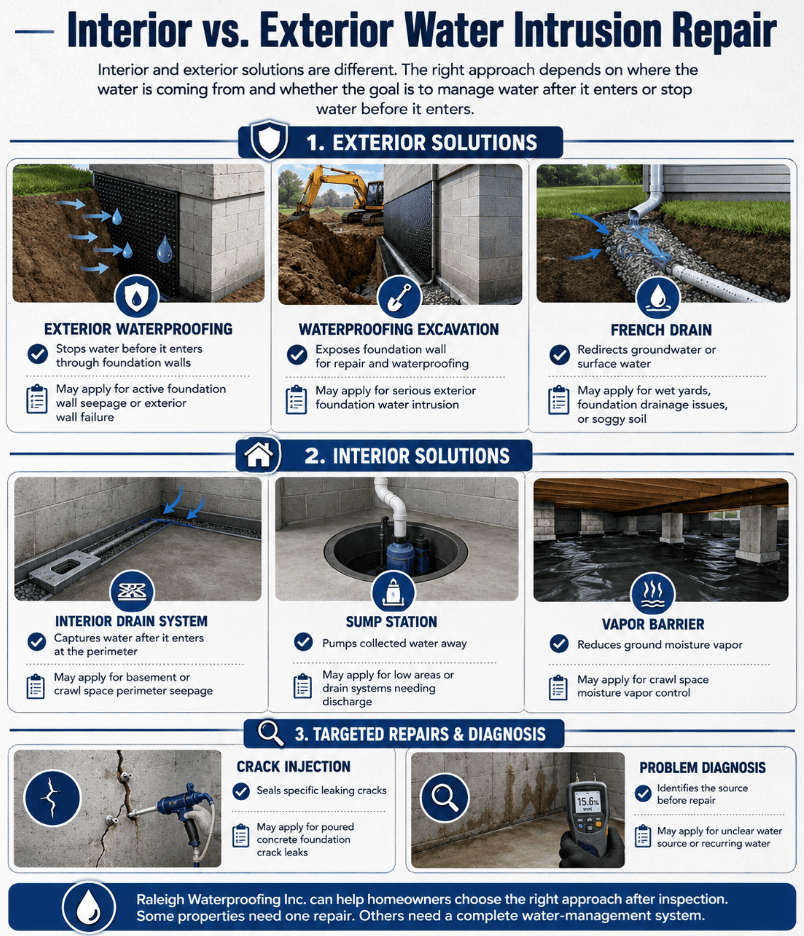
Raleigh Waterproofing Inc. can help homeowners choose the right approach after inspection. Some properties need one repair. Others need a complete water-management system.
When Interior Drain Systems Help
Interior drain systems are often used when water is entering a basement or crawl space around the perimeter. They collect water after it enters and direct it to a sump station or drainage point.
Interior drains may help when:
- Water appears along the wall-floor joint
- Foundation walls show recurring seepage
- Crawl space perimeter areas are wet
- Water needs to be collected before it spreads
- A sump station is needed for discharge
- Exterior excavation is not the immediate approach
- Water is entering at multiple perimeter points
- Basement flooding needs a controlled collection path
An interior drain is not the same as exterior waterproofing. It manages water after it has entered. For many homes, it can be an effective solution when designed and installed correctly.
When Exterior Waterproofing or Excavation Is Needed
Exterior waterproofing and waterproofing excavation may be recommended when water is entering through foundation walls and the best solution is to stop the water before it penetrates the foundation. This can be a larger project, but it may be the right option for certain foundation problems.
Exterior waterproofing may be needed when:
- Foundation walls show active seepage
- Water pressure is building outside the wall
- Exterior waterproofing has failed
- Wall cracks or porous masonry allow water entry
- Interior management is not enough
- Excavation is needed to access the problem area
- Drainage outside the foundation must be corrected
- The home has repeated basement wall moisture
Raleigh Waterproofing Inc. provides waterproofing excavations and foundation waterproofing repair for homes where deeper exterior work is the correct path.
When a Sump Station Is Needed
A sump station may be needed when water collects in a low area and cannot drain away naturally. Sump stations often work with interior drain systems, crawl space drainage, or basement water-management systems.
A sump station may help when:
- Water collects in a basement or crawl space
- Interior drains need a discharge point
- Water cannot daylight by gravity
- A crawl space has low spots
- Heavy rain creates recurring water
- The existing pump fails or runs constantly
- The discharge line sends water back toward the home
- A sealed crawl space would trap water without drainage
A sump pump without a drain system only removes water that reaches the pump. If water collects elsewhere, the drainage design may need to be improved.
Water Intrusion in Crawl Spaces
Crawl spaces can hide water intrusion for months or years. Because homeowners rarely enter them, problems may not be discovered until odors, pests, home inspection findings, or structural concerns appear.
Crawl space water intrusion may show up as:
- Standing water
- Mud or silt
- Wet insulation
- Damp floor joists
- Musty odors
- Mold-like growth
- Efflorescence
- Water under a vapor barrier
- Water on top of a vapor barrier
- Rotten wood
- High humidity
- Pest activity
- Sealed crawl space failure
A sealed crawl space is not automatically waterproof. If water penetrates through the foundation, sealing can trap water beneath the liner and create hidden damage. A waterproofing inspection before sealing can prevent expensive mistakes.
Water Intrusion in Basements
Basements are valuable spaces. They may be used for storage, living space, mechanical systems, workshops, bedrooms, or home offices. Water intrusion can damage finishes and make the area feel unreliable.
Basement water intrusion may show up as:
- Water along the perimeter
- Damp walls
- Efflorescence
- Wall cracks
- Floor cracks
- Peeling paint
- Wet carpet
- Musty odors
- Mold concerns
- Water after heavy rain
- Standing water near drains
- Rust on mechanical equipment
- Repeated dehumidifier use
- Humidity that will not stay controlled
A basement water issue should be diagnosed before installing new flooring, drywall, paint, or storage systems. Finishing a wet basement before fixing the water problem can lead to larger repair costs.
Water Intrusion and Foundation Cracks
Foundation cracks can be cosmetic, structural, water-related, or a combination. Some cracks allow water to pass through during storms or when groundwater pressure rises. Others indicate movement, settlement, or stress that should be evaluated.
Foundation crack warning signs include:
- Water coming through a crack
- Crack widening over time
- Stair-step cracks in block walls
- Horizontal cracks
- Damp streaks around cracks
- Efflorescence near a crack
- Cracks near windows or corners
- Basement wall staining
- Repeated seepage from the same location
Crack injection may be appropriate for specific poured concrete wall cracks, but not every crack should be treated the same way. A professional diagnosis helps determine whether crack repair, exterior waterproofing, drainage correction, or structural evaluation is needed.
Water Intrusion Repair Process at Raleigh Waterproofing Inc.
Water intrusion repair Raleigh NC service should begin with inspection and diagnosis. Raleigh Waterproofing Inc. evaluates the property, identifies the likely water source, and recommends the right repair plan based on the home.
A typical process may include:
- Homeowner concern review
The team asks when water appears, where it collects, how often it happens, and whether the problem follows storms, humidity changes, or seasonal groundwater conditions.
Basement or crawl space inspection
The inspection checks for standing water, damp walls, efflorescence, mold-like growth, wet insulation, wood damage, foundation cracks, and signs of water entry.
Exterior drainage review
The team reviews grading, downspouts, yard slope, drainage lines, soggy areas, and water flow around the foundation.
Moisture source diagnosis
The goal is to determine whether the issue is liquid water, moisture vapor, condensation, drainage failure, foundation seepage, or a combination.
System recommendation
The plan may include interior drains, sump stations, French drains, vapor barrier correction, foundation waterproofing, waterproofing excavation, crack repair, or yard drainage.
Repair planning
The homeowner receives a clear explanation of the repair, timeline, project scope, and what the system is designed to accomplish.
Professional installation
Approved repairs are completed according to the water-management plan.
Final review and prevention guidance
The completed system is reviewed, and the homeowner receives practical advice on maintenance, warning signs, and follow-up needs.
The right repair is based on diagnosis, not guesswork.
How Much Does Water Intrusion Repair Cost in Raleigh NC?
Water intrusion repair cost in Raleigh NC depends on the source of the water, affected area, repair method, foundation type, drainage needs, crawl space access, basement condition, sump station needs, excavation scope, vapor barrier condition, and whether multiple systems must work together.
Common cost factors include:
| Cost Factor | Why It Matters | What Homeowners Should Know |
|---|---|---|
| Water source | Water may come from drainage, foundation cracks, groundwater, or moisture vapor | Diagnosis determines the repair |
| Location | Basement, crawl space, yard, and foundation repairs differ | Access affects project scope |
| Repair method | Interior drains, sump stations, French drains, and exterior waterproofing vary | Each system solves a different problem |
| Damage level | Wet insulation, wood rot, finished basement damage, and mold concerns can add scope | Early repair may reduce costs |
| Drainage conditions | Poor grading or downspouts may need correction | Waterproofing is only as good as drainage |
| Foundation type | Block, poured concrete, and crawl space foundations behave differently | Repair design should match the structure |
| Sump needs | Pump, basin, backup, and discharge design affect cost | Pump alone may not solve the source |
| Excavation needs | Exterior waterproofing may require digging and restoration | Larger projects require more planning |
The best way to estimate water intrusion repair cost is to request a professional evaluation. A quote should be based on where the water comes from and what must be done to stop or control it.
How Long Does Water Intrusion Repair Take?
Water intrusion repair timelines vary depending on the repair type, access, weather, soil conditions, water volume, and whether multiple systems are needed.
| Project Type | Typical Scope | Timeline Factors |
|---|---|---|
| Problem diagnosis | Inspection and water source evaluation | Depends on accessibility and complexity |
| Crack injection | Specific leaking crack repair | Crack type and wall condition matter |
| Interior drain system | Perimeter collection and drainage | Basement or crawl space size affects time |
| Sump station | Basin, pump, discharge, and testing | Electrical and discharge routing matter |
| French drain | Exterior or yard drainage path | Length, slope, soil, and outlet affect schedule |
| Vapor barrier correction | Moisture-control layer and sealing | Cleanup and water source matter |
| Waterproofing excavation | Exterior foundation access and waterproofing | Larger project with excavation and restoration |
Many projects can be completed in stages. Raleigh Waterproofing Inc. can explain what needs to happen first, what can wait, and what should not be covered up.
DIY Water Intrusion Repair Risks
DIY waterproofing can seem cheaper at first, but water often finds the weakest point. Paint, sealers, patch kits, plastic liners, store-bought pumps, and quick fixes may hide symptoms without correcting the source.
Common DIY risks include:
- Painting over damp walls
- Covering active water with a vapor barrier
- Installing a pump without a drain system
- Sending discharge water back toward the foundation
- Ignoring grading and downspouts
- Patching cracks without diagnosis
- Missing efflorescence as a water clue
- Using thin plastic that traps water below
- Assuming a sealed crawl space is waterproof
- Installing drains without proper slope
- Failing to daylight water correctly
- Delaying exterior waterproofing when needed
- Allowing mold-supporting moisture to continue
Raleigh Waterproofing Inc.’s motto applies here: “You haven’t seen expensive until you hire an amateur.” A correct diagnosis can help prevent wasted money and repeat problems.
Water Intrusion Repair for Raleigh, Cary, Apex, Durham, Garner, Knightdale, and Wake Forest
Raleigh Waterproofing Inc. serves homeowners and property owners across Raleigh and nearby communities, including Apex, Cary, Durham, Garner, Knightdale, and Wake Forest. Water intrusion conditions can vary by soil, slope, home age, foundation type, drainage, and prior repairs.
Local homes may need water intrusion repair because of:
- Clay-heavy soil
- Heavy rain events
- Poor yard drainage
- Downspouts near the foundation
- Older crawl spaces
- Basement seepage
- Foundation cracks
- Failed vapor barriers
- Clogged drains
- Low yard areas
- Soggy soil near the home
- High crawl space humidity
- Construction or grading changes
- Sealed crawl spaces with hidden water
- Finished basements at risk of damage
A local inspection matters because two homes in the same neighborhood can have different water entry points.
How Raleigh Waterproofing Inc. Helps Homeowners
Raleigh Waterproofing Inc. was established in May 2001 by David Hawkins II to provide quality service, expert support, and knowledge. The company provides residential and commercial waterproofing and repairs across Raleigh and surrounding areas. The team’s approach is built around honest advice, customer satisfaction, and doing the work correctly.
Homeowners choose Raleigh Waterproofing Inc. for:
- Water intrusion repair
- Problem diagnosis
- Basement waterproofing
- Foundation waterproofing repair
- Waterproofing excavations
- Interior drain systems
- French drains
- Sump stations
- Vapor barrier installation
- Sealed crawl spaces
- Crawl space repair
- Yard drainage
- New construction waterproofing
- Commercial waterproofing
- Residential repair
- Crack injection
The goal is not to sell a one-size-fits-all repair. The goal is to identify where the water comes from and recommend the right long-term protection plan.
Anonymized Examples of Water Intrusion Repair Situations
Every home is different, but these examples show why Raleigh-area homeowners schedule water intrusion inspections.
A Raleigh homeowner with water under a vapor barrier
A homeowner noticed a musty smell and later found water trapped beneath the crawl space liner. Installing another vapor barrier would not solve the issue. The inspection needed to determine whether the home needed interior drainage, a sump station, foundation waterproofing, or grading correction.
A Cary homeowner with basement wall seepage
A homeowner saw damp block walls and white powdery residue after heavy rain. The concern suggested moisture moving through the wall system. A waterproofing evaluation helped determine whether exterior waterproofing, interior drainage, or another repair path was appropriate.
A Wake Forest homeowner with recurring sump pump activity
A sump pump ran often after storms, but water still appeared in parts of the crawl space. The issue may have involved poor collection, missing drain lines, discharge problems, or water entering at multiple points. A full system review was needed.
A Durham property owner with poor exterior drainage
Water from the yard flowed toward the foundation and created repeated dampness near the crawl space. The solution required more than drying the area. Drainage design, discharge routing, and foundation-area water control needed to be reviewed together.
These examples are educational and not based on identifiable customers. Project cost, timeline, parts, warranty, and recommendations depend on the property, water source, drainage design, moisture level, foundation condition, and inspection results.
Schedule Water Intrusion Repair in Raleigh NC
If your basement, crawl space, foundation wall, yard, or sealed crawl space has water that keeps returning, Raleigh Waterproofing Inc. can help you understand the next step.
Call 919-877-9969 or request a free estimate from Raleigh Waterproofing Inc.
- Request a free estimate
- Contact Raleigh Waterproofing Inc.
- Explore water intrusion repair
- Review problem diagnosis
- Explore basement waterproofing
- Learn about foundation waterproofing repair
- Explore waterproofing excavations
- Review interior drain systems
- Learn about French drains
- Learn about sump stations
- Review vapor barrier service
- Learn about sealed crawl spaces
- Explore crawl space repair
- Read more waterproofing articles
This article is for general information only. It is not a substitute for a professional waterproofing inspection. Water intrusion repair recommendations depend on the home, foundation, water source, drainage conditions, soil conditions, moisture level, and inspection findings.
FAQs About Water Intrusion Repair Raleigh NC
How do I know if I need water intrusion repair in Raleigh NC?
You may need water intrusion repair if you see standing water, damp walls, efflorescence, musty odors, water stains, wet insulation, foundation cracks, mold-like growth, or water trapped under a crawl space liner. Recurring moisture after rain should be professionally diagnosed.
What causes water intrusion in basements and crawl spaces?
Common causes include poor drainage, downspouts near the foundation, hydrostatic pressure, foundation cracks, porous masonry, clogged drains, grading problems, sump pump failure, damaged vapor barriers, and water entering around the wall-floor joint.
Is water intrusion the same as moisture vapor?
No. Water intrusion involves liquid water entering or collecting in the home. Moisture vapor rises from damp soil or surfaces. A vapor barrier helps with moisture vapor, but active water intrusion usually needs drainage, waterproofing, sump stations, or foundation repair.
How much does water intrusion repair Raleigh NC cost?
Cost depends on the water source, affected area, repair method, foundation type, drainage needs, crawl space access, basement condition, sump station needs, excavation scope, and whether related repairs are needed. A professional evaluation is the best way to estimate cost.
Can I fix water intrusion with a vapor barrier?
Not if liquid water is actively entering. A vapor barrier can help reduce ground moisture vapor, but it should not cover standing water, foundation seepage, or drainage failure. Active water should be corrected before the crawl space is sealed.
Do I need an interior drain or exterior waterproofing?
It depends on the source and goal. Interior drains manage water after it enters. Exterior waterproofing helps stop water before it enters. Raleigh Waterproofing Inc. can inspect the home and explain which approach fits the water problem.
Why is there water under my sealed crawl space liner?
Water under a liner often means active water intrusion, poor drainage, or a missing collection system. A sealed crawl space is not automatically waterproof. The water source should be diagnosed before adding more plastic or sealing work.
Can water intrusion cause mold?
Water intrusion can create damp conditions that support mold growth. The EPA explains that moisture control is key to mold control and that water problems should be fixed promptly. Existing mold concerns may require appropriate cleanup in addition to waterproofing.
How long does water intrusion repair take?
Timeline depends on the repair type. Problem diagnosis, crack injection, interior drains, sump stations, French drains, vapor barrier correction, and waterproofing excavations all have different scopes. Raleigh Waterproofing Inc. can explain the expected timeline after inspection.
Who should I call for water intrusion repair Raleigh NC?
Call Raleigh Waterproofing Inc. at 919-877-9969 for water intrusion repair Raleigh NC homeowners can trust. The company helps with problem diagnosis, basement waterproofing, foundation waterproofing, interior drains, French drains, sump stations, vapor barriers, sealed crawl spaces, and crawl space repair.
Sources
- Raleigh Waterproofing Inc.
- Raleigh Waterproofing Inc. Water Intrusion
- Raleigh Waterproofing Inc. Problem Diagnosis
- Raleigh Waterproofing Inc. Contact
- Raleigh Waterproofing Inc. Free Estimates
- Raleigh Waterproofing Inc. Basement Waterproofing
- Raleigh Waterproofing Inc. Foundation Waterproofing Repair
- Raleigh Waterproofing Inc. Waterproofing Excavations
- Raleigh Waterproofing Inc. Interior Drain
- Raleigh Waterproofing Inc. French Drains
- Raleigh Waterproofing Inc. Sump Stations
- Raleigh Waterproofing Inc. Vapor Barrier
- Raleigh Waterproofing Inc. Sealed Crawl Space
- Raleigh Waterproofing Inc. Crawl Space Repair
- Raleigh Waterproofing Inc. Blog
- EPA: A Brief Guide to Mold, Moisture and Your Home
- EPA: Mold Cleanup in Your Home
- International Code Council: Residential Code Information