
Sump Pump Installation Raleigh NC: Costs, Warning Signs, Process, and When You Need a Sump Station
Sump pump installation Raleigh NC homeowners can trust starts with one important question: where is the water going after it enters or collects around your home? If water gathers in your basement, crawl space, yard, or low drainage area, a sump station may be the system that collects that water and moves it away before it creates bigger problems.
A sump pump is not a magic fix for every moisture issue. It is one part of a properly designed water-management system. When installed correctly, it can help remove collected water from a sump basin and discharge it to a safer location. When installed poorly, placed in the wrong spot, connected without the right drainage system, or used as a shortcut for a bigger foundation problem, it may leave water behind and allow damage to continue.
For Raleigh homeowners, this matters because heavy rain, clay soil, low yard areas, poor grading, clogged drains, crawl space moisture, basement seepage, and foundation water intrusion can all create conditions where water needs a controlled exit path. Standing water can lead to damp odors, wood rot, mold concerns, damaged stored items, foundation stress, and expensive repairs if the source is ignored.
Raleigh Waterproofing Inc. helps homeowners, builders, and commercial property owners with sump stations, basement waterproofing, waterproofing excavations, foundation waterproofing repair, French drains, water intrusion repair, vapor barriers, sealed crawl spaces, interior drains, yard drainage, new construction waterproofing, and professional problem diagnosis. Established in 2001 by David Hawkins II, Raleigh Waterproofing Inc. is built on honest advice, quality service, expert support, and a belief that “You haven’t seen expensive until you hire an amateur.”
If you are seeing standing water, musty crawl space odors, basement seepage, or water returning after heavy rain, call 919-877-9969 or request a free estimate from Raleigh Waterproofing Inc.
What Is a Sump Pump?
A sump pump is an electric pump installed in a basin or pit, usually at a low collection point. Water flows into the basin from drainage systems, groundwater seepage, or low areas. Once the water reaches a certain level, the pump activates and moves that water out through a discharge line.
A sump station may include:
- A sump basin or pit
- A primary sump pump
- A float switch or pump control
- Discharge piping
- Check valve
- Drainage connection
- Proper discharge location
- Electrical connection
- Lid or cover
- Battery backup on some systems
- Interior drain connection when needed
- Crawl space drainage connection when needed
- Yard drainage connection when appropriate
A sump pump is only as good as the system around it. The basin must be placed correctly. Water must be directed to the basin. The discharge line must move water away safely. The system must be sized for the property’s water volume and conditions.
Sump Pump Installation Raleigh NC: Why It Matters
Sump pump installation Raleigh NC homeowners schedule early can help reduce standing water, protect crawl spaces and basements, and support long-term moisture control. When water is allowed to sit under or inside a home, it can contribute to mold growth, musty odors, wood deterioration, insulation damage, pest attraction, and foundation concerns.
A sump station may be needed when:
- Water collects in a basement
- Water collects in a crawl space
- An interior drain needs a discharge point
- A French drain needs to move water away
- Yard drainage collects in a low area
- Rainwater repeatedly enters the same location
- Foundation water intrusion needs controlled drainage
- A sealed crawl space needs water handled first
- A property has poor natural drainage
- Water cannot daylight away by gravity alone
A sump pump should not be installed as a guess. Raleigh Waterproofing Inc. can inspect the property and determine whether a sump station, French drain, interior drain, exterior waterproofing, yard drainage, vapor barrier, or other solution is the right fit.
Common Signs You May Need a Sump Pump
Homeowners often start searching for sump pump installation after noticing water where it should not be. Some signs are obvious, like standing water. Others are subtle, like odors, staining, or recurring dampness after rain.
Common warning signs include:
- Standing water in the crawl space
- Water on a basement floor
- Damp concrete walls
- Musty odors
- Efflorescence on foundation walls
- Mud or silt inside the crawl space
- Wet insulation
- Mold-like growth
- Rotten wood or soft framing
- Water stains near the floor
- Repeated flooding after heavy rain
- Water pooling near the foundation
- Yard areas that stay soggy
- Interior drain system without proper discharge
- Old pump that runs constantly
- Pump that fails during storms
- Sump basin that fills too quickly
- No battery backup in a high-risk area
- Finished basement at risk of water damage
- Crawl space vapor barrier with water underneath
If water keeps returning, do not assume the pump alone is the answer. The real question is why the water is there and how it should be collected, redirected, and discharged.
Is Standing Water in a Crawl Space or Basement Serious?
Standing water should be taken seriously. Water in a crawl space or basement can affect more than one room. Crawl space moisture may move into the living area above. Basement moisture can damage flooring, drywall, storage, mechanical systems, and indoor air quality.
Water may create problems such as:
- Musty odors
- Mold concerns
- Wood rot
- Damaged insulation
- Pest activity
- Rusted metal components
- Foundation staining
- Efflorescence
- Deteriorating block or mortar
- Higher humidity
- Sagging floors over time
- Repeated cleanup costs
- Reduced usable space
- Damaged stored belongings
The Environmental Protection Agency explains that moisture control is the key to mold control and recommends fixing water problems promptly. A sump pump can be part of that moisture-control strategy, but only when it is connected to a properly designed drainage plan.
Sump Pump vs. Sump Station: What Is the Difference?
A sump pump is the pump itself. A sump station is the broader collection and pumping setup. Homeowners often use the terms interchangeably, but the distinction matters when planning a professional system.
| Term | What It Means | Why It Matters |
|---|---|---|
| Sump pump | The mechanical pump that moves water | It is the active component that removes water |
| Sump basin | The pit or container where water collects | It must be placed and sized correctly |
| Sump station | Basin, pump, controls, discharge, and related setup | It is the full system, not just the pump |
| Interior drain | Drainage system that collects water inside a basement or crawl space | Often directs water to the sump basin |
| Discharge line | Pipe that carries pumped water away | Poor discharge can send water back toward the foundation |
| Battery backup | Secondary power source for pump operation during outages | Helpful where storm power loss is a concern |
The best sump pump installation Raleigh NC projects are planned as complete systems, not single parts.
Sump Pump vs. French Drain vs. Interior Drain
Sump pumps, French drains, and interior drains are related, but they do different jobs. A property may need one of them, or it may need a combination.
| System | Main Purpose | Common Use |
|---|---|---|
| Sump pump | Pumps collected water out | Basements, crawl spaces, low areas |
| Sump station | Collects and pumps drainage water | Where water cannot drain by gravity |
| French drain | Collects and redirects groundwater or surface water | Yard drainage, foundation drainage, wet areas |
| Interior drain | Captures water inside a basement or crawl space perimeter | Water penetration through foundation walls or footing areas |
| Waterproofing excavation | Stops water from entering through exterior foundation walls | Larger exterior foundation waterproofing needs |
| Vapor barrier | Helps reduce ground moisture vapor in a crawl space | Moisture control, not a fix for active water intrusion |
A vapor barrier is not waterproofing. If water is actively entering the crawl space, that water should be addressed before it is covered. A sump pump without the right drainage path may only remove water that reaches the basin while leaving other wet areas untreated.
When a Sump Pump Alone Is Not Enough
A sump pump can be helpful, but it does not automatically solve every water problem. If water is entering through foundation walls, pooling in multiple crawl space areas, flowing downhill toward the home, or collecting because of poor yard drainage, the pump may need supporting drainage work.
A sump pump alone may not be enough when:
- Water enters through several foundation areas
- Crawl space water collects far from the pump
- Foundation walls show efflorescence
- Basement walls are damp or stained
- Yard water flows toward the home
- Drain lines are missing or clogged
- Downspouts discharge too close to the foundation
- A sealed crawl space traps water under the liner
- The pump runs constantly after rain
- Discharge water returns to the house
- The pump is installed at the wrong low point
- The home needs exterior waterproofing or excavation
Raleigh Waterproofing Inc. can diagnose whether the right solution is a sump station, interior drain, French drain, waterproofing excavation, foundation repair, vapor barrier correction, or a combination.
How a Professional Sump Pump System Works
A professional sump pump system starts with water collection. Water must be guided to the basin through grading, drainage, interior drains, French drains, or natural flow. Once water enters the basin, the pump activates and moves water through a discharge line away from the protected area.
A well-planned system should answer these questions:
- Where is the water coming from?
- Where does the water collect?
- How much water enters during heavy rain?
- Is the issue inside, outside, or both?
- Can water drain by gravity?
- Does the home need an interior drain system?
- Does the yard need drainage correction?
- Is the sump basin placed at the true collection point?
- Where will the discharge line send water?
- Will the discharge create erosion or return flow?
- Is a battery backup recommended?
- How will the homeowner maintain the system?
A sump pump is not just “drop a pump in a hole.” It must be designed around water behavior.
Sump Pump Installation Process at Raleigh Waterproofing Inc.
Sump pump installation Raleigh NC service should begin with diagnosis and planning. Raleigh Waterproofing Inc. evaluates the water problem, looks for signs of foundation penetration, reviews drainage conditions, and recommends a system based on the property.
A typical process may include:
- Water problem review
The team asks when water appears, where it collects, how often it happens, and whether the problem occurs after rain, storms, or seasonal groundwater changes.
Basement or crawl space inspection
The inspection looks for standing water, mud, staining, efflorescence, damp walls, wood damage, vapor barrier issues, and signs of water entry.
Drainage assessment
Exterior grading, downspouts, yard drainage, foundation drainage, and discharge options may be reviewed.
System design
The plan may include a sump basin, pump, discharge line, interior drain, French drain, vapor barrier correction, or other waterproofing work.
Basin and pump installation
The sump basin is installed in the appropriate location and the pump is fitted based on the water-management plan.
Discharge routing
Water is directed away from the protected area to reduce the chance of immediate return flow.
Testing and verification
The system is checked for operation, drainage path, discharge behavior, and visible concerns.
Homeowner guidance
The homeowner receives practical advice on maintenance, warning signs, and when to request service.
The right installation protects the home better than a quick patch that only treats visible water.
How Much Does Sump Pump Installation Cost in Raleigh NC?
Sump pump installation cost in Raleigh NC depends on the property conditions, basin location, pump type, discharge routing, electrical needs, drainage connections, crawl space access, interior drain requirements, excavation, battery backup, and whether related waterproofing work is needed.
Common cost factors include:
| Cost Factor | Why It Matters | What Homeowners Should Know |
|---|---|---|
| Water source | Water may come from groundwater, foundation walls, yard flow, or drainage failure | Diagnosis determines the correct system |
| Basement vs. crawl space | Access, soil, height, and work conditions vary | Crawl spaces can require extra planning |
| Pump type | Primary and backup pump options differ | Reliability matters during heavy rain |
| Basin location | The basin must collect water efficiently | Wrong placement leaves water behind |
| Discharge route | Water must move away from the home | Poor discharge can recycle water back |
| Drainage connection | Interior drains or French drains may be needed | Pump alone may not solve the source |
| Electrical needs | Pumps require dependable power | Backup options may be recommended |
| Related repairs | Vapor barrier, drainage, excavation, or foundation repairs may be needed | Complete solutions reduce repeat problems |
The best way to estimate sump pump installation cost is to schedule a professional evaluation. A quote should be based on the actual water problem, not a generic pump price.
How Long Does Sump Pump Installation Take?
Sump pump installation timelines vary based on the condition of the basement or crawl space, the amount of water present, the drainage design, the discharge route, and whether additional waterproofing work is needed.
| Project Type | Typical Scope | Timeline Factors |
|---|---|---|
| Simple pump replacement | Existing basin and discharge line are usable | Often shorter when no redesign is needed |
| New sump basin | Basin must be installed and connected | Soil, concrete, access, and drainage affect timing |
| Sump station with interior drain | Water must be collected around the perimeter | Larger project with more installation steps |
| Crawl space sump system | Access, standing water, vapor barrier, and drainage matter | Crawl space conditions affect labor |
| Sump with battery backup | Adds backup protection | Requires proper setup and testing |
| Sump plus waterproofing repairs | May include drains, excavation, vapor barrier, or foundation work | Timeline depends on full repair plan |
Many waterproofing projects take longer than a simple pump swap because the goal is not just to install equipment. The goal is to control water.
Battery Backup Sump Pumps: Are They Worth It?
A battery backup sump pump can be valuable when a home is at risk of water entry during storms. Heavy rain and power outages can happen together. A primary pump that depends on electricity cannot help if the power goes out and there is no backup system.
Battery backup may be worth considering if:
- Your basement has finished space
- Your crawl space has repeated water issues
- The pump runs often during storms
- Your neighborhood loses power during heavy rain
- You store valuable items in the basement
- You have had past flooding
- The discharge system is critical to keeping water out
- You travel often and cannot monitor the home
- Your home has a high water table or poor drainage
A backup pump is not a replacement for proper drainage. It is an added layer of protection when the main pump loses power or cannot keep up.
Sump Pump Maintenance Tips
Even a well-installed sump pump needs maintenance. Homeowners should check the system periodically, especially before heavy rain seasons or when the pump has not run in a while.
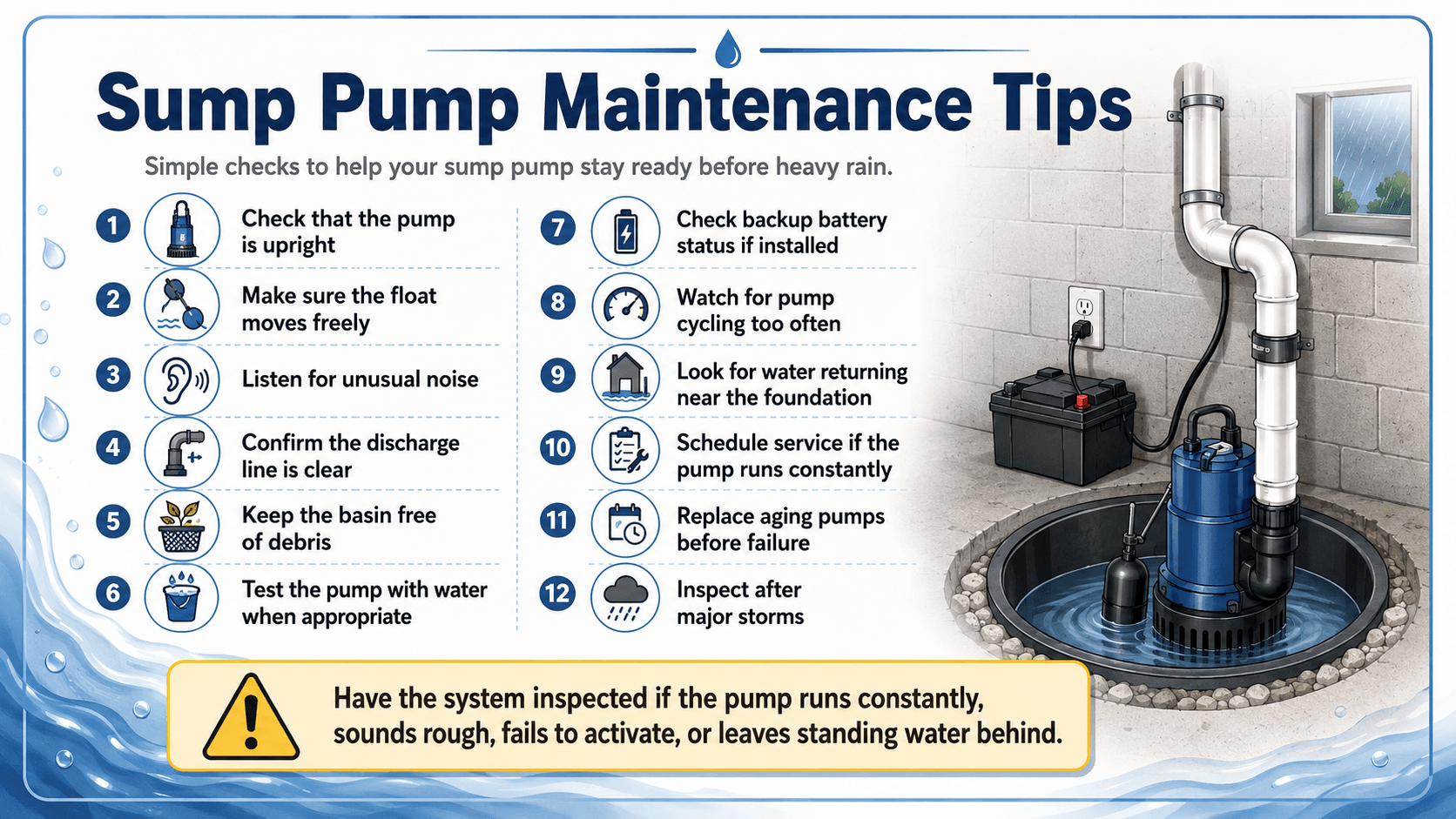
Helpful maintenance steps include:
- Check that the pump is upright
- Make sure the float moves freely
- Listen for unusual noise
- Confirm the discharge line is clear
- Keep the basin free of debris
- Test the pump with water when appropriate
- Check backup battery status if installed
- Watch for pump cycling too often
- Look for water returning near the foundation
- Schedule service if the pump runs constantly
- Replace aging pumps before failure
- Inspect after major storms
A pump that runs constantly, sounds rough, fails to activate, or leaves standing water behind should be inspected.
Sump Pump Problems Homeowners Should Not Ignore
A sump pump problem can become urgent during heavy rain. Many homeowners do not discover pump failure until water is already entering the basement or crawl space.
Warning signs of sump pump trouble include:
- Pump does not turn on
- Pump runs constantly
- Pump turns on and off rapidly
- Water remains in the basin
- Water remains in the crawl space
- Pump makes grinding noises
- Float switch sticks
- Discharge line is clogged
- Discharge line freezes or backs up
- Pump smells hot
- Backup battery alarm sounds
- Water returns near the foundation
- Pump is old and unreliable
- Basin fills faster than the pump can remove water
Do not wait for the next storm to test a questionable system. Raleigh Waterproofing Inc. can inspect the setup and explain whether repair, replacement, drainage correction, or redesign is needed.
Sump Pump Installation for Crawl Spaces
Crawl space sump pump systems require careful planning. Crawl spaces often have limited access, uneven soil, vapor barriers, foundation walls, piers, insulation, and drainage patterns that affect where water collects.
A crawl space sump system may be recommended when:
- Standing water appears after rain
- Water enters through foundation walls
- Water collects beneath a vapor barrier
- The crawl space smells musty
- Wood framing is damp
- Soil stays wet
- Interior drains are needed
- A sealed crawl space has trapped water
- Foundation vents or grading do not solve the problem
A vapor barrier can help control ground moisture vapor, but it should not be used to hide active water intrusion. If water collects under or on top of the liner, drainage and sump planning should be addressed.
Sump Pump Installation for Basements
Basement sump pumps are often part of an interior drain system. Water that enters at the wall-floor joint, through cracks, or from hydrostatic pressure may need to be collected and directed to the sump basin.
Basement sump systems may help when:
- Water appears along the basement perimeter
- Water enters after heavy rain
- There are damp block walls
- Efflorescence appears on foundation walls
- A finished basement needs protection
- Interior drains are installed
- Exterior waterproofing is not the immediate plan
- Water cannot drain by gravity
The best approach depends on whether water is being controlled after it enters or stopped before it enters. Exterior waterproofing excavations, interior drains, French drains, sump stations, and foundation repair each have a different role.
Sump Pump Installation for Yard Drainage
Some sump systems help move water from low areas where gravity drainage is difficult. Yard drainage problems may occur when water collects near the foundation, patio, driveway, retaining wall, or low lawn area.
Yard drainage concerns may include:
- Standing water after rain
- Water flowing toward the foundation
- Soggy lawn areas
- Erosion
- Downspout discharge problems
- Poor grading
- Drainage line backups
- Low spots that never dry
- Water collecting near basement walls
- Water entering a crawl space or basement
A French drain, box drain, yard drainage correction, or sump station may be part of the solution. The right design depends on water volume, slope, soil, discharge options, and property layout.
DIY Sump Pump Installation Risks
A DIY sump pump may seem simple, but mistakes can create costly problems. The pump may be undersized, the basin may be placed in the wrong location, the discharge may route water back to the home, or the system may fail during the next storm.
Common DIY risks include:
- Incorrect basin placement
- No drainage path to the basin
- Undersized pump
- Improper discharge location
- Missing check valve
- Poor electrical setup
- No backup plan
- Discharge line clogging
- Pump short-cycling
- Water returning to the foundation
- Failure to address the source of water
- Covering active water intrusion with a vapor barrier
- Damaging concrete or foundation components
- Creating a system that is hard to service
Raleigh Waterproofing Inc.’s motto is a useful reminder: “You haven’t seen expensive until you hire an amateur.” A professionally planned system can help reduce mistakes that cost more later.
Sump Pump Installation for Raleigh, Cary, Apex, Durham, Garner, Knightdale, and Wake Forest
Raleigh Waterproofing Inc. serves homeowners and property owners across Raleigh and surrounding areas, including Apex, Cary, Durham, Garner, Knightdale, and Wake Forest. Drainage needs can vary by lot, slope, soil, foundation type, and neighborhood age.
Local homes may need sump pump installation because of:
- Clay-heavy soil
- Poor yard drainage
- Low crawl spaces
- Basement water intrusion
- Older foundation systems
- New construction drainage gaps
- High water volume during storms
- Downspout discharge problems
- Retaining wall drainage issues
- Crawl space humidity
- Foundation wall seepage
A local inspection matters because two homes on the same street can have very different water problems.
How Raleigh Waterproofing Inc. Helps Homeowners
Raleigh Waterproofing Inc. was established in May 2001 by David Hawkins II to provide quality service, expert support, and knowledge. The company provides residential and commercial waterproofing and repairs across Raleigh and surrounding areas. The team’s approach is built around honest advice, customer satisfaction, and doing the work correctly.
Homeowners choose Raleigh Waterproofing Inc. for:
- Sump stations
- Sump pump installation
- Sump pump replacement
- Basement waterproofing
- Interior drain systems
- French drains
- Waterproofing excavations
- Foundation waterproofing repair
- Water intrusion diagnosis
- Crawl space repair
- Sealed crawl spaces
- Vapor barriers
- Yard drainage
- New construction waterproofing
- Commercial waterproofing
- Problem diagnosis
- Residential repair
The goal is not to sell a one-size-fits-all solution. The goal is to identify the water problem and recommend the right system for long-term protection.
Anonymized Examples of Sump Pump Installation Situations
Every home is different, but these examples show why Raleigh-area homeowners schedule sump station inspections.
A Raleigh homeowner with standing crawl space water
A homeowner noticed standing water after repeated storms. The crawl space had a vapor barrier, but water was collecting underneath it. Inspection was needed to determine whether the home needed an interior crawl space drain, sump station, discharge correction, or foundation water intrusion repair.
A Cary homeowner with a finished basement
A finished basement showed damp carpet near one wall after heavy rain. The homeowner wanted to protect the finished space before the next storm. A waterproofing evaluation helped determine whether an interior drain and sump station were needed.
A Wake Forest homeowner with a failing old pump
The existing sump pump ran loudly and did not always activate. The homeowner had no backup system and was concerned about power outages. Inspection helped determine whether pump replacement, battery backup, discharge correction, or basin updates were needed.
A Durham property owner with poor yard drainage
Water collected near the foundation after rain and slowly seeped toward the crawl space. The solution required more than a pump alone. Drainage design, discharge planning, and foundation-area water control needed to be reviewed together.
These examples are educational and not based on identifiable customers. Project cost, timeline, parts, warranty, and recommendations depend on the property, water source, drainage design, and inspection results.
Schedule Sump Pump Installation in Raleigh NC
If your basement, crawl space, yard, or foundation area has standing water, musty odors, damp walls, repeated seepage, or an unreliable pump, Raleigh Waterproofing Inc. can help you understand the next step.
Call 919-877-9969 or request a free estimate from Raleigh Waterproofing Inc.
- Request a free estimate
- Contact Raleigh Waterproofing Inc.
- Learn about sump stations
- Explore basement waterproofing
- Review interior drain systems
- Learn about French drains
- Explore water intrusion repair
- Review vapor barrier service
- Learn about sealed crawl spaces
- Explore waterproofing excavations
- Review problem diagnosis
- Read more waterproofing articles
This article is for general information only. It is not a substitute for a professional waterproofing inspection. Sump pump installation recommendations depend on the home, foundation, water source, drainage conditions, power needs, discharge options, and inspection findings.
FAQs About Sump Pump Installation Raleigh NC
How do I know if I need sump pump installation in Raleigh NC?
You may need sump pump installation if water collects in your basement, crawl space, yard, or foundation area after rain. Other warning signs include musty odors, damp walls, efflorescence, mud, standing water, a failing pump, or water trapped beneath a crawl space vapor barrier.
How much does sump pump installation Raleigh NC cost?
Sump pump installation cost depends on the basin location, pump type, drainage connections, discharge route, crawl space or basement access, electrical needs, backup options, and whether interior drains, French drains, waterproofing repairs, or vapor barrier corrections are needed. A professional evaluation is the best way to estimate cost.
Is a sump pump enough to waterproof a basement?
Not always. A sump pump removes collected water, but it does not stop water from entering through foundation walls by itself. Some homes need interior drains, exterior waterproofing excavations, French drains, crack repair, drainage correction, or foundation waterproofing repair in addition to a sump station.
Do I need a battery backup sump pump?
A battery backup may be recommended if your pump runs during storms, your basement is finished, your crawl space has repeated water issues, your neighborhood loses power, or you travel often. A backup system can add protection when the primary pump loses power.
Can a sump pump help a wet crawl space?
Yes, a sump pump can help a wet crawl space when it is part of a properly designed drainage system. If water is collecting in several areas or under a vapor barrier, the crawl space may also need interior drainage, vapor barrier correction, or water intrusion repair.
What is the difference between a sump pump and a French drain?
A French drain collects and redirects water through a gravel-filled trench and perforated pipe. A sump pump moves collected water out of a basin using electrical power. In some systems, a French drain or interior drain directs water to a sump basin for pumping.
How long does sump pump installation take?
The timeline depends on whether the project is a simple pump replacement, a new sump basin, a crawl space drainage system, an interior drain connection, or a larger waterproofing repair. Raleigh Waterproofing Inc. can explain the expected timeline after inspecting the property.
Can I install a sump pump myself?
DIY sump pump installation can lead to problems if the basin is placed incorrectly, the pump is undersized, the discharge route is wrong, or the source of water is not addressed. Professional diagnosis helps prevent amateur mistakes and repeat water problems.
Does a vapor barrier replace a sump pump?
No. A vapor barrier helps reduce ground moisture vapor in a crawl space, but it is not a solution for active water intrusion. If water collects under or on top of the liner, drainage and sump planning should be addressed before the space is sealed.
Who should I call for sump pump installation Raleigh NC?
Call Raleigh Waterproofing Inc. at 919-877-9969 for sump pump installation Raleigh NC homeowners can trust. The company helps with sump stations, basement waterproofing, interior drains, French drains, vapor barriers, sealed crawl spaces, water intrusion repair, and professional problem diagnosis.
Sources
- Raleigh Waterproofing Inc.
- Raleigh Waterproofing Inc. Sump Stations
- Raleigh Waterproofing Inc. Contact
- Raleigh Waterproofing Inc. Free Estimates
- Raleigh Waterproofing Inc. Basement Waterproofing
- Raleigh Waterproofing Inc. Interior Drain
- Raleigh Waterproofing Inc. French Drains
- Raleigh Waterproofing Inc. Water Intrusion
- Raleigh Waterproofing Inc. Vapor Barrier
- Raleigh Waterproofing Inc. Sealed Crawl Space
- Raleigh Waterproofing Inc. Waterproofing Excavations
- Raleigh Waterproofing Inc. Problem Diagnosis
- Raleigh Waterproofing Inc. Blog
- EPA: A Brief Guide to Mold, Moisture and Your Home
- EPA: Mold Cleanup in Your Home
- International Code Council: Residential Code Information